In 1976 Suzanne Ciani submitted a report to the National Endowment for the Arts documenting a "Basic Performance Patch" for the Buchla Series 200 modular synthesizer. The document, which came to be called The Buchla Cookbook, outlines four musical ideas—"Keyboard Rotations," "Melodic‑Rhythmic Reliefs," "Vertical Sequencer," and "String Patch"—centered on the Model 248 Multiple Arbitrary Function Generator (MARF), a 16‑stage memory module that can function as a sequencer, envelope generator, or oscillator. Ciani, a classically trained pianist who studied with Don Buchla at UC Berkeley in the late 1960s, wrote the report to satisfy the grant; she did not expect it to become a widely referenced text. The original typewritten pages included hand‑drawn patch diagrams and musical illustrations that have now been digitally republished by ECHO (the Orpheus Institute’s research platform) as part of a three‑layer enhancements set.
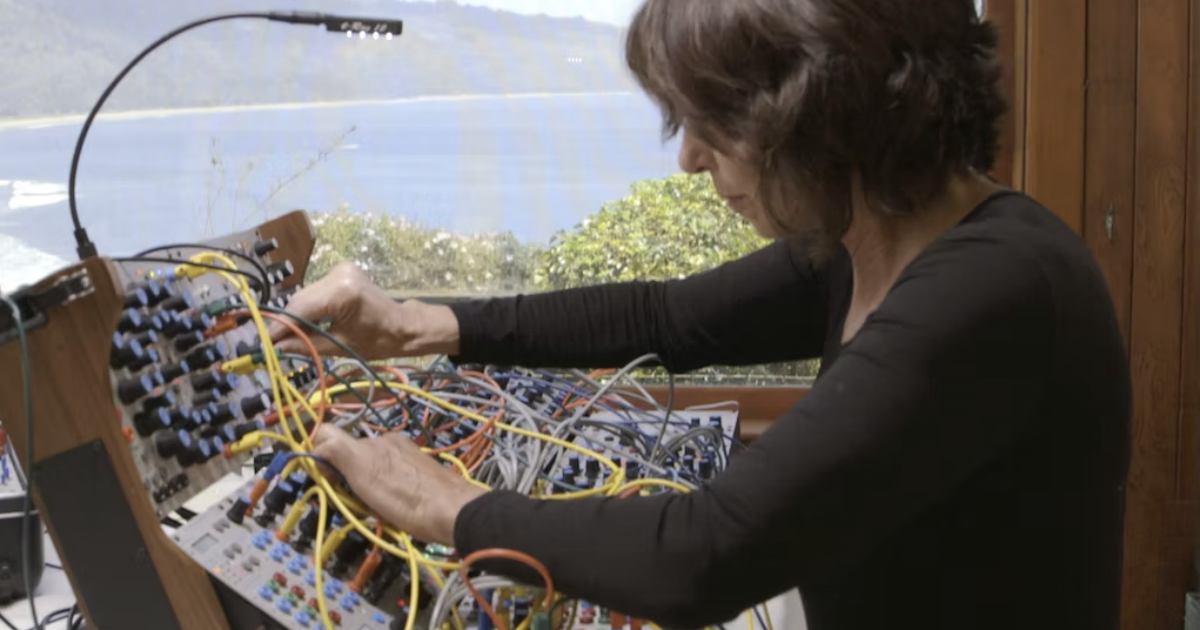
The article profiles Suzanne Ciani's 1976 NEA Composer Grant report, The Buchla Cookbook, which documented her modular synthesizer techniques. This photograph of Ciani, credited to Sean Hellfritsch, introduces the composer whose work is the subject of the digital reissue.
The digital edition presents Ciani’s original 1976 tape examples alongside vector adaptations of her diagrams that users can zoom and browse, and interactive musical illustrations built in VCV Rack that playback each patch’s core logic independent of the hardware. A color‑coded cable convention (yellow for audio signals, green for pitch CV, blue for modulation CV, red for gate CV) makes the West Coast voltage‑control paradigm—touch‑plate interfaces, voltage‑controlled processes, improvisation‑oriented design—accessible to musicians who never owned the original Buchla 200 series. The edition’s structure lets readers follow the same metamorphic transitions Ciani described, from one patch type to another, as a live‑performance blueprint.
The MARF itself has had a parallel afterlife. Scarce for decades, the original Model 248 existed mostly as a catalog item until Tiptop Audio—working from Buchla’s 1977 manual and in official partnership with Buchla USA—released a Eurorack recreation, the 248t, in early 2026, marketed as "the holy grail of West Coast signal creation." This reissue has lowered the entry barrier for a new generation of musicians discovering non‑keyboard instruments for the first time. Ciani has been an active part of that revival, performing regularly, giving workshops, and collaborating with younger Buchla‑identified artists such as Kaitlyn Aurelia Smith. Despite the documented resurgence, the source does not establish whether Ciani’s specific melodic sequences— which she calls "raw material" that gets transformed in performance—translate meaningfully outside her personal practice, nor how the 248t’s behavior compares to the original MARF in the absence of a working reference unit.