Liquid AI has released LFM2.5-24B-A2B, the largest model in its LFM2.5 family. The model is specifically engineered for "on-device" agents—AI systems that run locally on a user's hardware rather than in the cloud—to ensure privacy and low latency. It utilizes a Mixture-of-Experts (MoE) architecture, which allows the model to have a large total parameter count (24 billion) while only activating a small subset (2 billion) for each token generated. This design choice enables the model to run significantly faster than comparable MoE models on consumer-grade hardware, such as achieving 184 tokens per second on an Apple M5 Max.

The image serves as a primary visual for the LFM2.5-24B-A2B model, illustrating its role as a high-speed on-device agent.
The LFM2.5-24B-A2B model is a "reasoning-only" model, meaning it is trained to produce an explicit chain of thought before delivering a final answer. This approach is intended to improve answer quality while leveraging the high decode speeds of the MoE architecture. To support complex agentic tasks, the model underwent a five-stage post-training pipeline including Supervised Fine-Tuning (SFT), teacher specialization, and Agentic Reinforcement Learning. These stages were designed to help the model master tool-calling, multi-turn trajectories, and interaction patterns within popular agent harnesses like OpenClaw and Hermes Agent.
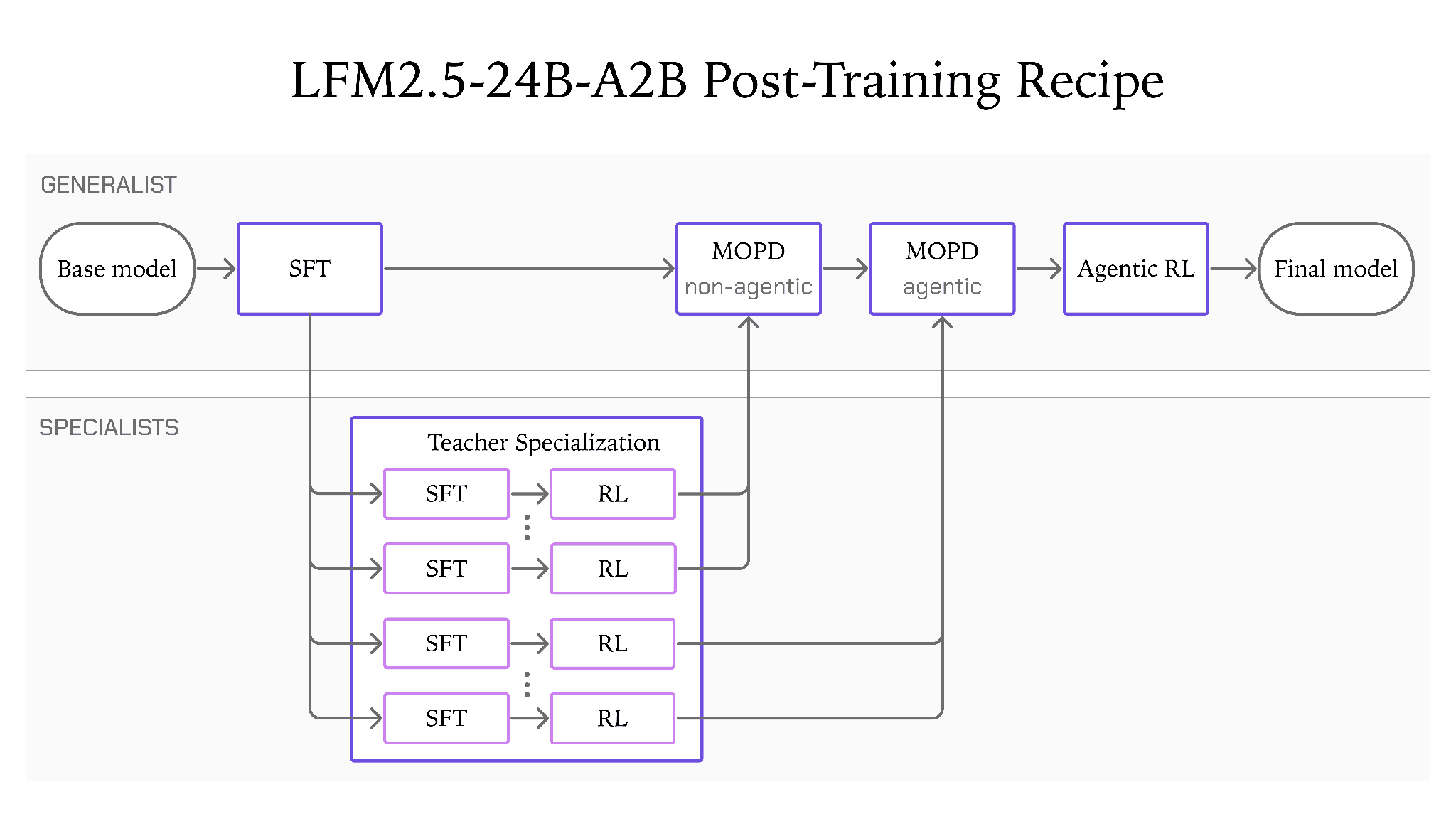
This diagram explains the specific training stages, including SFT and Agentic Reinforcement Learning, mentioned in the text.
While the model shows strong performance in tool-use and instruction-following benchmarks—outperforming some larger models in categories like AutomationBench—it faces trade-offs in knowledge-heavy tasks. Liquid AI notes that for workloads requiring deep factual knowledge, the model should be paired with retrieval-augmented generation (RAG) or web search. Furthermore, while the model excels at speed and specific agentic workflows, users have noted that it may struggle with complex coding tasks compared to larger models, highlighting the balance between its optimized inference speed and its capacity for deep reasoning in specialized domains.