The lunar terminator paradox describes how the illuminated portion of the Moon can appear to point upward even after the Sun has set, contrary to the naive expectation that the bright limb should face downward toward the Sun's position. Dima Kogan noted this while camping after sunset: despite the Sun being below the horizon, the Moon's bright limb pointed upward. This observation triggered an investigation into the geometric explanation.
The paradox arises because observers view the Moon from below. When the Moon is near the horizon and full, the Sun is directly behind the observer, illuminating the Moon's near side fully. As the Moon rises in the sky, the same solar illumination continues to strike the same area of the lunar surface, but because the observer's line of sight is from below, the lower edge of the Moon's disk enters the shadowed region. The result is a bright upper limb and a dark lower slice, making the Moon appear to point upward. This effect grows stronger as the Moon's phase approaches full, while a half‑Moon shows little or no paradoxical behavior.
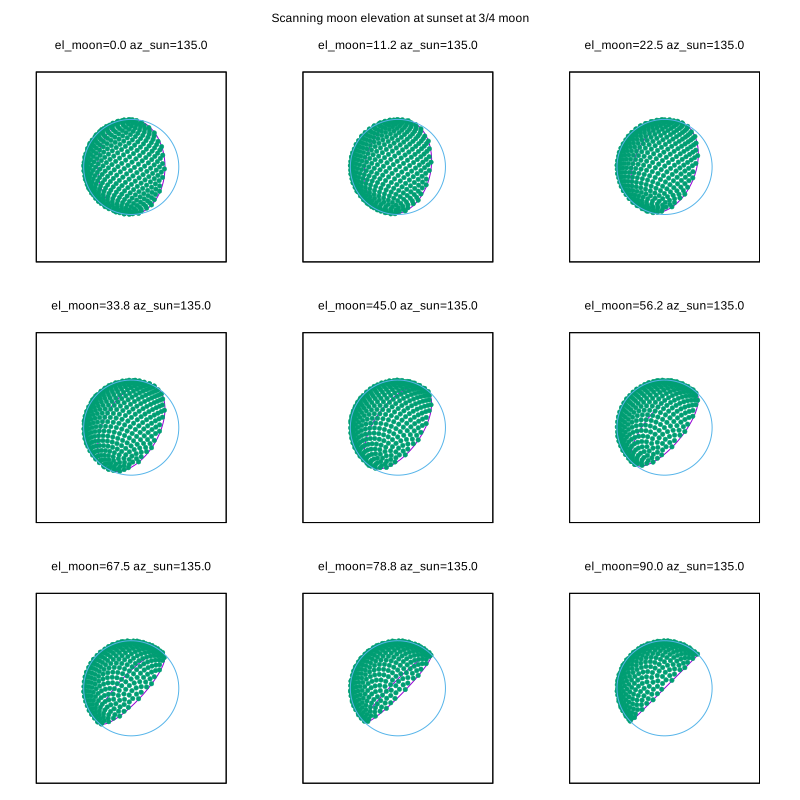
This diagram depicts the Moon's elevation angle relative to the observer, supporting the explanation of why the bright limb appears upward when the Moon is low in the sky.
Independent analysis of the lunar terminator illusion supports this geometric view. When the Moon and Sun are separated by a wide angle in the sky, the terminator (the day‑night line on the Moon) projects as a half‑ellipse whose major axis is perpendicular to the Sun‑Moon direction. In a cylindrical or panoramic projection of the celestial sphere, straight lines become sinusoidal, causing the terminator to appear tilted relative to the horizon. This projection effect explains why the illuminated limb can seem high even when the Sun is low, and why the illusion is most striking for large Moon‑Sun separations.
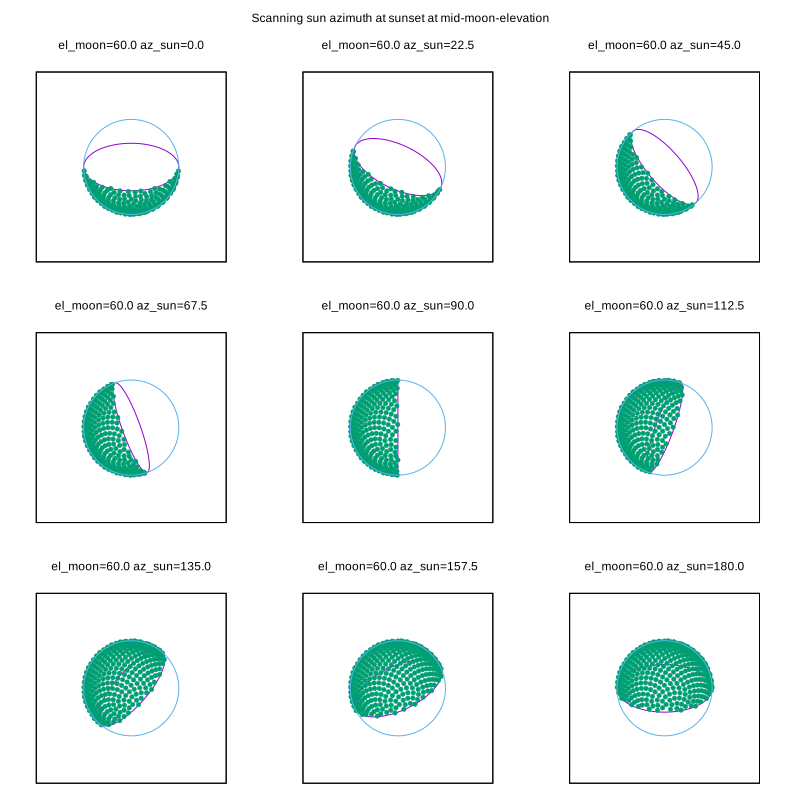
This diagram shows the Sun's azimuth angle, illustrating how a large Moon‑Sun separation leads to the terminator appearing as a tilted half‑ellipse in celestial projections.