Data-Oriented Design (DOD) shifts the design process to first consider how data will be stored in memory and what operations will be performed on it, before deciding on algorithms or class hierarchies. The article argues that this approach helps programmers stay close to the hardware’s characteristics, which is essential for performance-critical applications such as games, real‑time media processing, or software running on fixed‑hardware consoles where every cycle matters.
A core benefit of DOD is improved cache utilization: by arranging data so that frequently used elements lie next to each other in contiguous memory (e.g., plain arrays or std::vector), the likelihood of cache hits increases because the processor loads whole cache lines (typically 64 bytes) at once. In contrast, pointer‑heavy structures like linked lists, trees, or std::set/std::map scatter elements across RAM, causing frequent cache misses that can outweigh any theoretical advantage in algorithmic complexity. The article illustrates this with a static dataset: a sorted array accessed via binary search can be faster in practice than a tree‑based set despite the same asymptotic complexity.
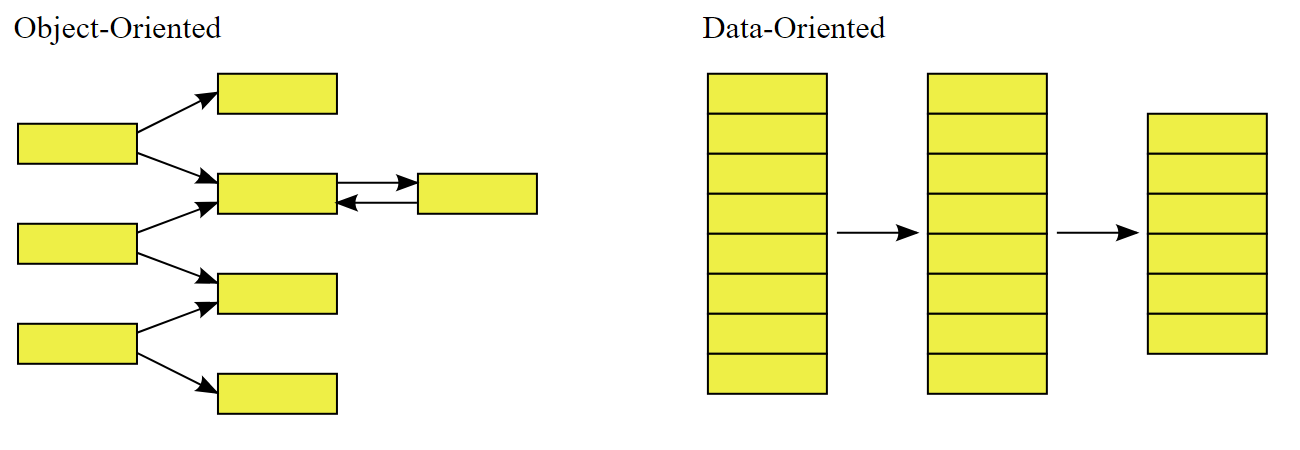
This image illustrates the cache utilization benefit discussed in the article, showing contiguous data layouts improve performance.
While DOD encourages simple, direct solutions, the article warns against over‑engineering—such as wrapping libraries in extra abstraction layers or defining interfaces with only virtual methods—because these add runtime costs that may not be justified. It also notes that the discussion does not cover other performance factors like branch prediction, synchronization, or SIMD, leaving open questions about how data‑oriented principles interact with those aspects in complex codebases.