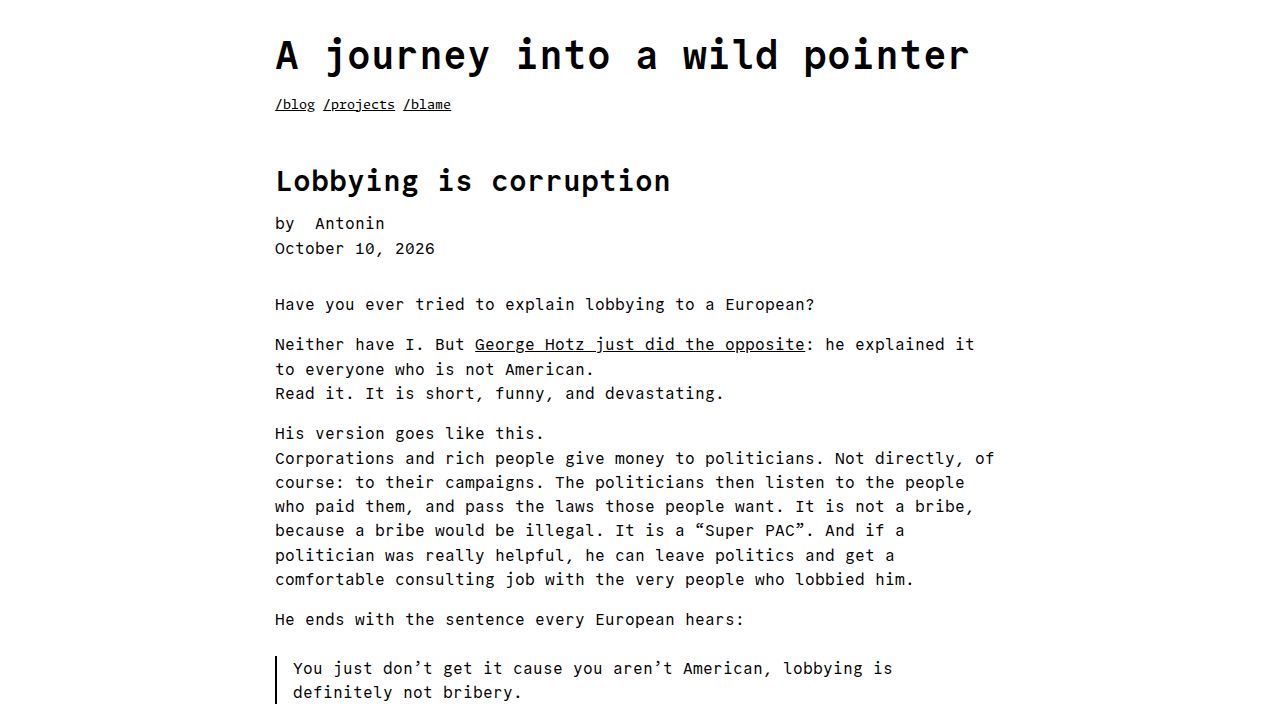
The article on carrette.xyz asserts that lobbying in the United States fits the definition of corruption as the abuse of entrusted power for private gain. It begins by noting that explaining lobbying to Europeans often meets disbelief, but then cites George Hotz’s description of the practice as a way to show how Americans view it. The author then points to the Wikipedia entry on corruption, which explicitly lists bribery, influence peddling, embezzlement, fraud, and adds that practices legal in many countries—such as lobbying—are also included under the heading of “legal corruption.” This framing is used to argue that the activity is substantively the same as corruption, differing only in its legal status.
To illustrate how lobbying works, the piece describes the flow of money from corporations and wealthy individuals to political campaigns, emphasizing that contributions are made indirectly through vehicles like Super PACs rather than as direct bribes. Politicians, having received this support, are said to listen to their donors and pass laws that benefit those interests. After leaving office, many of these politicians take consulting or advisory roles with the same corporations or lobbying firms, creating a revolving door that rewards the original donors. The author characterizes this sequence as a legalized form of bribery that would be recognized as corrupt by observers outside the United States.
The author concludes that the disagreement between Americans and Europeans is largely semantic: Americans call the described activity lobbying, while Europeans call it corruption. He argues that the United States has a tendency to rebrand controversial practices, but the underlying behavior—using financial influence to shape legislation and secure post‑office employment—remains unchanged. By invoking the Wikipedia definition and noting the existence of a “legal corruption” section, the article insists that labeling the practice as lobbying does not alter its nature as the abuse of entrusted power for private gain.