Edi Life OS is a self-hosted web application that brings together ten distinct workspaces—Overview, Growth, Focus, Habittify, Kanban, Calendar, Goals, Notepad, and Notes—into a single private dashboard. According to its GitHub repository, all workspaces share one design, one sign-in, and one MySQL database, aiming to eliminate the fragmentation of using separate apps for habits, goals, budgeting, timing, and note-taking by connecting these functions so they inform each other, such as habits driving goal progress and Kanban cards appearing in the calendar.
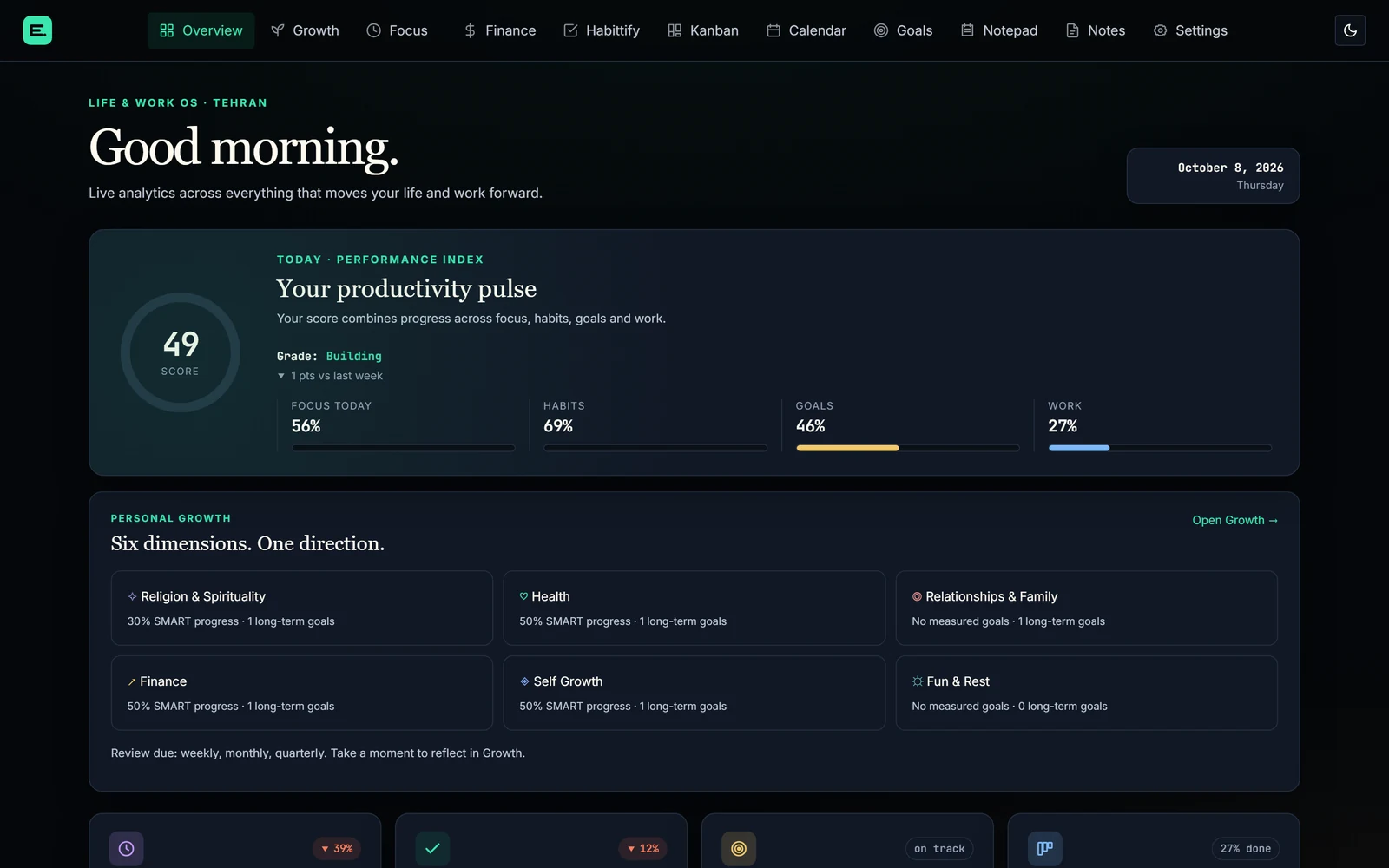
This image illustrates the unified dashboard described in the first paragraph, showing how the Overview workspace integrates focus, habits, goals, and other metrics.
A distinctive feature is the optional MCP (Model Context Protocol) server that exposes 26 tools for AI assistant integration. The server runs over stdio and communicates with the application through a token‑protected HTTP API, never touching the database or credentials directly. Users can connect the MCP server to clients like Claude Desktop or Claude Code and issue natural language commands—for example, requesting a dashboard overview, creating a SMART goal with an associated task, marking a habit as complete, or logging a financial transaction and checking the resulting balance.
This badge represents the optional MCP server feature mentioned in the second paragraph, which exposes 26 tools for AI assistant integration.
Edi Life OS can be deployed via Docker, on shared hosting, or with a local PHP server, requiring PHP 8.1+ with PDO MySQL and mbstring extensions and MySQL 8+ or MariaDB 10.4+. The documentation emphasizes that the platform is built for a single owner; the API token grants read and write access to every supported domain without implemented token scopes or app‑level rate limiting, so users must set request limits at the hosting layer and use HTTPS for non‑localhost connections. Data remains in the user’s MySQL database, with attachments stored separately, and backups should include the database, attachment files, and configuration.
This badge reflects the self-hosted nature of Edi Life OS discussed in the third paragraph, emphasizing private deployment on user infrastructure.