The Terse plugin for Claude Code is designed to counteract the assistant's habit of delivering essay‑like responses laden with filler such as slogans, metaphors, and self‑referential phrasing. Its GitHub page explains that the plugin supplies a set of 22 writing rules and 18 before/after pairs (totalling 877 words) that reshape every reply into a strict format: a single sentence with the answer, followed optionally by a list or table, then at most one caveat sentence, and then stops. This style eliminates first‑person references, slogans, metaphors, and 'X, not Y' reframes, thereby cutting the verbosity that many users find distracting.
This image shows the plugin's stated goal as described on its GitHub page, which motivates the strict writing rules that reduce verbosity.
Measurements supplied with the plugin show that for Opus 5.5 (high effort) the median reply length drops from 636 words to 181 words (−72%) across ten chat replies, while output tokens fall by 45% and style violations per 1,000 words decline from 11.1 to 1.1 (−90%). Specific reductions include slogans and metaphors going to zero per 1,000 words, first‑person references falling by 83%, and 'X, not Y' reframes decreasing by 33%. Similar gains are reported for Fable 5.1, with 46% fewer words and 51% lower cost.
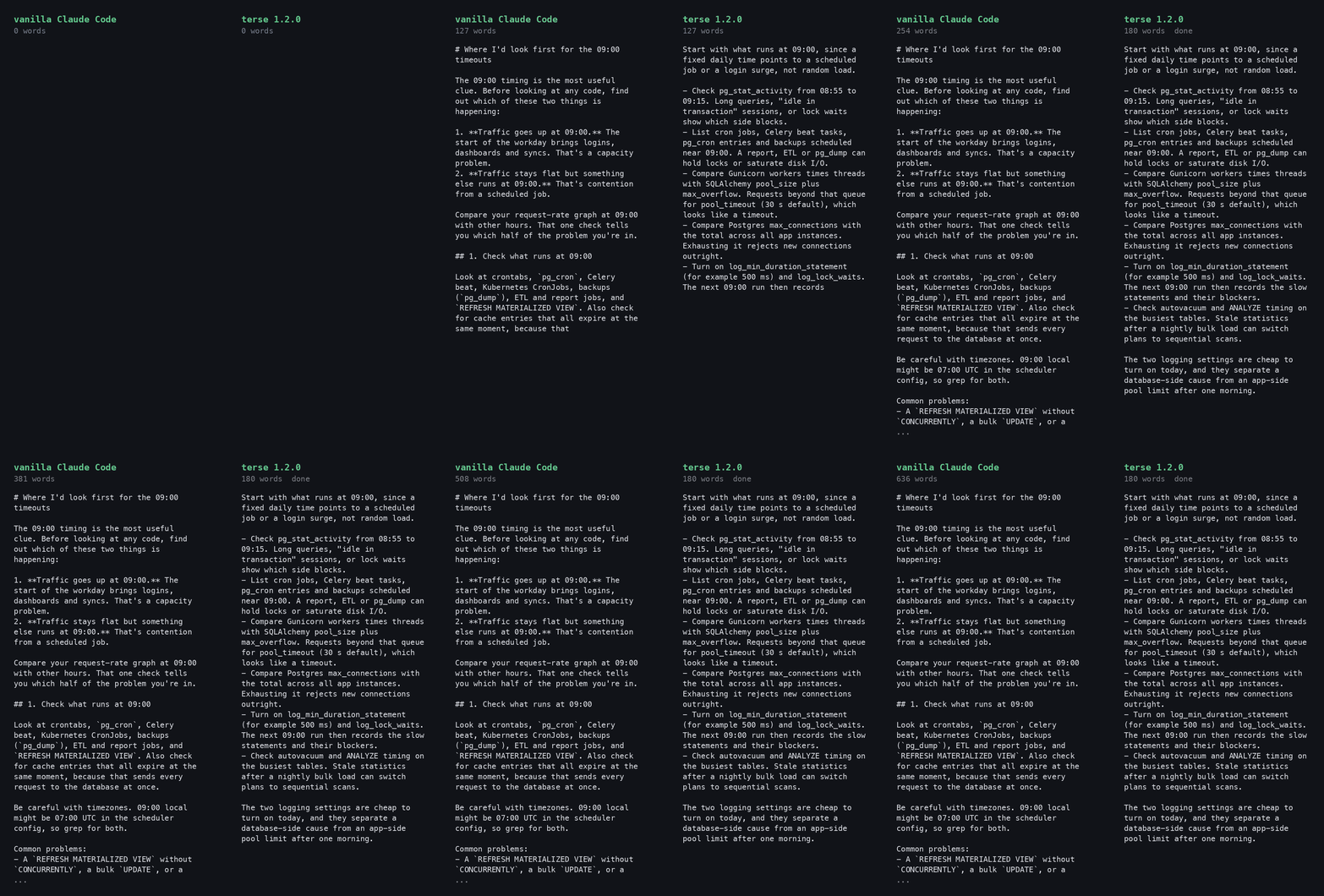
This image illustrates the quantitative reduction in response length described in the measurements section, where median reply length drops from 636 to 181 words for Opus 5.5.
Beyond rewriting responses, Terse adds a context meter that displays the model name and context fill as a percentage in the status line. The meter’s thresholds—green below 37%, yellow from 37%, orange from 49%, skull from 60%—are derived from studies indicating retrieval quality degrades well before the context window fills, such as Chroma's Context Rot report (degradation from 50k tokens on a 200k window), NoLiMa (11 of 13 models at half baseline by 32k tokens), and the Lost in the Middle phenomenon.