When performing numerical calculations in programming, developers often transfer safety habits from integer arithmetic to floating-point operations. However, these two paradigms follow fundamentally different approaches to handling errors and edge cases. With integer arithmetic, operations that exceed representable limits cause undefined behavior or program crashes, making it essential to anticipate and prevent problematic operations before they occur. This mindset leads developers to implement preemptive checks for potential overflow or underflow conditions.
Floating-point arithmetic, governed by the IEEE-754 standard, handles exceptional cases differently. Rather than causing immediate failures, operations that exceed limits or involve invalid inputs produce special values: NaN (Not a Number) for undefined results like 0/0, and infinity for overflows like division by zero. These values propagate safely through subsequent calculations - for example, any operation involving NaN produces NaN, and dividing a finite number by infinity yields zero. This containment property means developers can often validate results after computation rather than needing to prevent every possible error condition upfront.
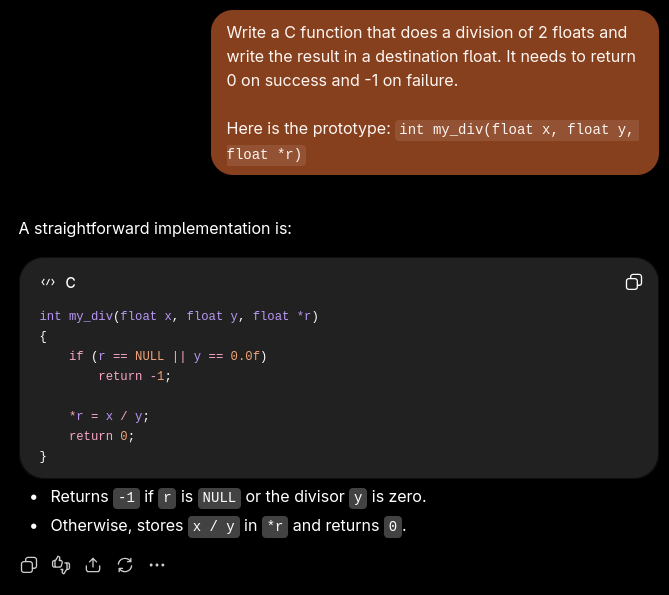
This image illustrates how floating-point division by zero produces infinity, a special value that propagates safely, supporting the article's point about post-operation validation.
A common mistake illustrates this paradigm mismatch: checking for zero denominators using FLT_EPSILON (the smallest representable difference between 1.0 and the next floating-point value). As demonstrated in the source material, this approach fails because the success of division depends on the magnitude of both numerator and denominator. A large numerator divided by a moderately small denominator (like 0.9) can still produce infinity, while a moderate numerator divided by an extremely small denominator (like FLT_EPSILON's successor) can also yield infinity. The proper solution is to check whether the result of a calculation is finite using language-specific functions like isfinite() in C or Rust, which catches both NaN and infinity values in a single validation step after the operation completes.