After using DeepSeek 4.1 Flash heavily across a dozen projects for about a month, one developer reports that its conversational quality, work product, and speed are indistinguishable from frontier models such as Opus 5.5 when the model name is hidden. This subjective parity extends to everyday coding tasks, allowing the developer to treat the model as a frontier-level assistant despite its significantly lower price.
The developer attributes this cost‑performance edge to a roughly 437× reduction in KV cache size compared to DeepSeek’s V1 model, which cuts GPU memory consumption and keeps all‑day coding sessions under a dollar in expected cost. Independent benchmark snippets from the model’s provider show individual tasks costing fractions of a cent (e.g., $0.0098 for a piano synth, $0.98 total for a 2048 game build), confirming that the low marginal cost is reproducible across varied workloads.
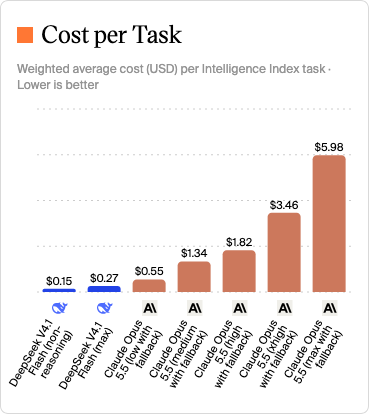
This image illustrates the low marginal cost mentioned in the article, where individual tasks like a piano synth cost $0.0098 and a 2048 game build totals $0.98.
Because the model makes expensive experimentation cheap, the developer now spins up exploratory UI tests and “mindless” tasks without hesitation, reserving Opus 5.5 only for occasional final code reviews to catch edge cases. Despite these advantages, the wider industry has not reacted with alarm; the post notes that many users rely on heavily subsidized plans that mask true API prices, and that firms like FAANG continue to prioritize spending the most for the highest intelligence, creating a market dynamic where ultra‑cheap alternatives do not trigger the expected disruptive response.

The article notes that developers use DeepSeek 4.1 Flash for inexpensive experimentation, such as creating UI tests and games, reserving more expensive models for final reviews.

Because the model makes experimentation cheap, developers run simulations like particle flow without hesitation, as described in the article's third paragraph.

The article explains that low cost enables developers to spin up exploratory visualizations like force‑directed graphs for quick insights.