Google announced EmbeddingGemma 2 on October 6, 2026, as an open-weight multimodal embedding model that processes text, images, audio, and video in a unified embedding space. Released under the Apache 2.0 license, the model builds on the Gemma 4 architecture and contains 740 million parameters, enabling on-device inference for cross-modal search and retrieval tasks without requiring an internet connection.
The model features a modular design allowing developers to use only the text encoder (270 million parameters) or add optional vision (170M) and audio (300M) encoders for full multimodal support. It employs Matryoshka Representation Learning (MRL) to dynamically truncate output vectors from 768 dimensions to 512, 256, or 128 dimensions, achieving up to 6x storage reduction for vector databases. Additionally, its 8K token context window—four times larger than the first EmbeddingGemma—enables processing of approximately 5.5 minutes of audio, 29 images, or 58 video frames directly on local hardware.

This image illustrates the edge deployment capability of EmbeddingGemma 2, supporting the article's discussion of on-device inference and modular multimodal support.
EmbeddingGemma 2 delivers a 9.92-point improvement on code performance (MTEB Code) over its predecessor, rising from 68.76 to 78.68, and runs efficiently on devices like the Google Pixel 11 Pro with ~191MB RAM for text-only weights and ~567MB for the full multimodal model when quantized. While the source highlights strong quality-per-parameter and notes that it outperforms some specialist models more than twice its size, it does not provide modality-specific performance breakdowns for image, audio, or video tasks, leaving the exact gains in those areas unspecified.
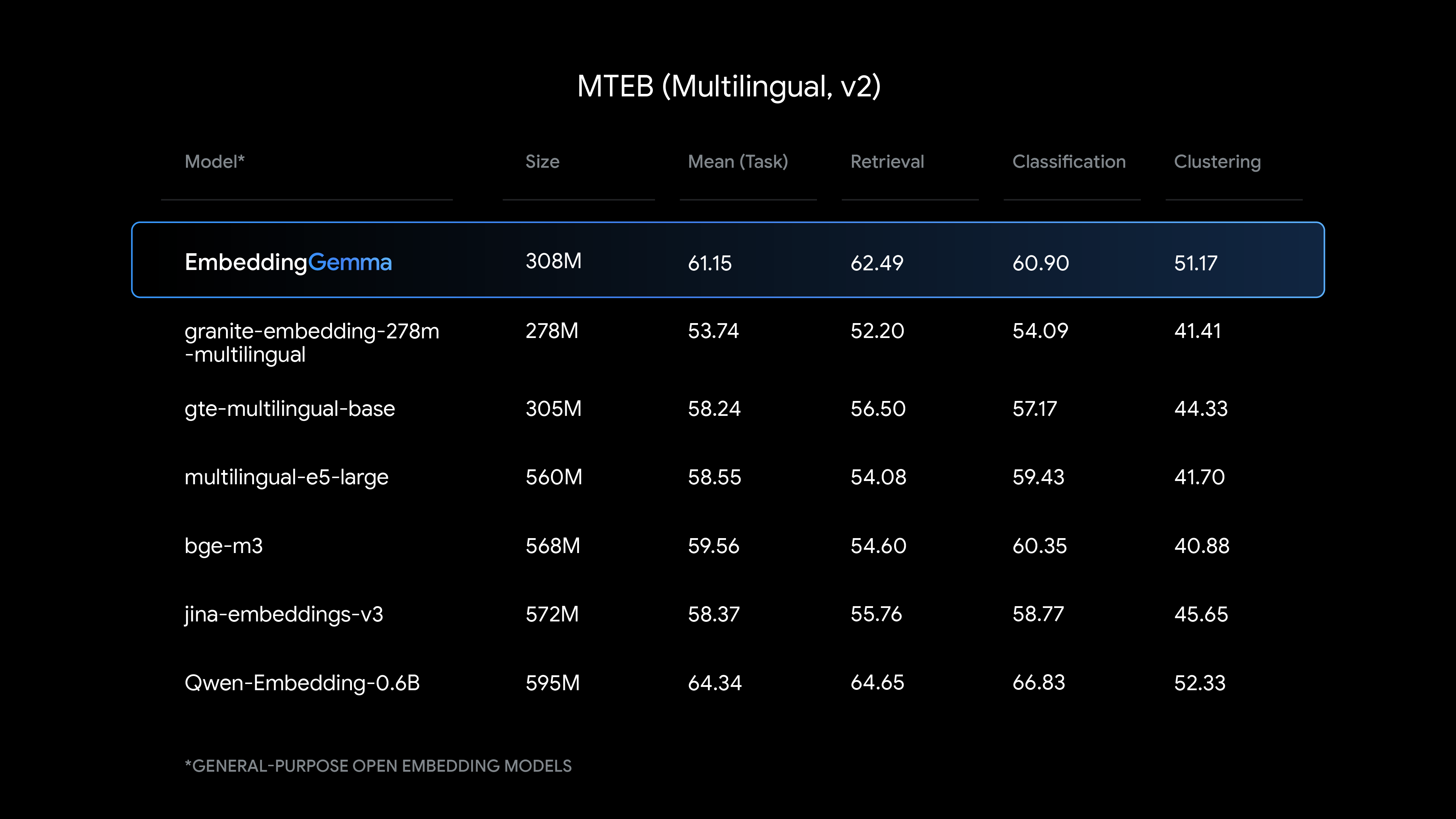
The chart presents MTEB Multilingual v2 evaluation results, complementing the article's reported MTEB Code improvement and highlighting the model's multilingual capabilities.