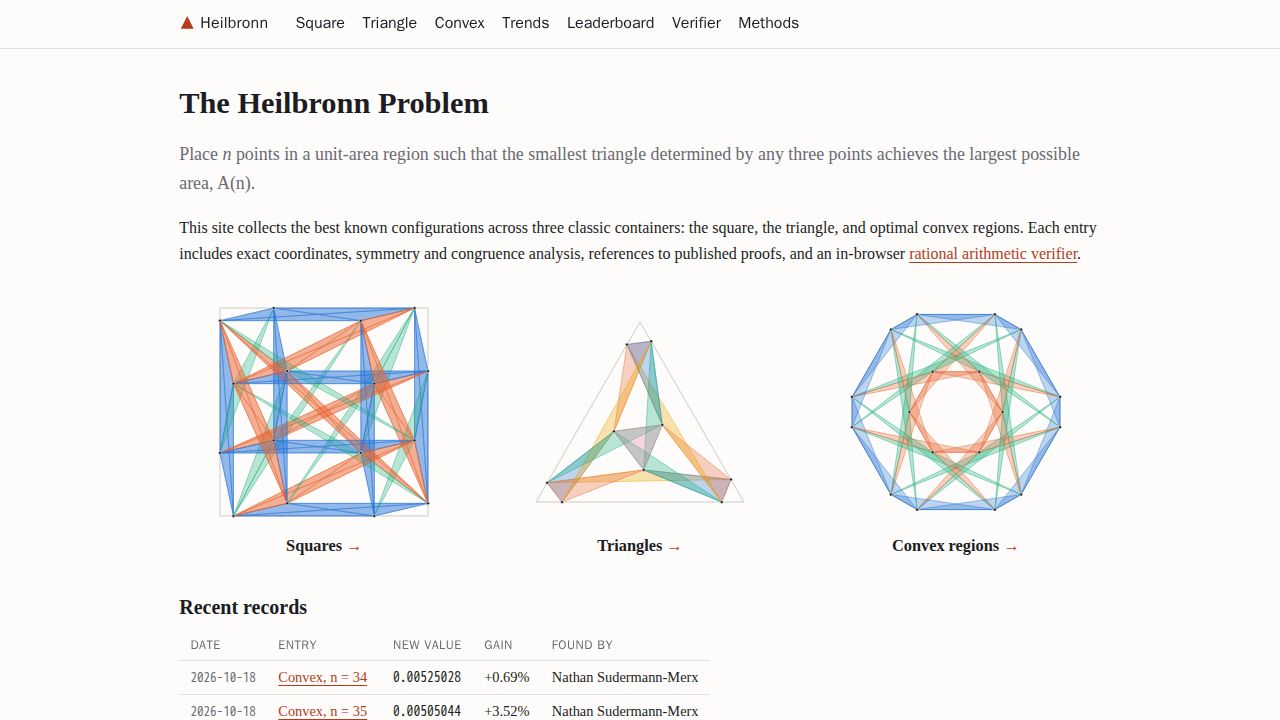
## What the Heilbronn Problem Asks
The Heilbronn problem is a discrete geometry optimization challenge: given a region of unit area—a square, an equilateral triangle, or any convex shape—place *n* points so that the smallest triangle determined by any three of those points is as large as possible. The value of that largest possible minimum triangle area is denoted *A*(*n*).
First studied by Hans Heilbronn in the 1950s, the problem sits at the intersection of combinatorial geometry and computational optimization. For each container shape and each *n*, the goal is to find a point configuration that pushes *A*(*n*) higher than any previously known arrangement. Proving that a configuration is truly optimal (rather than merely the best found so far) is a separate, often harder task.
## A Live Leaderboard with Verifiable Records
The website **math.tejstead.com/heilbronn/** serves as a living archive of the best-known configurations for three classic containers: the unit square, the unit equilateral triangle, and the optimal convex region for each *n*. Each entry lists:
- Exact coordinates for the *n* points - Symmetry and congruence analysis of the configuration - References to published proofs where optimality has been established - An **in-browser rational arithmetic verifier** that lets anyone recompute the minimum triangle area exactly, without floating-point rounding errors
The site marks entries with a ▲ symbol when a configuration has been proven optimal. For most *n* and most containers, the listed values remain "best known" rather than proven optimal.
## Recent Record Improvements (September–October 2026)
Since late September 2026, the leaderboard has seen a cluster of new records, nearly all contributed by independent researchers working outside traditional academic channels:
| Date | Container | *n* | New *A*(*n*) | Gain | Contributor | |------|-----------|-----|--------------|------|-------------| | 2026-10-01 | Triangle | 20 | 0.01260939 | +2.37% | Rob Gardiner | | 2026-10-01 | Square | 23 | 0.00975728 | +1.18% | Rob Gardiner | | 2026-09-28 | Square | 21 | 0.01147376 | +1.85% | Rob Gardiner | | 2026-09-28 | Square | 23 | 0.00964331 | +1.97% | Rob Gardiner | | 2026-09-28 | Square | 25 | 0.00823006 | +3.74% | Rob Gardiner | | 2026-09-28 | Square | 35 | 0.00443228 | +0.53% | Rob Gardiner | | 2026-09-25 | Convex | 31 | 0.00630967 | +3.46% | Alexandar Lackovic (with help of Opus 5.5) | | 2026-09-25 | Convex | 33 | 0.00547013 | +3.21% | Alexandar Lackovic (with help of Opus 5.5) | | 2026-09-23 | Triangle | 19 | 0.01348189 | +0.21% | Marc-Emmanuel Coupvent des Graviers | | 2026-09-23 | Triangle | 29 | 0.00612369 | +2.55% | Marc-Emmanuel Coupvent des Graviers |
The site's creator notes that "lately there has been a wave of contributions of new records made by amateur mathematicians." The involvement of AI assistance (Opus 5.5) in the convex-region records by Lackovic marks a notable development in how computational search is being conducted.
## How the Values Compare Across Containers
The table of best-known values (truncated to eight decimal places) shows how the achievable minimum triangle area shrinks as *n* grows, and how container shape matters:
- For *n* = 3, the square and triangle both achieve *A*(3) = 0.5 (the triangle itself), while the optimal convex region achieves 1.0 (the whole region). - By *n* = 10, the square leads at ~0.0465, followed by the convex region at ~0.0520, with the triangle at ~0.0434. - At *n* = 35, the square reaches ~0.00443, the convex region ~0.00477, while the triangle entry is not yet tabulated.
The convex region consistently outperforms the fixed square and triangle for larger *n*, as expected—optimizing the container shape itself adds a degree of freedom.
## Open Questions and Known Limits
**Asymptotic behavior.** A comment on the submission thread sketches a simple pigeonhole argument giving an upper bound of roughly 1/*n* for the square: divide the unit square into *n*/3 vertical strips; one strip must contain three points, and any triangle inside has area at most the strip's area (~1/*n*). The best known *lower* bound is on the order of (log *n*)/*n*²—a vast gap. The primary source does not discuss these asymptotic bounds; they remain an active research area (notably advanced by Komlós, Pintz, and Szemerédi).
**Criterion for inclusion.** The site does not explicitly state its criterion for listing a configuration as the current best-known value. The leaderboard is finite because only configurations that improve on all previously published results are recorded; the "infinitely long" list a reader might imagine would consist of configurations that are *not* improvements.
**Proven optimality.** Only a handful of entries carry the ▲ mark. For the vast majority of (*n*, container) pairs, the true optimum is unknown. The rational arithmetic verifier confirms that a submitted configuration achieves the claimed *A*(*n*), but it does not prove no better configuration exists.
## Why This Matters
The Heilbronn problem is a rare example of a fundamental geometric optimization question where:
1. **The search space is continuous and high-dimensional** (2*n* coordinates), yet 2. **Exact verification is possible** via rational arithmetic, and 3. **Non-experts with computational tools can still advance the frontier.**
The recent flurry of records demonstrates that the problem remains empirically active. Whether the gap between the 1/*n* upper bound and the (log *n*)/*n*² lower bound will ever close—or whether the true asymptotic order lies somewhere between—remains one of the problem's central mysteries.