Fixed point theory, a concept from mathematics and computer science, provides an unexpected lens for understanding collective decision-making in student unions, according to a 2012 blog post by programmer Paul Khuong. The core idea revolves around finding solutions to equations of the form x = f(x), known as fixed points. When dealing with monotone functions - those that preserve order - Tarski's fixed point theorem guarantees the existence of both a least and greatest fixed point when the domain forms a complete lattice. In programming contexts, this theory manifests in problems like dead value elimination in compilers. Khuong notes that when asked to identify useless variables in code, many people intuitively start by assuming all values are live (used) and then prune away those that compute only useless values. This approach, however, converges to the greatest fixed point when what's actually desired is the least fixed point - the maximum set of eliminable computations. The correct approach reverses the intuition: start by assuming only return values and memory writes are live, then iteratively add values that compute live values until no more can be added. This yields the least fixed point - the optimal set of values to eliminate. Khuong extends this insight to a real-world scenario involving student unions in Québec. During periods of tuition fee protests, university and CEGEP student unions vote on strike mandates that often include conditions about minimum participation - for example, requiring that a certain number of other students or unions also commit to striking before taking action. These mandates create a monotone system: if a set of unions satisfies the conditions for striking, then any larger set (a superset) will also satisfy them. This mathematical property means Tarski's theorem applies, with the power set of unions ordered by subset inclusion forming a complete lattice. The critical question becomes: which fixed point represents the actual outcome of the strike vote process? Khuong argues that the goal is to identify the largest possible set of unions that can strike simultaneously - the greatest fixed point under the subset ordering. However, intuitive algorithms for solving this problem often start with no unions on strike and iteratively add unions whose conditions are met by the current striking set. This approach seeks the least fixed point and can lead to deadlock situations where no union strikes despite the potential for collective action. As an illustrative example, Khuong describes two unions each with 5,000 members and a strike mandate requiring 10,000 participating students. Starting from zero striking unions, neither union would join the strike because the condition isn't met, resulting in a stalemate. The correct approach begins by assuming all mandate-holding unions are on strike, then removes unions whose conditions aren't satisfied by the current set, converging to the greatest fixed point where both unions strike. While Khuong characterizes this as 'a pretty neat case of abstract mathematics helping us interpret a real-world situation,' he acknowledges it may remain primarily theoretical. Nevertheless, the example highlights a broader pattern: in fixed point computations, intuitive conservative approaches often converge to suboptimal solutions, and choosing between least and greatest fixed points should be a deliberate decision based on the problem's requirements rather than an unconscious bias. The blog post concludes by noting that while conservative initial values may lead to faster convergence and always-correct intermediate results, settling for suboptimal solutions ought to be an explicit choice rather than a consequence of overlooking alternative fixed points.
HN Digest / · HN #49916550
Fixed Point Theory Applied to Student Strike Mandates
A 2012 blog post explains how fixed point mathematics from computer science applies to student union strike mandates in Québec, showing why intuitive approaches to determining striking unions often fail and how seeking the greatest fixed point provides the correct solution.
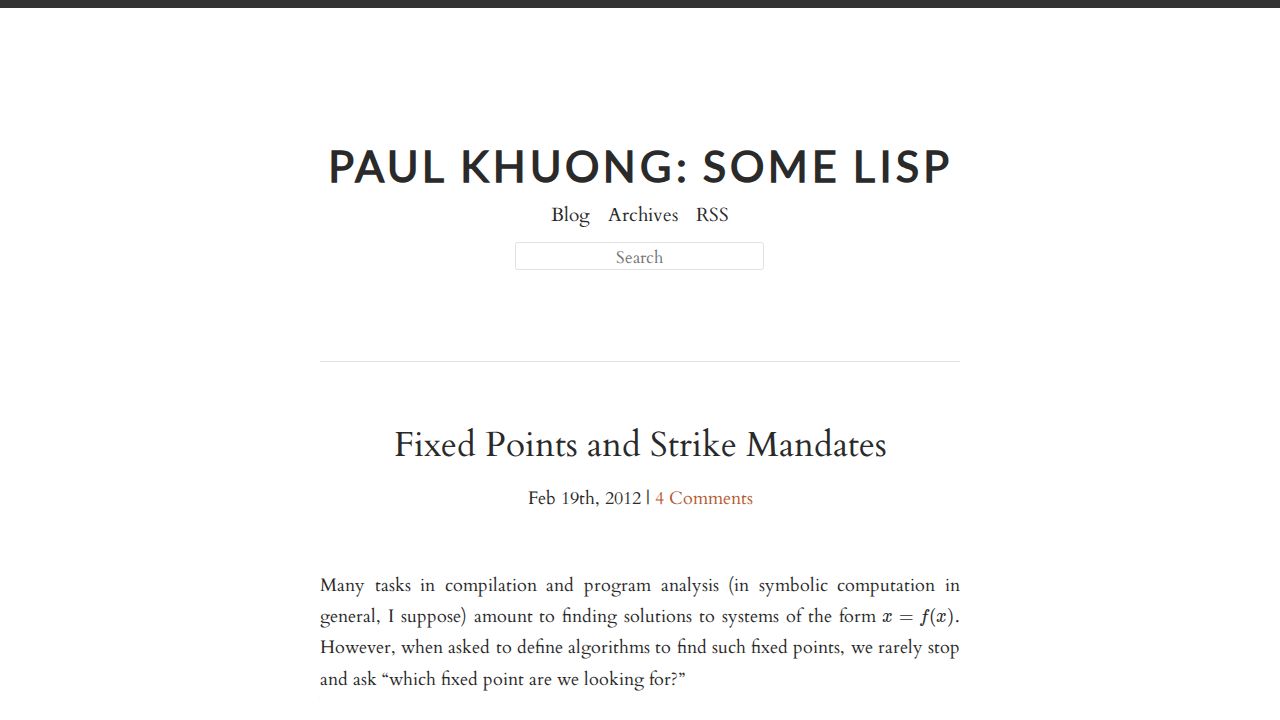
Screenshot of the source page (pvk.ca)