AI coding agents have become a crowded desk. If you use more than one — Claude Code in one terminal, Codex in another, each with its own login and usage limit — you already feel the cost of switching: lost context, separate windows, and the constant question of which agent actually holds the right answer on a given task.
Offrun is a free Mac application built to replace that desk with a single workspace. It does not host the agents themselves. It runs the command-line interfaces (CLIs) you already use — Claude Code, Codex, and Grok Build, among others, with Pi and OpenCode listed as coming soon — on your Mac, signed in as you. You bring your own accounts and subscriptions; Offrun provides the orchestration and charges nothing for it.
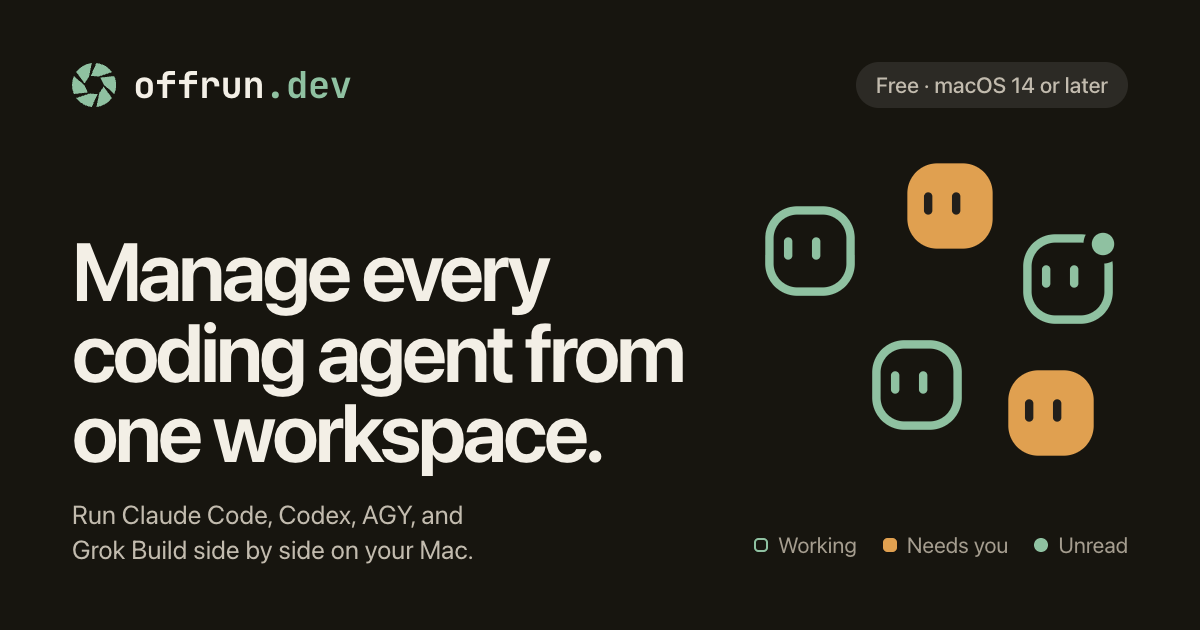
The article explains that AI coding agents have become a crowded desk of separate terminals and logins, and that Offrun replaces that with a single workspace running Claude Code, Codex, and Grok Build under your own accounts. This is the product's own view of that workspace, showing multiple agent faces in one place.
Setup is deliberately light. Download the app, drag it to Applications, then connect each agent under Settings → Agents, where you can add multiple accounts for the same agent if you have them. The app requires an Apple Silicon Mac (M1 or newer) running macOS 14 Sonoma or later, plus at least one agent CLI you already use. In Offrun's own framing: it does not replace Claude Code or Codex — it runs them, and you keep your own accounts and subscriptions.
The most distinctive structural feature is worktrees. A git worktree is a linked working directory that lets you check out a different branch in a separate folder without disturbing your main checkout. Offrun gives every agent in a project its own worktree, so two agents working the same repository never touch the same files. The practical effect: one agent can refactor a parser while another fixes a flaky test, and because they operate on separate branches, they cannot step on each other's changes. The site's framing is direct — run a refactor and a bug fix at once and merge them on your own schedule.
Peer review is the feature most likely to change daily workflow. Rather than reviewing your own diff — the set of proposed changes — you pick a second agent to read it first. Its findings land in the conversation while the work is still uncommitted, so you can ask for fixes before anything is sent. Critically, nothing merges on its own; every decision after that is yours. Review runs on one of your own agent accounts, so there is no second subscription and no bot added to your pull requests. The reviewer can only read the diff and post what it found; it cannot modify your code.
The site illustrates what a review finding looks like with a concrete example. An agent had been asked to cap retry backoff at 30 seconds and add jitter, and produced this:
// Shortened excerpt rendered from the example on offrun.dev async function retry(req, n) { const wait = Math.min(2 ** n * 100, 30_000) const jitter = wait * 0.2 * Math.random() await sleep(wait + jitter) }
The reviewer flagged a problem: the 30-second cap is longer than the gateway's 25-second timeout, so the last retry is cut off before it can complete.
Offrun's handling of accounts addresses a real operational headache. You can point each agent at a different login — the site shows, for example, separate work and personal accounts for Claude Code and multiple accounts for Codex. When one login hits its usage limit, Offrun moves the active chat to a login that still has room and tells you so; you send your message again and the new login picks up the whole conversation. If you run out of logins entirely, it offers another agent instead.
What the site does not establish is whether Offrun shows you remaining headroom before you dispatch a task, as opposed to discovering the limit only when an agent runs into it. The described behavior is reactive: the limit is detected mid-task and the conversation is relocated. Whether that handoff is seamless in practice, and whether any warning precedes it, is not answered by the supplied material.
Offrun's answer to agents forgetting context between sessions is project memory. It keeps repo-wide conventions in one place and each agent's own goal, plan, and dead ends in another. Agents read that context at the start of every session and write back to it as they go, so the fourth session knows what the first one already tried. The memory lives as plain files in your project folder — conventions.md, plan.md, dead-ends.md — so you can open, edit, and version them yourself.
Offrun watches coding agents anywhere on your Mac, including ones running in a terminal it never launched. When an agent finishes or stops to ask a question, you get a notification even if that window is buried four spaces away. Alongside the conversation, a preview pane shows changed files, diffs with line numbers, rendered markdown and tables, images, and PDFs, plus a small browser with an address bar — so you can read the work without leaving the chat.
Two modes let you control how much rope an agent gets. Build makes the change and runs it to prove it works. Planner works out the approach and writes it down without changing a file. You can switch any chat between the two modes at any time.
Dictation lets you speak your prompts: hold a key and talk, and Offrun transcribes on your Mac. It keeps identifiers spelled the way your code spells them — learning vocabulary like 'retryBackoffHelper' and 'Kubernetes' from voice samples you record — and drops clean text wherever your cursor is. Transcription runs entirely on your Mac; nothing is recorded and nothing is uploaded. It needs a network connection only during setup.
The site is unusually explicit about what leaves your machine. Dictation and your project files stay on your Mac. Agent prompts and code go straight to your provider — Anthropic, OpenAI, Google, or xAI — on your own account, never through Offrun. Offrun states it has no server in that path and never handles your keys.
Offrun is free — every feature, no limits, no seats to count, no credit card required. You keep paying your agent providers for their subscriptions; Offrun charges nothing for the layer it adds.
A natural question is what Offrun offers that similar tools do not, and specifically how it compares to Herdr. The supplied source does not mention Herdr or any competing product, so no comparison can be drawn from this material. What the source does establish about Offrun's positioning is concrete: it is free, requires no new account or API key, runs agents locally on your machine under your own subscriptions, keeps dictation and project memory on-device, and explicitly routes agent traffic directly to your provider rather than through its own servers.
What remains unclear is bounded but real. The source does not state when Offrun will be generally available. It describes concurrent worktrees but does not detail how their results are merged beyond the user's own schedule. The reactive account-failover is described, not demonstrated, and the site does not quantify performance, reliability, or privacy assurances beyond its own statements. Whether the product delivers on its stated scope depends on details the landing page has not yet supplied.