Austin Henley set himself a constraint: write a Python interpreter in 1024 bytes of C, no macros, no libraries. The result is less a Python implementation than a Python-shaped calculator that happens to accept familiar-looking syntax.
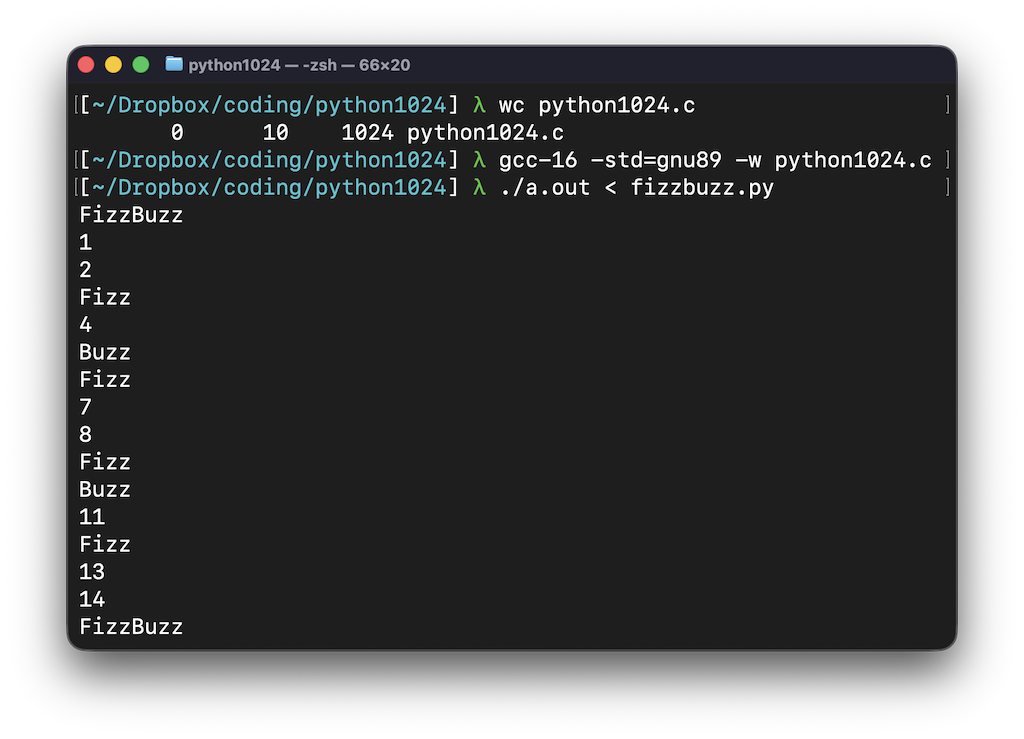
A terminal screenshot captures the full workflow: checking that the golfed C file is exactly 1024 bytes, compiling it with gcc, and executing fizzbuzz to demonstrate the interpreter produces correct output.
The interpreter holds the entire program in a fixed 999-character source buffer, with a 256-entry symbol table for single-letter lowercase variables. It tokenizes on the fly — stripping whitespace, assuming keywords are spelled correctly, and treating any line starting with 'f' as a for-loop, 'w' as while, 'i' as if, 'd' as def, and 'p' as print. There is no error recovery; it makes a lot of assumptions about the correctness of the input.
Expressions are evaluated during parsing with a standard recursive-descent walk. Control-flow blocks continue until indentation decreases, using C's call stack for nesting. Loops work by remembering the position of the condition expression, then jumping backward and reparsing the source on every iteration. Functions save the caller's location, jump to the body on call, and restore the caller when they reach the end. No intermediate representation is generated.
The feature list is deliberately short: integer literals and single-letter variables, assignment, arithmetic with + - * % and precedence, comparisons with < > <= >= ==, integer truthiness, if/else, while/for with else blocks, no-argument function definitions and calls, indentation-based blocks without scope, and print for strings or integers.
Henley golfed the readable 4,800+ byte version down to exactly 1024 bytes using techniques from a Stack Overflow 'Tips for golfing in C' thread: single-letter names, implicit int, ASCII values instead of character literals, ternary and comma operators, bitwise operations in place of logical ones. The golfed source is a single dense block; the readable version is preserved alongside it on GitHub.
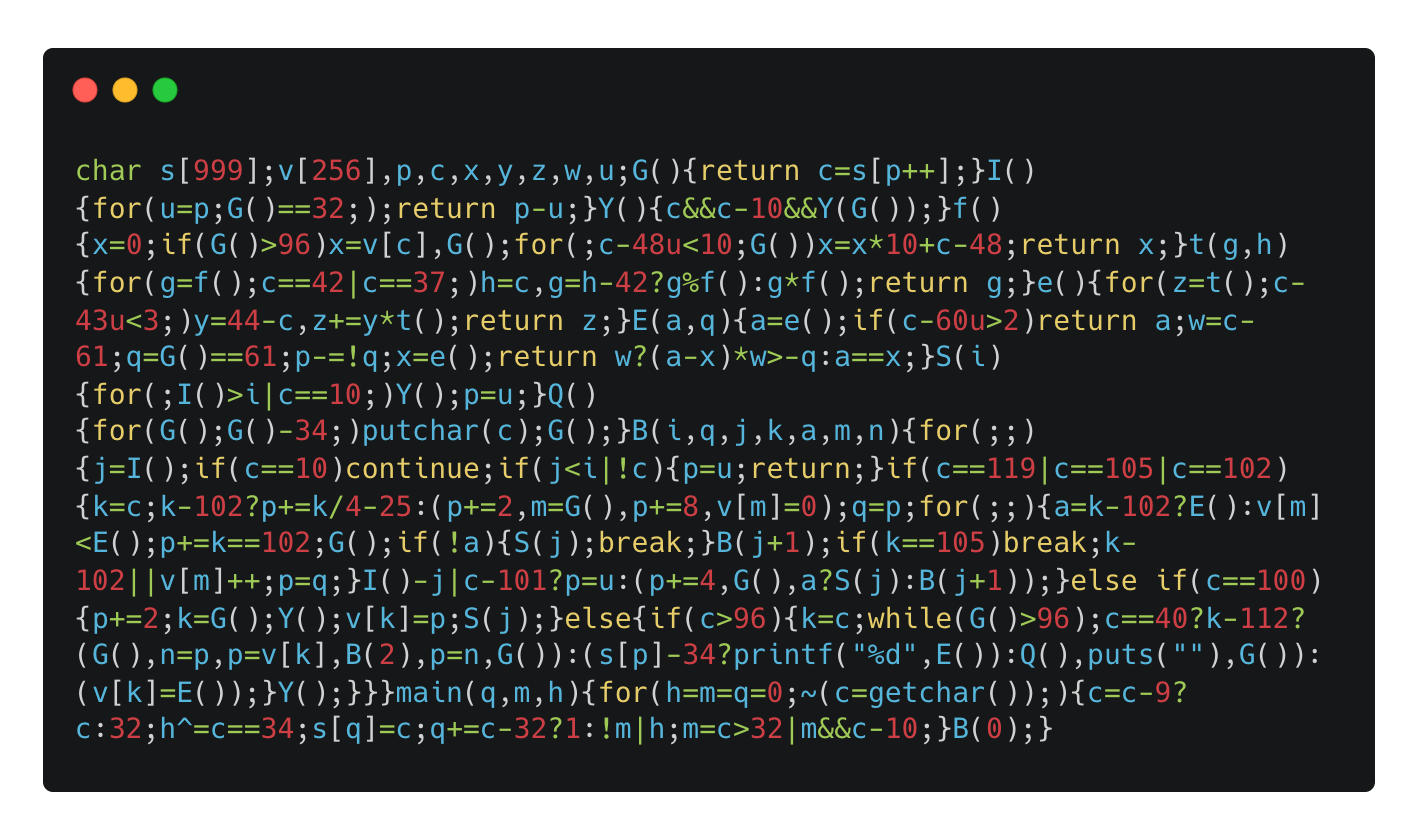
This screenshot displays the entire minimized C source. Every technique from the Stack Overflow golfing thread is visible: implicit int, ASCII literals, comma and ternary operators, bitwise tricks, and single-character identifiers compressed into one dense block.
The interpreter is a demonstration, not a production tool. It assumes well-formed input, supports only one comparison per expression, and handles unary plus/minus only at the start of an expression. Henley notes he could probably get fizzbuzz alone below 800 bytes.