Biodiversity research relies on herbarium specimens—pressed and dried plant samples—paired with voucher records that document who collected them, where, when, and under what name. Traditionally, this information is assembled piecemeal as the specimen moves through pressing, drying, identification, and data entry, a process that can take months or years and introduces opportunities for errors or omissions. Recent digitization efforts have focused on improving backend databases while neglecting the critical moment of collection when all provenance details are known firsthand. The Independent File (IF) addresses this gap by starting the voucher record in the field at the instant a specimen is collected. [primary] [support-1] IF is a self-contained HTML document of approximately 750 KB that requires no installation, account, server, or network connection to operate. Upon opening, it generates a unique QR code and voucher identifier. Collectors can then photograph the specimen in situ, record GPS coordinates (correctable later), and add relevant photographs before saving the voucher locally in the browser. The file ties together specimen data, images, collector information, locality, and date through semantics by construction: its structure and behavior inherently carry meaning, eliminating the need for later reconstruction across multiple systems. [primary] IF supports both preprinted label workflows and a 'Cowboy' method for reconciliations after collection. Users can print QR labels beforehand using IF's built-in print function, scan them with a phone to adopt the identifier, and fill in fields before pressing the specimen. Alternatively, if no labels are available, IF generates a QR code after imaging; the collector notes the occurrence identifier's last four characters with the specimen and later reconciles them using IF's label-printing tool. The system exports records in HTML, JSON, CSV, and XLSX formats, writes packages for Symbiota, Specify, and DiSSCo biodiversity data platforms, and can push to GitHub—all while storing data locally unless the user chooses to share it. Nothing leaves the device unless the collector sends it, ensuring provenance remains with the record regardless of institutional changes. [primary] Technically, IF operates as a zero-dependency primitive: one file of about 762 KB and 12,376 lines contains the interface, code, styles, and record rules, with no external libraries, frameworks, build steps, or required services. It includes 573 named functions plus 93 from a vendored QR library, with 1,401 function-to-function call wires documented in a function manifest. Self-test verification passes 73/73 checks when accessed via ?selftest, and comments constitute roughly 30% of the JavaScript by character count, allowing users to trace behavior to source without execution. Critically, IF makes zero unprompted network requests; its only network capability is re-reading its own file on command. [primary] Audits cited in the paper reveal that herbarium and GenBank records frequently lack the provenance a voucher should carry—less often than hoped—underscoring the value of capturing data at collection. While no service life has been measured for IF, its design emphasizes open formats, inspectable source, and independence from any single host, aiming for decades of usability as a field book that follows a collector's career and remains intelligible to future users. The specimen may reside in a collection, but the record can stay with the collector, ensuring identity persists even if institutional databases change. [primary] [support-1] By assigning Darwin Core terms at the moment of record creation, IF enables exports to meet diverse destination requirements while preserving core identity through embedded or linked photographs and QR codes that can carry minimal Darwin Core records. This approach plugs holes in the data dike before information leaks out, offering a practical tool for biodiversity fieldwork that prioritizes immediacy and integrity of provenance.
HN Digest / · HN #49929461
Born Twice: Specimen and Record at the Moment of Collection
A single HTML file called the Independent File (IF) enables biodiversity collectors to create complete voucher records at the exact moment of specimen collection, embedding QR codes, GPS coordinates, photographs, and Darwin Core metadata without requiring external dependencies, accounts, or network connectivity.
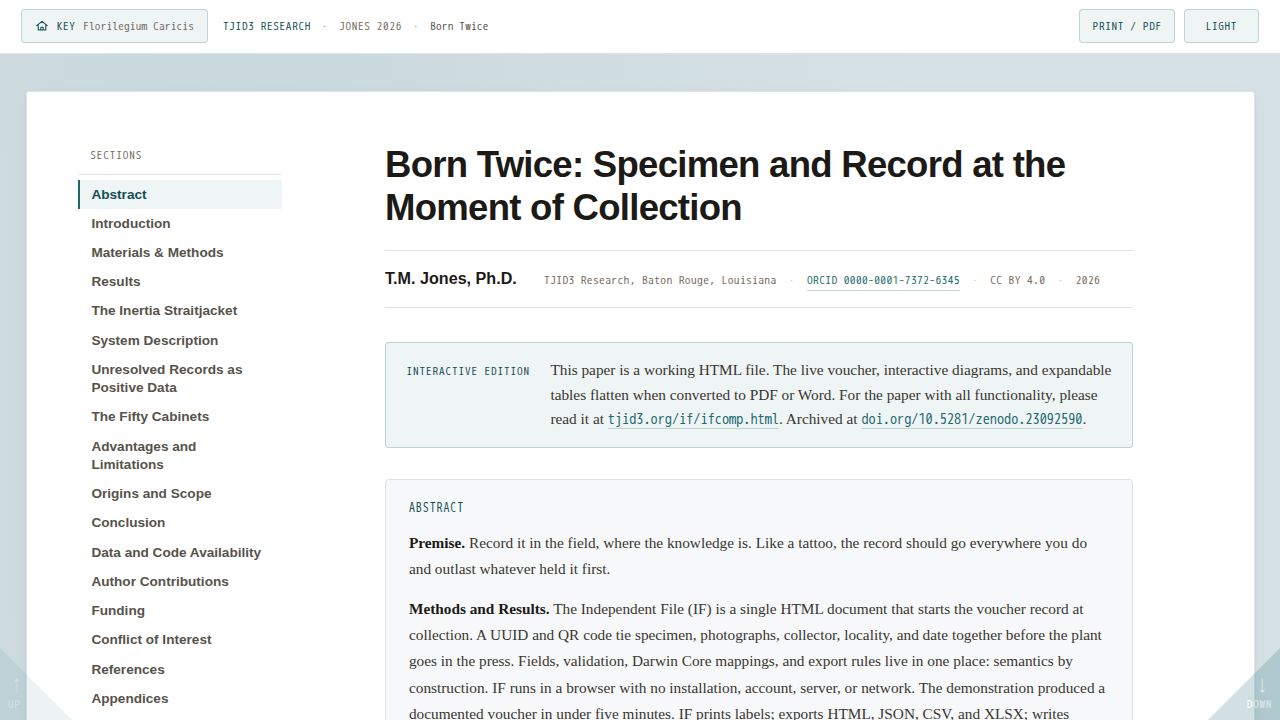
Screenshot of the source page (tjid3.org)
Sources
- Born Twice: Specimen and Record at the Moment of Collection
- Born Twice: Specimen and Record at the Moment of Collection