Strands Decider 2B is a 2‑billion‑parameter open‑source decision model released by Strands Agents. It starts from the Qwen3.5‑2B base model, removes the language model head that generates text, and replaces it with a pointer head that scores the hidden state of each answer option against a reference position. This architecture lets the model choose from a predefined set of alternatives and output a numerical confidence score rather than free‑form text.{primary}
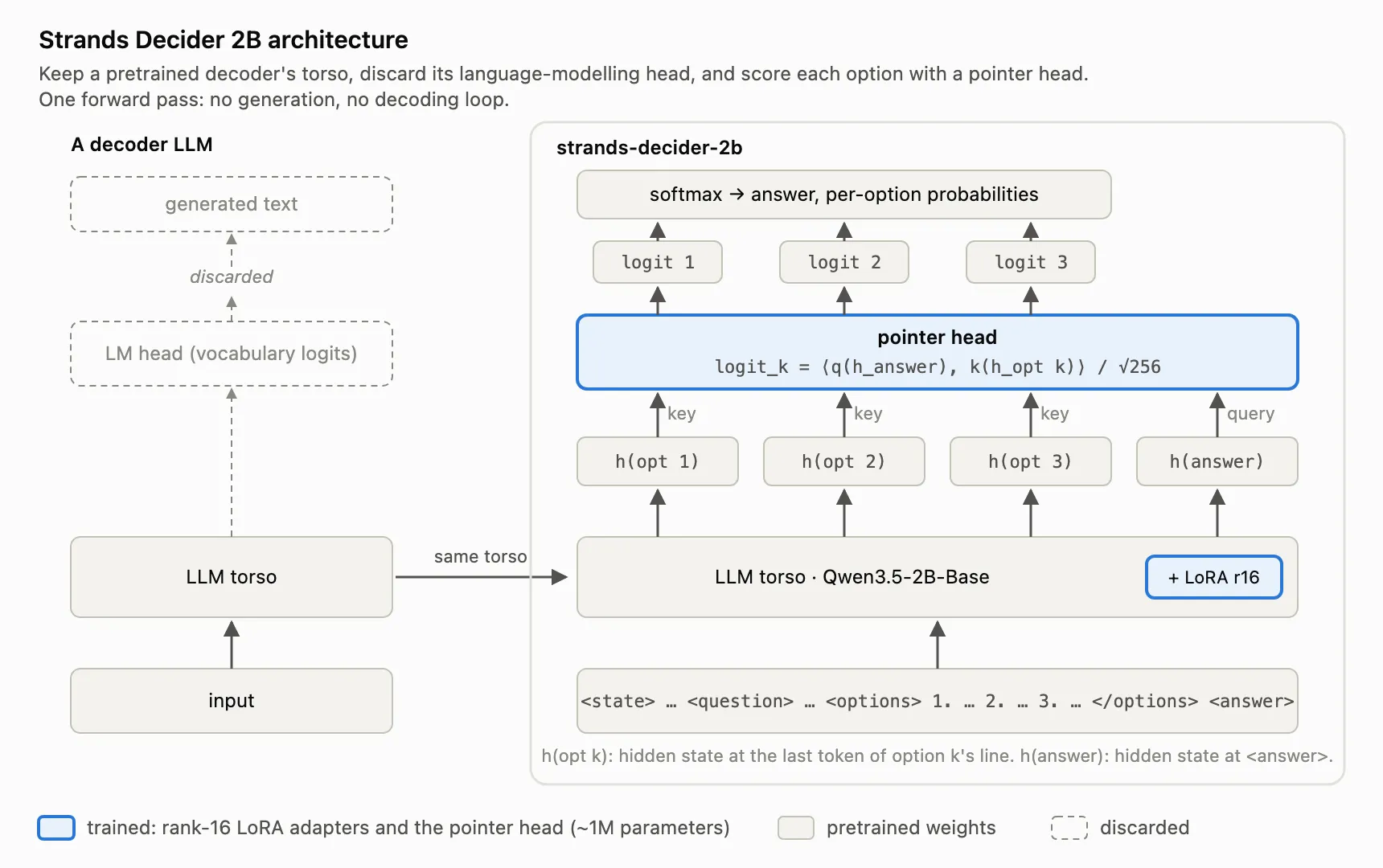
The article explains that Strands Decider 2B starts from Qwen3.5-2B base model, removes the language model head, and replaces it with a pointer head that scores answer options.
Because it is constrained to a fixed option set, Strands Decider 2B always returns an answer from those choices and can do so with very low latency—about 115 ms median on an RTX 3090 GPU and 153 ms on an M3 MacBook for small tasks, with latency growing roughly linearly with the number of tokens in the prompt.{primary} On the public JevBench benchmark the model ranks third among 33 decision models in the 2 B‑parameter class and first when excluding models just over 2 B, showing competitive accuracy and calibration.{primary} It also provides a reliability score that estimates confidence in its selection, a feature not typically exposed by standard LLM inference APIs.{primary} These properties make it suited for rapid decision‑driven tasks such as model routing, tool selection, guardrails, memory management, policy classification, and simple game or maze navigation.{primary} A community‑contributed WebGPU version quantizes the model to int4 and runs entirely in the browser; on a 27‑item benchmark it matches the PyTorch implementation’s top answer in every case, with a mean absolute probability error of only 0.019 due to quantization.{support-1}
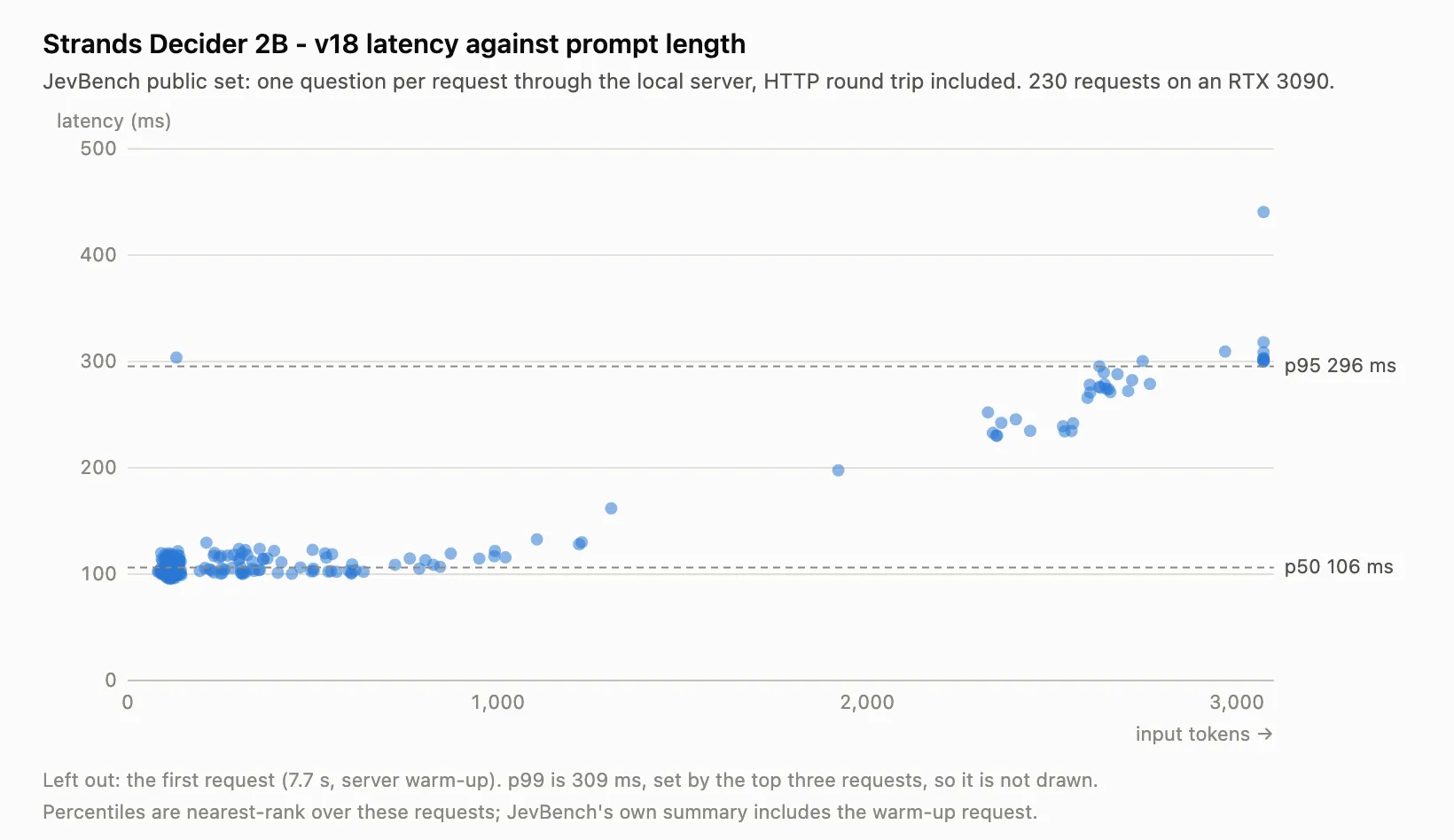
The article notes low latency of about 115 ms on RTX 3090 and 153 ms on M3 MacBook, growing roughly linearly with prompt tokens.
The trade‑off for this speed and deterministic output is reduced flexibility: decision models are significantly worse at solving complex problems than full LLMs and cannot generate text, so they are unsuited for chatbots, document summarization, coding, or other open‑ended LLM tasks.{primary} The model is released under an open‑source license with all training data, scripts, and weights available on GitHub and Hugging Face, enabling local experimentation on modest hardware.{primary} Developers can integrate Strands Decider 2B into agentic workflows using the provided CLI tool or Python examples, which show how to pass a state description and a list of choices to obtain both the selected option and its confidence score.{primary}
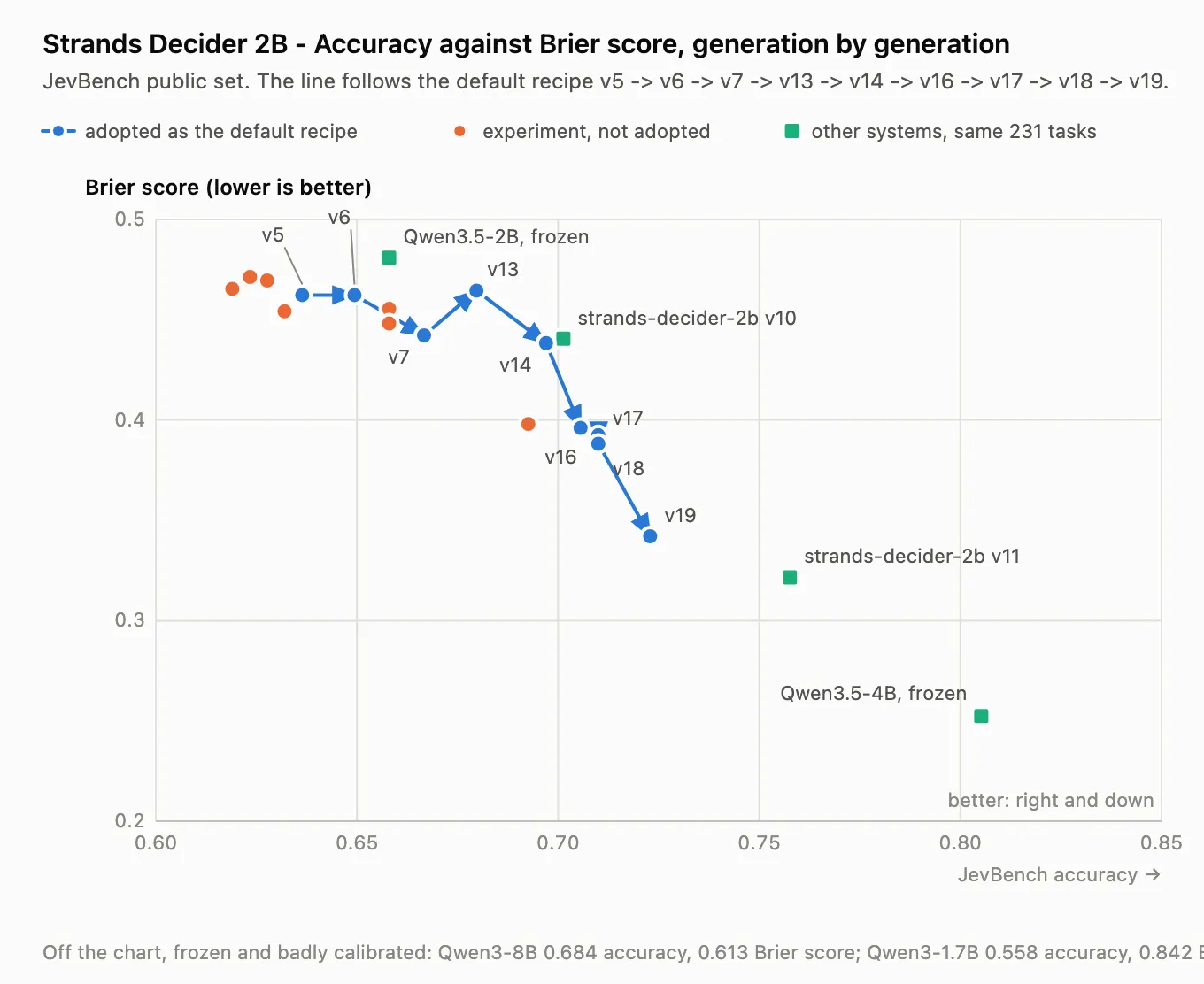
On JevBench benchmark the model ranks third among 2B parameter decision models and first when excluding slightly larger models, indicating strong accuracy and calibration.