The great dirhombicosidodecahedron, nicknamed "Miller's Monster" after J.C.P. Miller, is a degenerate nonconvex uniform polyhedron: a shape whose faces are all regular polygons and whose vertices are all identical under symmetry, but which is not convex. It has 124 faces — 40 triangles, 60 squares, and 24 pentagrams — plus 240 edges and 60 vertices. Wikipedia notes it was enumerated by Miller, H.S.M. Coxeter, and M.S. Longuet-Higgins in their 1954 paper "Uniform polyhedra" in Philosophical Transactions of the Royal Society of London.
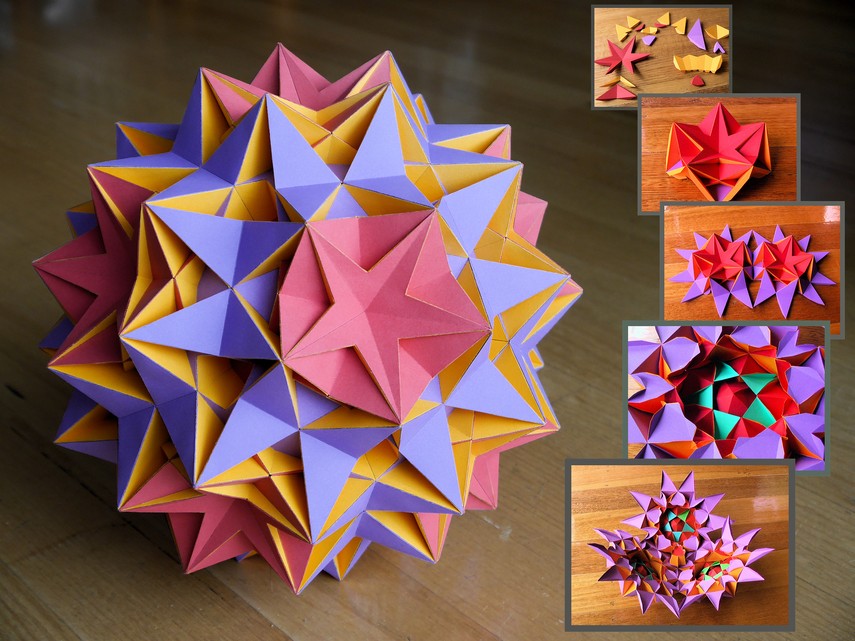
The great dirhombicosidodecahedron is a degenerate nonconvex uniform polyhedron with 124 faces, 240 edges, and 60 vertices. Robert Webb built this physical model after working with nets that filled 42 A4 pages, with the finished piece measuring approximately 21.6 cm in edge length and 30.6 cm in diameter.
What makes it exceptional among the uniform polyhedra: it is the only non-degenerate uniform polyhedron with more than six faces meeting at a single vertex — eight per vertex (two pentagrams, two triangles, four squares). It is also the only uniform polyhedron with snub faces other than triangles; its squares serve as snub faces. Every face occurs in a coplanar pair, and all 60 of its double-square facial planes pass through the center, classifying it as a hemipolyhedron. Unlike nearly all other uniform polyhedra, it cannot be constructed by the Wythoff construction (a method that builds uniform polyhedra from a spherical triangle); its Wythoff symbol | 3/2 5/3 3 5/2 relates it to a spherical quadrilateral instead.
Robert Webb, creator of the Stella software family, physically built the model. The software3d.com page reports the nets filled 42 A4 pages (10 red, 9 purple, 23 yellow), with a finished edge length of about 21.6 cm and diameter 30.6 cm. The build proceeded in stages: a starting core, red triangle pairs added around it, five subunits connected, then purple triangle pairs (the pentagram arms) added once the main structure was joined. Small retaining parts (20 of them) held everything together; internal green support pieces, generated by Stella's faceting mode, were not visible externally.

The construction proceeded in stages: a starting core, red triangle pairs added around it, five subunits connected, then purple triangle pairs (the pentagram arms) added once the main structure was joined. Small retaining parts held everything together, with internal green support pieces generated by Stella's faceting mode that are not visible externally.
A common point of confusion, reflected in reader questions, is the meaning of "uniform": a uniform polyhedron has regular polygon faces and is vertex-transitive, but that does not make the physical model visually straightforward — the nonconvexity and faces passing through the center mean the shape is hard to "read" in a photograph, which is presumably why the builder needed detailed staged instructions rather than working from the final image alone.

Every face occurs in a coplanar pair, and all 60 of its double-square facial planes pass through the center, classifying it as a hemipolyhedron. Unlike nearly all other uniform polyhedra, it cannot be constructed by the Wythoff construction, relating it to a spherical quadrilateral instead.