Mike Tomlin, who coached the Pittsburgh Steelers for 18 seasons and won Super Bowl XLIII, has unveiled a personal project that surprises even those familiar with his football resume: a massive, meticulously planned Minecraft city built over 12 years. The reveal came via a YouTube video in which Tomlin narrates a fly-through of the virtual metropolis, explaining design choices with the same measured cadence he once used for injury reports.
Tomlin, 54, stepped down as Steelers head coach after the 2025 season. He was the NFL's second-longest-tenured coach and never posted a losing season. During his tenure — spanning playoff runs, star-player departures, and mounting media pressure — he turned to Minecraft as a way to connect with his young children. What began as family time became a long-term creative pursuit.
"More than anything, it was therapeutic for me," Tomlin says in the video. The city grew alongside his coaching career, with construction continuing through periods of team turmoil: Le'Veon Bell's 2018 holdout, Antonio Brown's exit, and a nearly decade-long playoff victory drought.
The city is organized around a large central lake, a layout Tomlin compares to Pittsburgh's three rivers converging at Point State Park. "This is kind of where it all started, around this body of water," he says. From there, the urban landscape radiates outward.
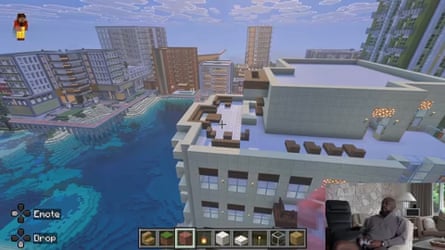
Tomlin compares the central lake to Pittsburgh's three rivers converging at Point State Park, noting the body of water as where the whole project started. From that hub the urban landscape radiates outward, anchoring the entire 12-year build.
The first structure Tomlin built, around 2014, was a boutique hotel with an executive spa, therapy rooms, and a multipurpose conference room with tall windows and a glass roof. "I was very lighting conscious," he explains. "You'll consciously see me do things with glass ceilings where appropriate." That attention to natural light recurs throughout the build.
Other landmarks include an aquarium-themed apartment highrise positioned across from a separately built aquarium (which Tomlin promises will be "crazy" in a future episode), an MLS stadium, and a baseball field nestled into the cityscape much like Pittsburgh's PNC Park. One highrise offers a direct view of the ballpark — Tomlin describes himself as "view-conscious" and takes visible pleasure in city vistas.
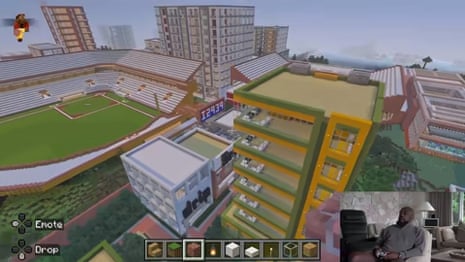
The city's landmarks include an aquarium-themed apartment highrise, an MLS stadium, and a baseball field positioned like Pittsburgh's PNC Park. One highrise even offers a direct view of the ballpark, reflecting Tomlin's self-described view-conscious approach to the layout.
Practical infrastructure isn't overlooked. Tomlin notes his fixation on bedroom details and his commitment to providing an "appropriate number of public restrooms" in office and multipurpose spaces — a pragmatic touch he frames as the urban-planning equivalent of valuing offensive linemen alongside star receivers.
Personal touches dot the map. A collegiate apartment complex named "The View" echoes a real complex in College Park, Maryland, where Tomlin's son Dino — a former college wide receiver and the video's producer — began his college career.
The project's creation method adds another layer of dedication: Tomlin built the entire city using a controller with slow sensitivity settings, which his son estimates doubled the time required compared to keyboard-and-mouse play.
Public reaction has been overwhelmingly positive. Viewers found it refreshing that a high-profile coach in one of America's most pressure-intensive jobs would sustain a hobby this creative and patient. A minority response, including one self-described chief economist, questioned whether the time spent represented misplaced ambition — a critique the Guardian piece characterizes as bizarre given Tomlin's established professional achievements.
The video suggests more episodes are coming, including the promised aquarium tour. For now, the city stands as an unusual intersection of elite sports leadership and patient, block-by-block world-building — a reminder that creative outlets need not have an end goal to be meaningful.