The Bloomberg Terminal began as the Market Master terminal created by Innovative Market Systems (IMS), a company founded in 1981 after Michael Bloomberg left Salomon Brothers with a $10 million equity payout and partners Thomas Secunda, Duncan MacMillan and Charles Zegar. IMS’s first product combined a monochrome CRT monitor, a custom keyboard and a controller that linked to a private data network, delivering U.S. government bond prices and basic bond‑calculation tools. In 1982 the first 22 units were shipped to Merrill Lynch during a global recession, giving traders a dedicated tool for analyzing volatile interest‑rate markets. Merrill Lynch invested $30 million for a 30 percent stake and waived its exclusive rights in 1984, allowing broader distribution.
Over the next decade the terminal’s interface was refined for traders. The original “Chiclet” keyboard featured color‑coded function keys labeled for specific financial tasks, eliminating the need to memorize commands. Around 1990 a trackball was added to navigate multiple windows, and two years later the keyboard gained a built‑in speaker together with telephone, headphone and microphone jacks to support multimedia. A signature feature, Instant Bloomberg, let users chat directly over the proprietary network. By 1996 the keyboards supported 23 languages, and in the early 2000s biometric login via fingerprint readers appeared. Beyond hardware, Bloomberg launched its own news service in 1990, recruiting Matthew Winkler of the Wall Street Journal to lead a team whose stories and charts advertised the terminal’s analytical power; this eventually grew into Bloomberg Businessweek, Bloomberg Radio and Bloomberg Television. Subscription pricing reflected the system’s value: a single terminal leased for $1,600 per month in 1999 with a two‑year contract, while today the annual cost exceeds $32,000. In 1995 Bloomberg introduced “Open Bloomberg” software that ran on customers’ PCs, and by the early 2000s the company stopped leasing dedicated terminals, shifting to mobile applications so the term now denotes the integrated suite of data, analytics, news, communications and trading tools.

Illustrates the hardware evolution described in the article, specifically the Chiclet keyboard with color-coded keys and added speaker for multimedia functions.
Although the shift away from dedicated terminals was a logical response to the rise of the internet and publicly available market data, earlier electronic financial information systems laid groundwork. In the mid‑1970s the Reuters Monitor terminal was built around Digital Equipment Corporation PDP‑8 minicomputers, using wire‑wrapped processor boards, custom display‑sync generators and parallel ports for keyboards and modems. These units delivered real‑time market data over private links, illustrating how firms were already moving from ticker‑tape and telephone quotes to computer‑based displays before Bloomberg’s entry. The Reuters Monitor’s heavy, unreliable PDP‑8 hardware prompted an internal effort to replace it with an Intel‑based prototype, a precursor to the kind of integrated, proprietary hardware Bloomberg would later perfect. Retired Bloomberg Terminals have become museum pieces, such as the Bond King Bill Gross keyboard in the Smithsonian’s National Museum of American History, which bears his login and password taped to the front, embodying the blend of network infrastructure, mathematical calculation and financial‑market culture that the platform helped spread across global trading floors.
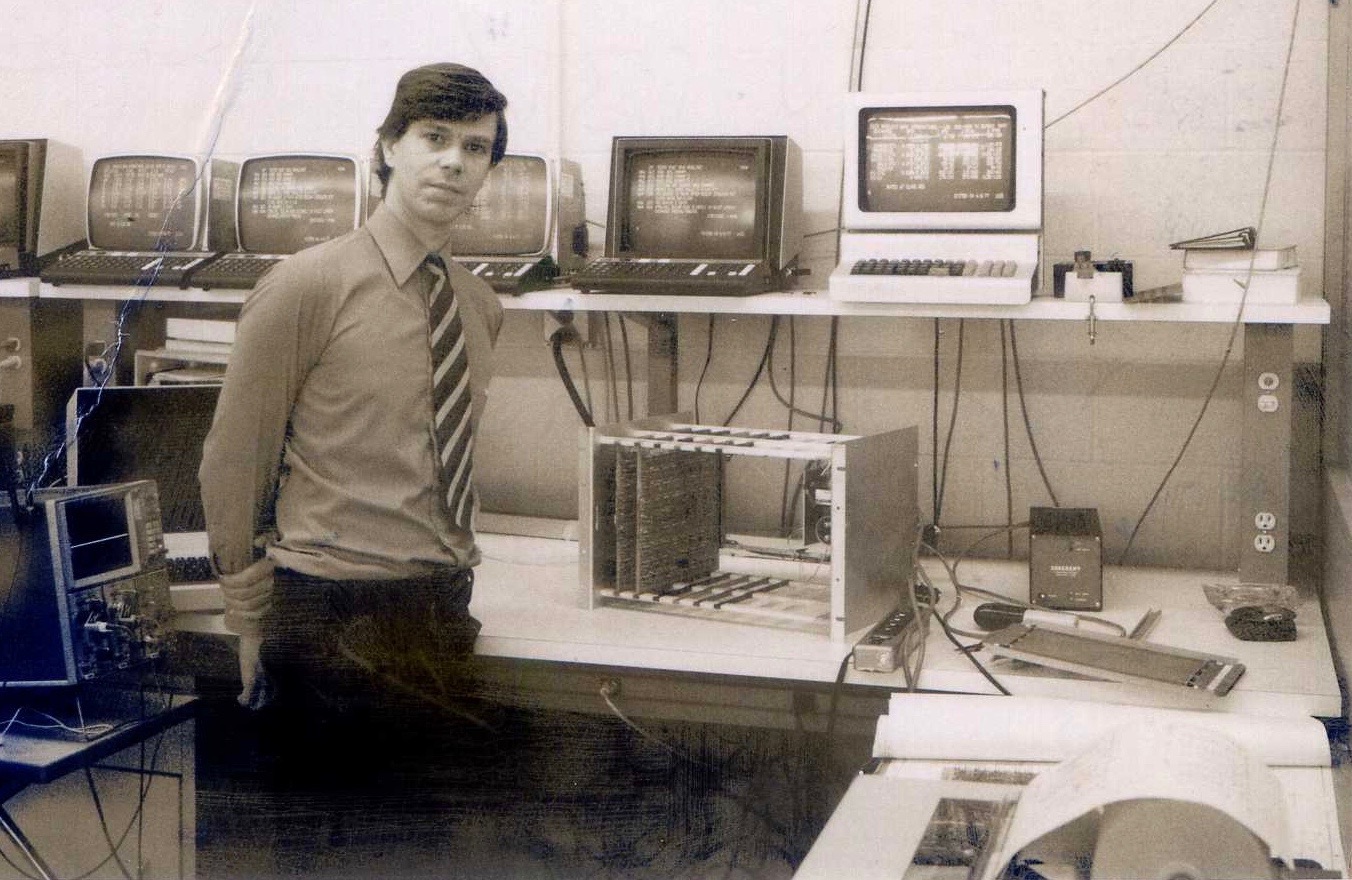
Shows the early electronic financial information system referenced in the article as groundwork for later Bloomberg Terminal development.