OpenArm is a 7-degree-of-freedom (7DOF) humanoid arm released as open-source hardware and software by the Enactic project. It is designed for physical AI research—particularly tasks involving contact, such as manipulation—where safe human-robot interaction matters. The arm emphasizes backdrivability and compliance, meaning it can be moved by hand and yields under force, rather than resisting rigidly.
A complete bimanual (two‑arm) system is priced at $6,500 USD and is available assembled or DIY through verified manufacturers. Each arm offers a 633 mm reach, 4.1–6 kg peak payload, and ±0.2 mm precision over a CAN‑FD control bus running on 24/48 V DC with Linux-supported software in Python, Rust, and C++.
The project ships nine repositories covering the full stack: mechanical CAD (STL, STEP, Fusion 360 files), robot description for simulation (URDF/xacro), low‑level CAN motor control, ROS2 integration nodes, unilateral and bilateral teleoperation packages, Isaac Lab training tasks, MuJoCo specification files and assets, a dataset format with recording tools and Python API, and Dora dataflow nodes for data collection and inference. A standardized "OpenArm Cell" environment—fixed background, lighting, and camera placement—aims to let labs worldwide reproduce evaluations under consistent conditions.
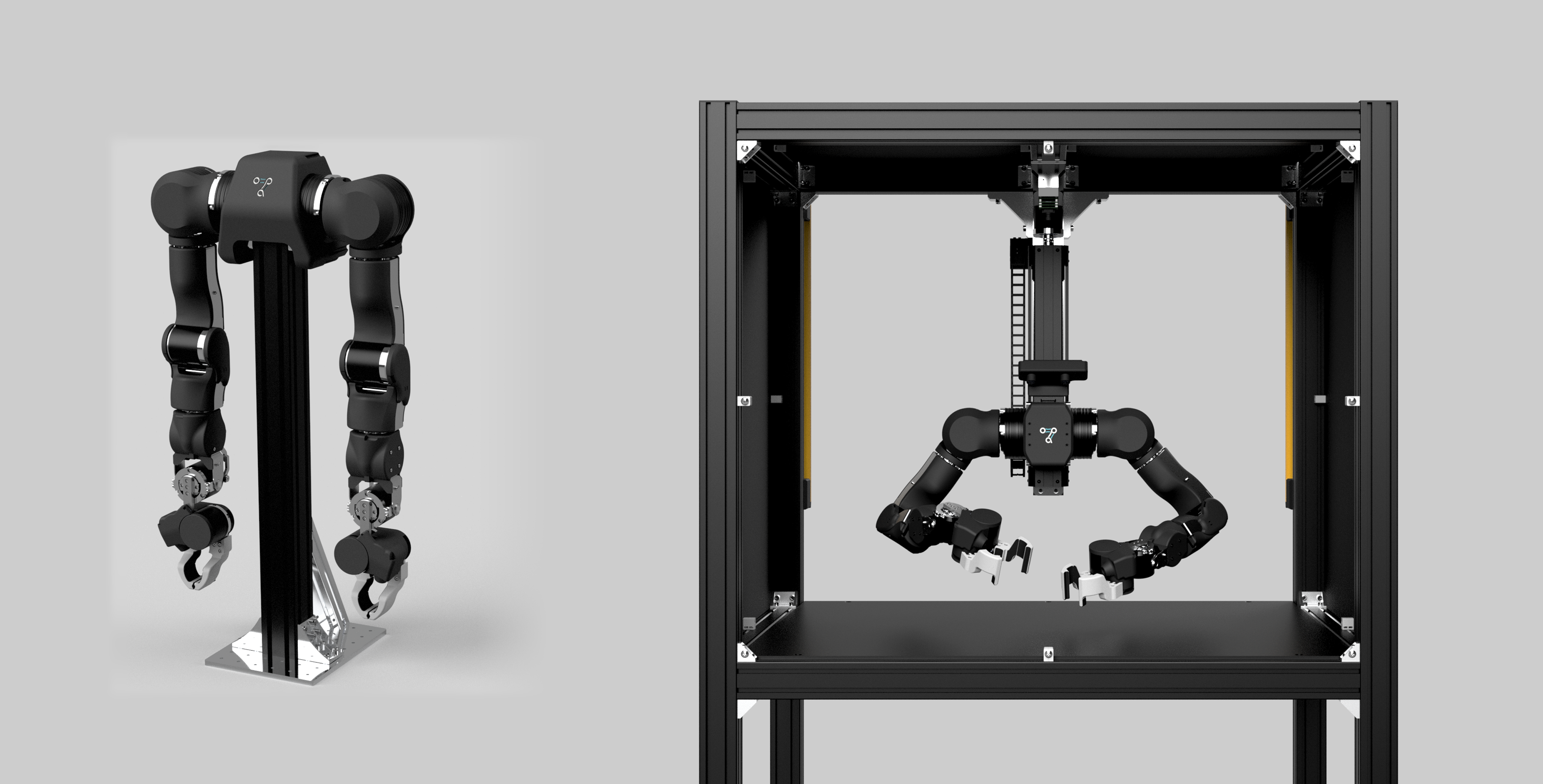
The article describes the OpenArm Cell—a fixed background, lighting, and camera setup designed for consistent lab-to-lab evaluations; this photograph shows the arm in that environment.
What the sources do not clarify is how much autonomous capability exists today versus teleoperated demonstration. The project's own materials highlight teleoperation and imitation learning as primary use cases; the supplied page does not report autonomous‑task success rates or real‑world deployment results. The practical "killer app" also remains unclear: contact‑rich research tasks are the stated focus, but concrete benchmarks against other 7DOF arms are not supplied in the packet. Reproducibility of results across labs is a stated goal, but independent verification is not yet available from these sources.
OpenArm is licensed under CERN‑OHL‑S‑2.0 for hardware and Apache‑2.0 for software, and governed by a Code of Conduct. The project is actively seeking contributors and research partners.