A new kind of language model entered public view in mid-September 2026 when TypeSafe AI announced Jev, the first release in what the company calls its "System One" model family. Jev does not chat, write code, or generate open-ended text. Instead, it takes unstructured input—documents, messages, program state—and returns typed, probabilistic decisions: classifications, scores, routing choices, extractions. Its creators position it as the "ChatGPT moment for classification": a single, general-purpose model that can cheaply handle diverse classification tasks without the per-task fine-tuning that has long been standard practice.
The release arrives alongside a technical retrospective by Sebastian Raschka that walks through the history of text classification—from bag-of-words and naive Bayes through recurrent and convolutional neural networks to modern transformers—to frame what Jev changes and what it does not.
## From bag-of-words to calibrated decisions
Raschka's article begins with the bag-of-words era, where texts were reduced to fixed-size word-count vectors fed into naive Bayes, logistic regression, or XGBoost. The approach is fast and interpretable but discards word order: "the dog bites the man" and "the man bites the dog" become identical vectors. N-grams can recover some local structure at the cost of vocabulary explosion.
Deep learning introduced word embeddings—dense vectors representing individual words—enabling recurrent neural networks (RNNs) and convolutional neural networks (CNNs) to model sequence and local context. RNNs process tokens step by step, maintaining a hidden state that summarizes history; LSTMs and GRUs added gating to mitigate vanishing gradients. CNNs slide learned filters over windows of adjacent embeddings, then pool to fixed-length representations. Both architectures preceded transformers but were harder to train and less parallelizable.
The 2018 ULMFiT paper demonstrated that pre-training an RNN on large corpora then fine-tuning could reach 95.4% accuracy on the IMDb sentiment benchmark, far above the 85.7% of a from-scratch LSTM and the 89.9% of bag-of-words logistic regression. Transfer learning became the dominant paradigm, culminating in transformer-based models like BERT and the GPT series.
## What Jev does differently
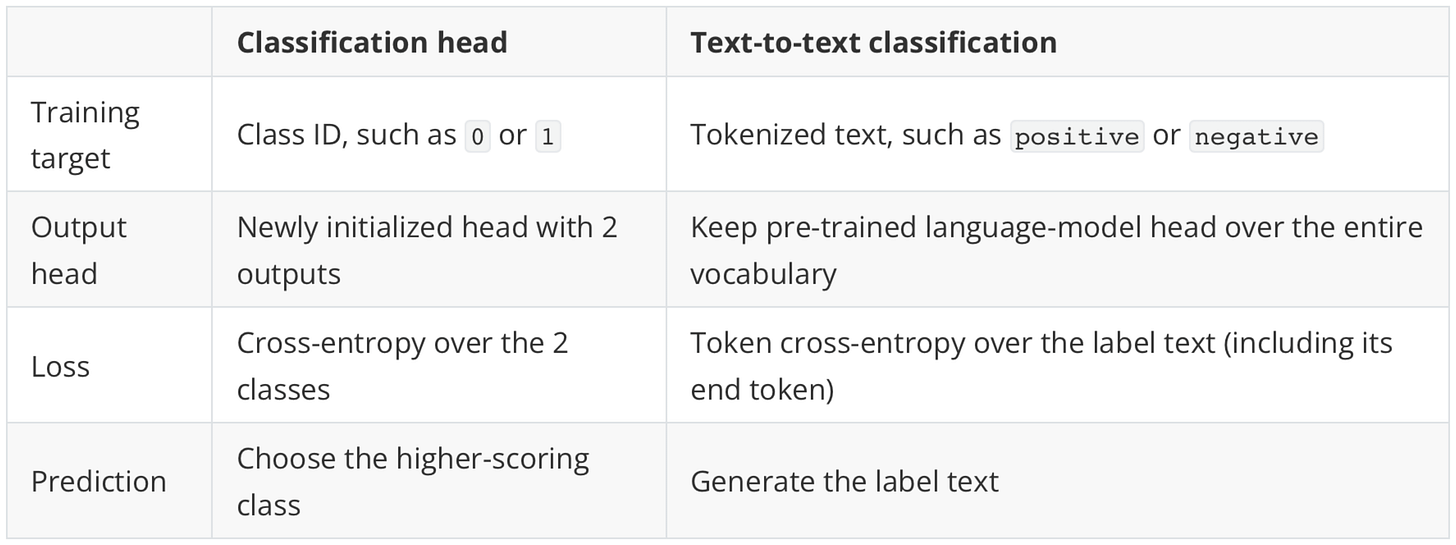
TypeSafe's announcement frames Jev as a departure from the LLM paradigm in several dimensions, starting with its output space: Jev emits structured, type-safe values—classes, scores, boolean flags—defined in advance. It cannot produce free-form strings, which eliminates hallucination and parsing failures by construction.
TypeSafe's announcement frames Jev as a departure from the LLM paradigm in several dimensions:
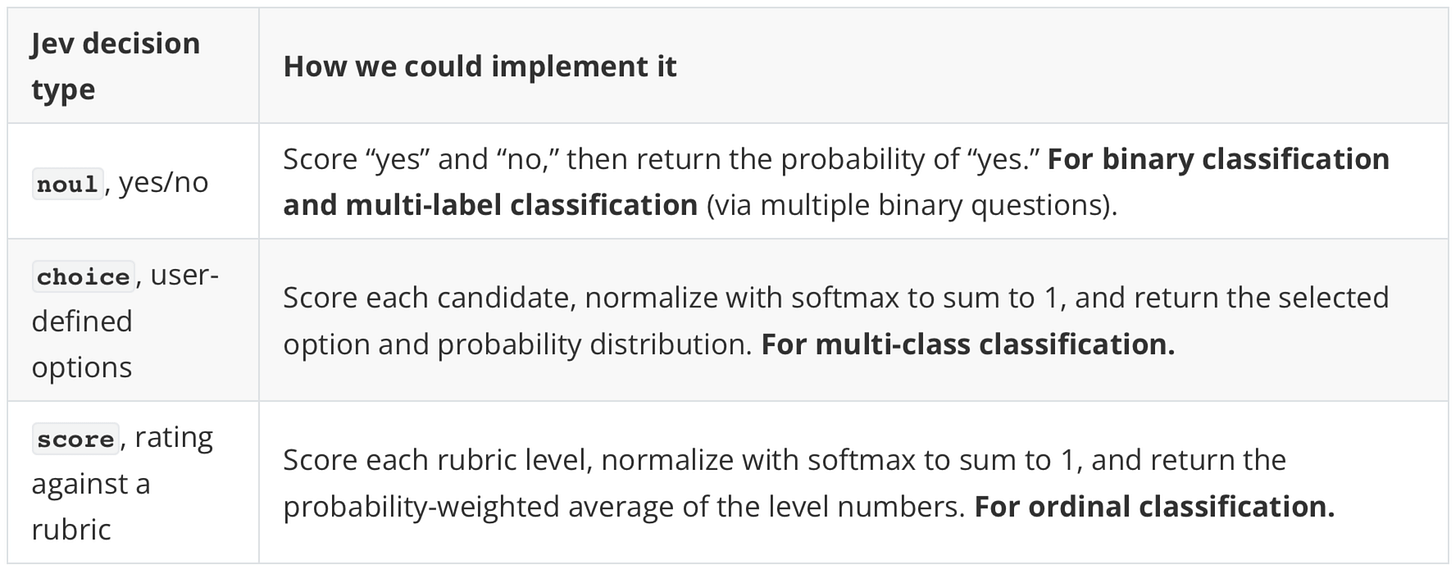
Where LLMs generate tokens sequentially (3–329 seconds end-to-end for frontier models), Jev computes all output probabilities in parallel, completing in 70–500 milliseconds. Its input tokens cost $0.042 per million versus $0.20–$10 for LLMs, and output tokens are described as too cheap to meter because the model does not generate variable-length sequences.
- **Output space**: Jev emits structured, type-safe values—classes, scores, boolean flags—defined in advance. It cannot produce free-form strings, which eliminates hallucination and parsing failures by construction. - **Sampling**: Where LLMs generate tokens sequentially (3–329 seconds end-to-end for frontier models), Jev computes all output probabilities in parallel, completing in 70–500 milliseconds. - **Training objective**: Instead of Reinforcement Learning from Human Feedback (RLHF) or Verifiable Rewards (RLVR), TypeSafe developed Reinforcement Learning for Calibrated Decisions (RLCD). The goal is "epistemically honest probabilities": when Jev assigns 90% confidence, it should be correct roughly 90% of the time, and similar inputs should yield similar confidence distributions. - **Economics**: Input tokens cost $0.042 per million (versus $0.20–$10 for LLMs); output tokens are described as "too cheap to meter" because the model does not generate variable-length sequences.
Raschka notes that Jev sits between two extremes: general-purpose LLMs that can classify but are slow and expensive, and narrow specialist classifiers that are faster and cheaper for a single task but lack generality. Jev's pitch is breadth at speed—one model for routing, scoring, extraction, guardrail checks, and real-time decision branches.
## Calibration as the automation enabler
The calibration claim is central to the automation argument. Conventional LLMs, even when prompted for confidence, tend to be overconfident and inconsistent. If a model succeeds 95% of the time but cannot signal which 5% it will fail, downstream software cannot safely act on its output without human review. Jev's RLCD training explicitly optimizes for reliability of the reported probabilities, not just top-1 accuracy.
TypeSafe's side-by-side demo illustrates the architectural difference: Jev returns a full probability distribution over predefined keys in a single forward pass, while an LLM would generate a JSON object token by token. The parallel design also means latency scales with model size, not output length.
## Scope and limitations
Both sources are careful about boundaries. Raschka emphasizes that for a narrow, well-defined problem, a special-purpose classifier will likely beat Jev on accuracy, speed, and cost. Jev's value is generality: "far more general than those task-specific models." TypeSafe acknowledges that long-term pricing sustainability remains unproven and that published latency numbers come from West Coast laptops hitting their current service region.
The model is in early access. No independent benchmarks or third-party evaluations were supplied in the source packet. The arXiv reference (Raschka, 2014) provides historical context on naive Bayes but does not bearing on Jev's performance.
## Why the technical community is reacting
The discussion cue attached to the Hacker News submission captures a recurring theme: developers who have spent years building per-task classifiers see in Jev a potential inflection point—one model, no fine-tuning, immediate structured output. The analogy to ChatGPT's impact on text generation is explicit: a general-purpose tool that removes the bespoke engineering step for a broad class of problems.
Whether Jev delivers on that promise at scale remains to be validated. But the architectural choices—parallel structured output, calibrated probabilities, fixed-schema decisions—represent a coherent alternative to the dominant LLM paradigm for the subset of AI workloads that are fundamentally classification-shaped.