Throughout the second quarter of 2026, Backblaze monitored 359,101 drives used for customer data storage. After removing 3,881 boot drives and 705 drives that did not meet minimum population or runtime thresholds, 354,415 drives remained for the quarterly analysis. These drives accumulated 31.6 million drive-days and suffered 1,498 failures, yielding an aggregated annualized failure rate (AFR) of 1.73%. The company noted this is "the highest it's been in quite a while" and provided a quarter-over-quarter chart showing a steady upward trend.
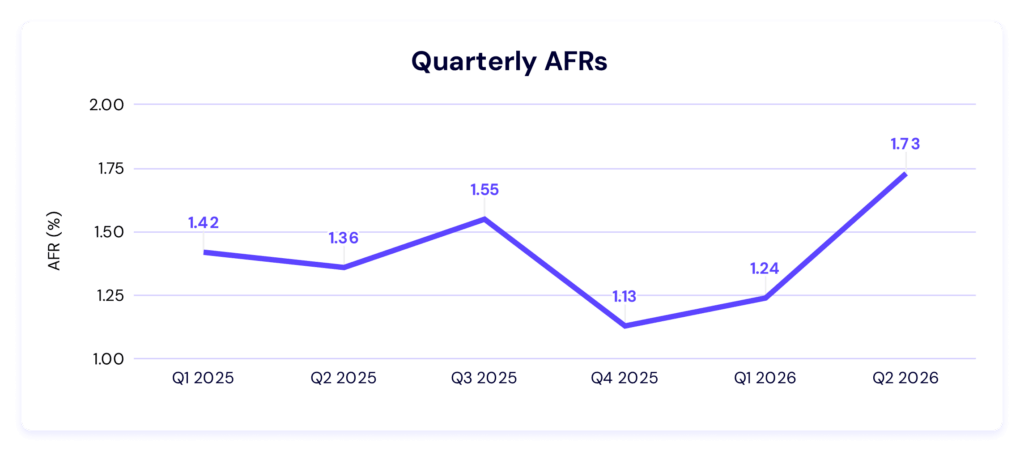
The article opens by noting the quarterly AFR rose to 1.73% and mentions a quarter-over-quarter chart showing a steady upward trend; this chart visualizes that trajectory.
A structural shift in the fleet underlies much of the change. Drives of 20 TB and larger now account for more than one-quarter of all drives in the dataset, and new deployments continue to concentrate at the high-capacity end. In Q2 2026, Backblaze added roughly 10,220 drives, of which 9,404 were 20 TB or above. Those newer, larger drives as a group posted an AFR of just 0.85%, but the aging tail of the fleet—particularly models approaching seven to nine years of service—pulls the overall average upward.
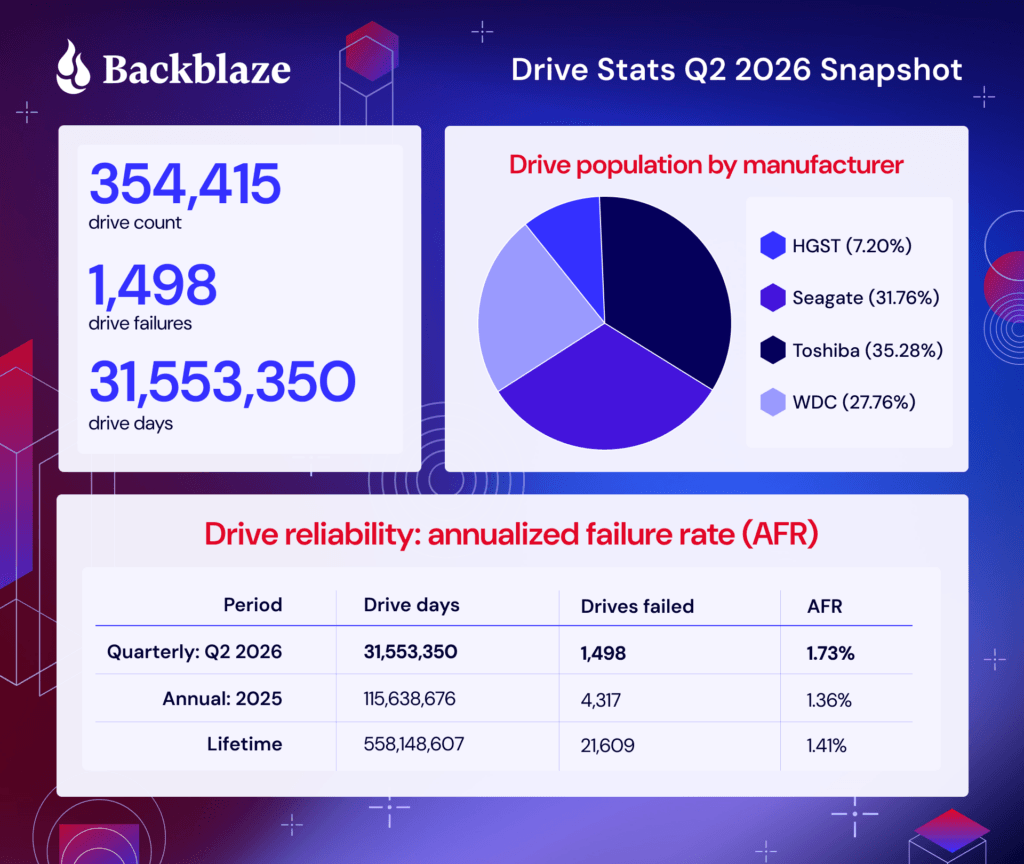
After the opening discussion of the 354,415-drive fleet and 1,498 failures, this infographic provides a visual summary of the report's central statistics.
Three models stood out as statistical outliers using a quartile-based threshold of 6.95% AFR: the HGST HUH721212ALN604 (12 TB) at 7.63%, the Seagate ST10000NM0086 (10 TB) at 9.33%, and the Seagate ST14000NM0138 (14 TB) at 8.26%. In each case, the elevated rate reflects a combination of advanced age (the HGST model is nearly seven years old; the 10 TB Seagate about 8.5 years) and relatively small population sizes (965 and 1,235 drives respectively), which amplify the impact of each failure. Ten of the 31 qualified models exceeded a 3.0% AFR this quarter, a higher proportion than in recent periods.
On the positive side, Seagate claimed the entire zero-failure honor roll: the 8 TB ST8000NM000A, the 12 TB ST12000NM000J, and the 14 TB ST14000NM000J recorded no failures in Q2. The 16 TB ST16000NM000J logged a single failure. Two long-serving models fully retired this quarter—the 4 TB HGST HMS5C4040BLE640 at nearly nine years and the 8 TB HGST HUH728080ALE600 at nearly eight years—both having reached the end of their operational lives.
The lifetime AFR across the fleet ticked up slightly to 1.41%, from 1.24% in the prior quarter. Four newer high-capacity Seagate models (ST8000NM000A, ST14000NM000J, ST16000NM000J, ST16000NM002J) did not yet meet the 500-drive / 100,000-drive-day threshold for lifetime reporting, though the first three also appeared on the zero-failure quarterly list.
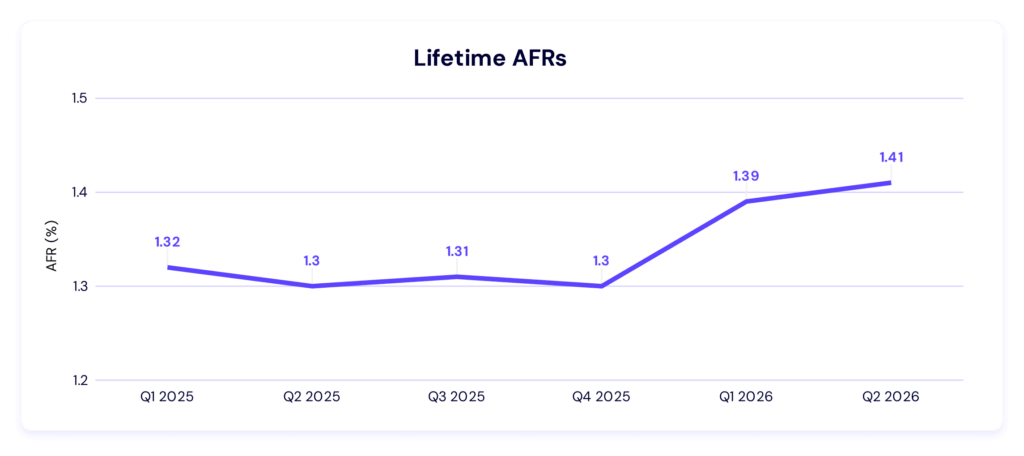
Paragraph 5 discusses the lifetime AFR increase and notes four newer high-capacity Seagate models had not yet met lifetime reporting thresholds; this chart illustrates the lifetime trend.
The report devotes significant space to explaining how recording technology is evolving. Conventional Magnetic Recording (CMR) writes tracks side-by-side with guard bands. Shingled Magnetic Recording (SMR) overlaps tracks like roof shingles, yielding roughly 10–25% more capacity per platter. The trade-off is that random rewrites may require reorganizing an entire band or zone, making workload shape a critical factor. SMR comes in three flavors: drive-managed (firmware handles placement, appears as a normal block device), host-managed (the OS or application writes sequentially to designated zones), and host-aware (a hybrid). Heat-Assisted Magnetic Recording (HAMR) uses a laser to briefly heat a microscopic spot, enabling smaller, more stable magnetic grains; it can be combined with SMR. Western Digital has announced a 40 TB UltraSMR drive with a roadmap targeting 100 TB by 2029.
For data-center operators, the shift toward SMR and HAMR means drive qualification becomes less a simple swap and more a project involving sustained write behavior, rebuild performance, erasure-coding overhead, firmware maturity, and storage-software compatibility. Backblaze notes there are currently no SMR drives in its fleet, but the industry trajectory suggests that will change.
Historical context from long-time observers shows a striking extension of drive useful life: in 2013 the fleet hit ~14% cumulative failure at roughly 3.25 years; by 2021 that milestone moved to ~7.75 years; and in 2025 the failure rate was only ~5% at 10.25 years. This trend reflects steady improvements in manufacturing and firmware, even as capacities have multiplied. However, the current quarter's rising AFR reminds operators that aging drives still dominate the failure statistics, and the growing share of ultra-high-capacity drives introduces new operational considerations—particularly rebuild times that can stretch to days for the largest volumes, affecting RAID resilience and recovery planning.
What remains uncertain is whether the quarterly AFR increase represents a temporary bulge from the aging cohort or the start of a sustained uptick as the fleet transitions to newer recording technologies. Backblaze's dataset, published in full for download, will continue to provide the ground truth for that question.