Western European heraldry treats a coat of arms as a structured description that can be turned into an image. A blazon such as “Azure, a lion rampant Or” specifies the field’s tincture, the charge, its motif and attitude in a precise vocabulary, allowing a generator to first produce a valid textual description and then hand it to a renderer. This makes the generative process analogous to producing a sentence in a constrained language, where the abstract blazon holds the identity and different renderings remain recognizable as the same arms【primary】.

Illustrates the blazon example given in the article, showing how a textual description translates to a visual coat of arms.
Japanese mon, by contrast, lack an equivalent to blazon; they are identified primarily by the visual arrangement of stylized motifs. A mon such as the Tokugawa mitsuba aoi is defined not by a verbal description but by the geometric relationship of three hollyhock leaves rotated around a central point, suggesting a generator that works directly with graphical primitives—duplicating a base shape, rotating, scaling, and enclosing the result【primary】. Because the identity resides in the visual composition rather than a textual blazon, the procedural model for mon resembles a scene graph more than an abstract syntax tree.

Shows the specific mon mentioned in the article, defined by the geometric relationship of three hollyhock leaves rotated around a central point.
The usefulness of either tradition lies not in the raw symbols but in the rules that govern their combination. In Western heraldry, the rule of tincture discourages placing a metal on a metal or a color on a color, ensuring strong contrast; a generator that independently chooses field and charge tinctures would frequently violate this convention unless it makes the choice conditional on the field【primary】. Similarly, mon impose constraints on symmetry, repetition, enclosure, and negative space; simply pasting a motif repeatedly onto a circle does not produce a convincing mon unless the generator respects those spatial and compositional rules【primary】.
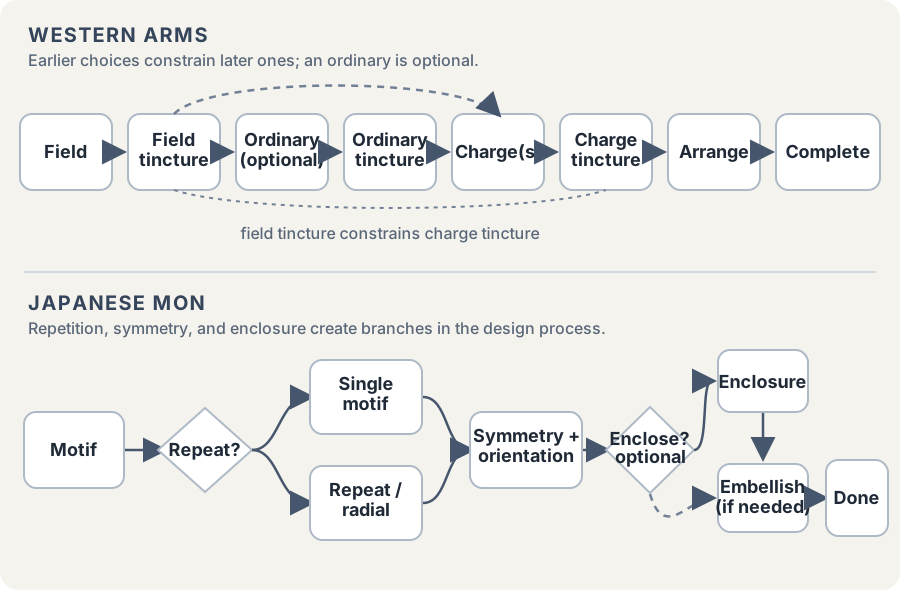
Depicts the procedural generation steps described in the article, including how Western heraldry enforces the rule of tincture and how mon generation considers symmetry and enclosure.
Historical practice shows that even well‑established rules have exceptions, and a generator must decide whether to model the idealized grammar or the attested corpus. The arms of the Kingdom of Jerusalem, which place gold crosses on a silver field (metal on metal), illustrate a deliberate exception to the rule of tincture that reflects historical usage rather than an error【primary】. For mon, the historical record shows variation in how motifs are combined, simplified, or used across related groups, indicating that a clean taxonomy cannot capture all attested forms【support-1】. A practical solution is to separate grammar—the set of normal generative operations—from corpus—the collection of historically documented examples that may lie outside the grammar—allowing the software to generate typical designs while acknowledging exceptional specimens【primary】.

Illustrates the historical exception to the rule of tincture mentioned in the article, where metal is placed on metal.