OpenSpec is a spec-driven development (SDD) framework designed to keep AI coding assistants aligned with human-intended requirements. Rather than prompting an agent directly, a developer writes specifications in plain Markdown — requirements with concrete scenarios — then runs slash commands that guide the assistant through exploring the codebase, proposing a plan, implementing tasks, and verifying the result against the spec. The project, published by Fission-AI under an MIT license (current version v1.13.0), reports 68.0k GitHub stars and roughly 265,000 monthly developers.
The OpenSpec framework overview from openspec.dev presents the project's branding and adoption indicators, corresponding to the introduction of the SDD framework, its plain Markdown approach, and the reported 68.0k GitHub stars and 265,000 monthly developers
The workflow centers on five commands: /opsx:explore maps a problem before committing to a plan; /opsx:propose generates proposal.md, specs/, design.md, and tasks.md; /opsx:apply implements the tasks; /opsx:verify checks code against the spec; and /opsx:archive closes completed changes. Specs are deliberately plain Markdown — no custom syntax — and the framework ships with profiles for Claude Code, Codex, Cursor, GitHub Copilot, Gemini CLI, and roughly 30 other tools.
GitHub OpenGraph image for the Fission-AI/OpenSpec repository displaying the project description as a spec-driven development framework for AI coding assistants, aligning with the five-command explore-propose-apply-verify-archive workflow and 30+ compatible tool profiles discussed in this paragraph
A newer feature, "Stores," is in beta and attempts to solve a cross-team problem: a platform team owns shared requirements in a dedicated repo, and product teams reference them read-only from their own coding-agent workflows. The idea is that specifications become a first-class git artifact rather than a drifting wiki.
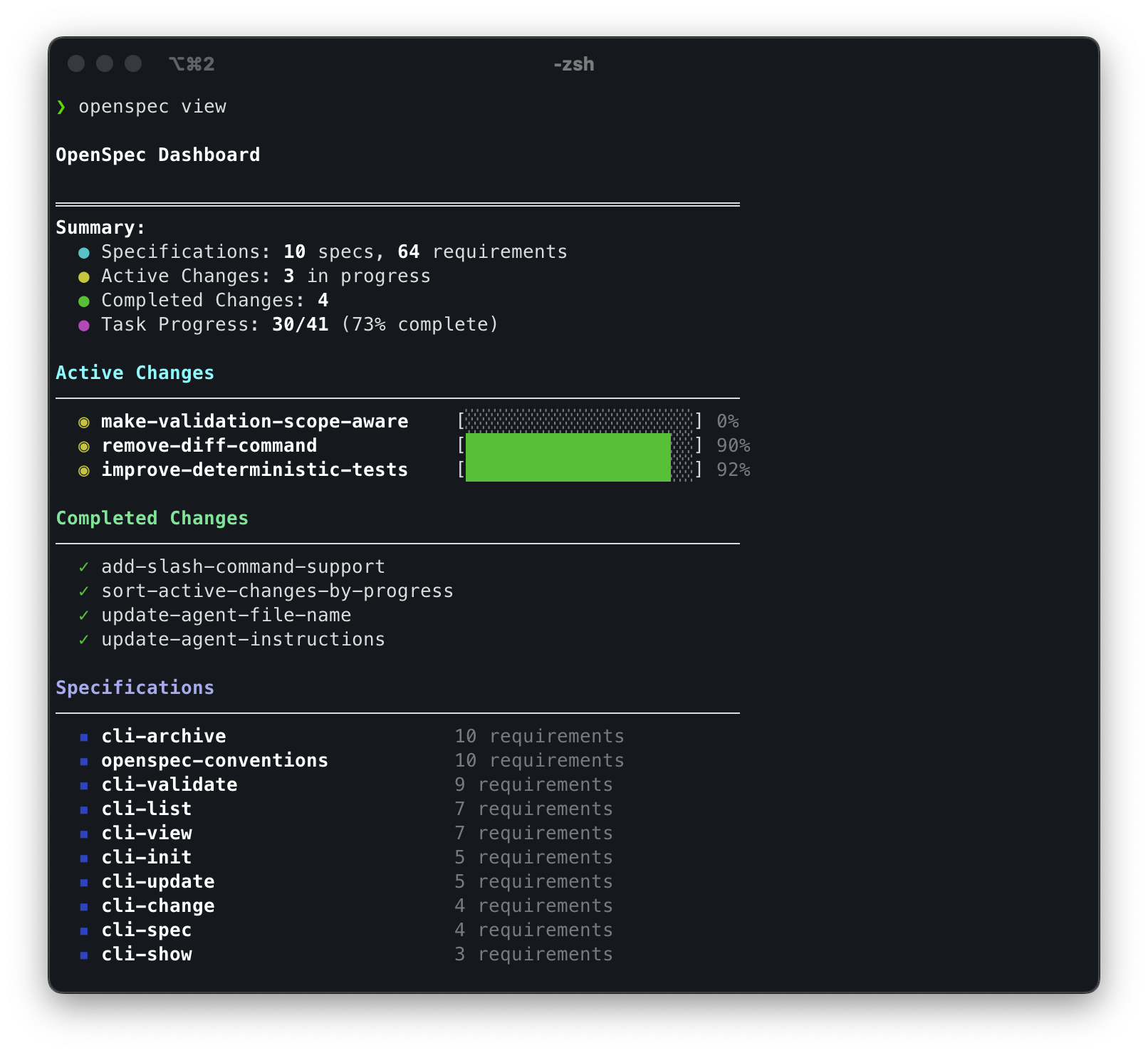
Dashboard preview from the OpenSpec repository showing the spec management workspace, illustrating the kind of interface that supports the beta Stores feature for cross-team specification sharing discussed in this paragraph
However, the supplied discussion raises a durability concern. One experienced user reports that after six to nine months on two solo projects, the specs diverged so far from the actual code that they abandoned the specification layer entirely, retaining only the proposal-review-implement-review process. This echoes a broader observation: in long-lived, multi-developer codebases, spec rot can outweigh the planning benefit. The project's own documentation does not include independent benchmarks or drift measurements, so the quantitative claims (specs per second, star count) should be read as self-reported adoption signals rather than verified efficacy data. The "Stores" feature is also still in beta, and its real-world reliability at scale is not yet established by the supplied sources.