Nike's 18-year run in the S&P 100 has ended. The athletic wear giant will be removed from the benchmark index on September 21, 2026, S&P Dow Jones Indices confirmed, after failing to meet the index's market-capitalization thresholds.
The index reshuffling follows a catastrophic decline that has erased more than $200 billion from Nike's market valuation since its all-time high of $264 billion in November 2021. At current trading around $38 per share, Nike's market capitalization stands at approximately $57 billion—a 78 percent drop from its peak. The company's $53.03 billion market cap as of September 25, 2026, places it as the world's 467th most valuable company by this measure.
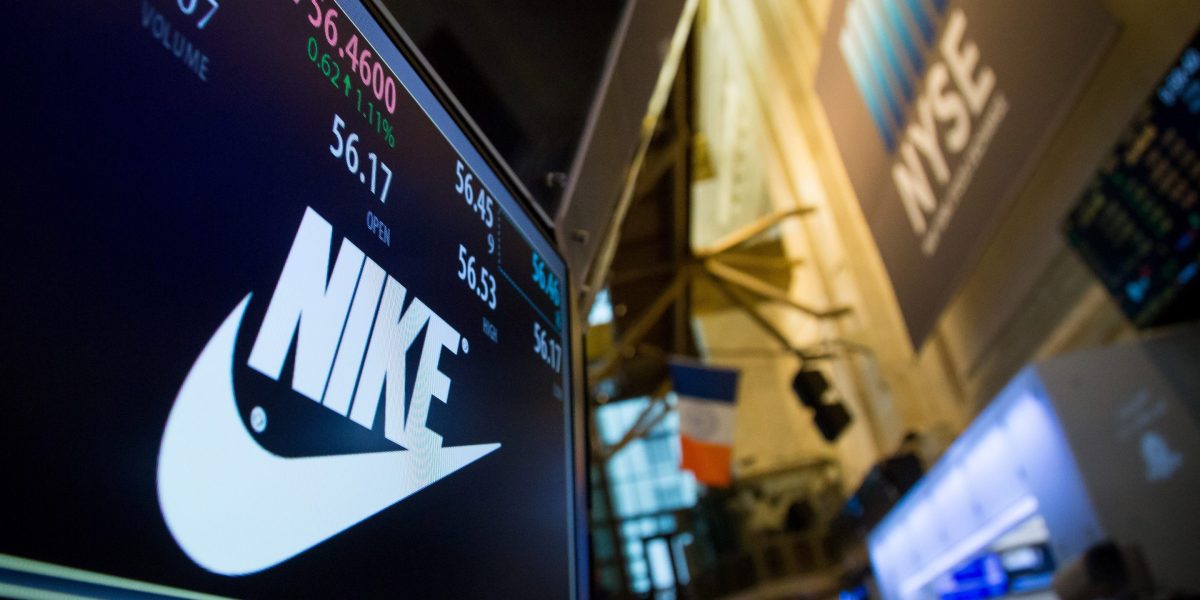
The image shows Nike branding on the NYSE, relevant to discussions of the company's stock price decline and removal from the S&P 100 index.
The S&P 100's removal rules are designed to keep the index representative of market-capitalization ranges. Nike's exit coincides with the admission of information technology companies—Dell Technologies, Palo Alto Networks, Arista Networks, and Sandisk—reflecting a broader shift toward data infrastructure holdings in the blue-chip benchmark.
Multiple headwinds drove Nike's freefall. The company's fiscal 2026 revenue reached $46.4 billion, representing a modest 2 percent decline on a currency-neutral basis. Its direct-to-consumer retail segment, once a key growth engine, contracted 6 percent to $17.7 billion, while wholesale revenue grew 6 percent to $27.5 billion. Greater China proved especially problematic, with fourth-quarter sales falling 17 percent on a constant-currency basis despite the quarter ending May 31, 2026.
CEO Elliott Hill's turnaround strategy has emphasized rebuilding wholesale relationships, reducing excess inventory, and refocusing on performance products. "We made meaningful structural improvements to lay the groundwork for our Sport Offense across our team culture, innovative product, brand strength, and how we serve consumers in our countries and cities," Hill wrote in Nike's investor report. "While we continue to face top-line headwinds, we're encouraged by progress in performance product and are focused on consistent execution, improved profitability and scaling our wins to realize our full potential."
China represents a critical battleground. Nike has endured eight consecutive quarters of declining sales in the market and is gaining greater control over online distribution by pulling sales rights from major retail partners. The company also faces intensifying competition from Chinese brands like Anta and Li Ning, as well as international rivals including Hoka and On.
For context, Nike's stock has fallen approximately 35 percent in 2026 alone, with the full decline spanning multiple years as investor skepticism grew about the turnaround's effectiveness. When Nike shares traded at $179.10 in November 2021, the company's market cap peaked at $264 billion. The trade now stands at roughly $38, making Nike's market-cap wipeout one of the largest in corporate history relative to brand value.
Other companies removed from the S&P 100 alongside Nike include Honeywell Aerospace, Simon Property Group, and Colgate-Palmolive, all replaced by technology sector entrants.
Nike did not immediately respond to Fortune's request for comment.