"Fourier Analysis: Drawing Llamas with Circles" is the title of a post on Dekau.dev that takes a mathematical tool best known for cleaning up audio and compressing images and points it at a whimsical problem: how do you draw a llama?
The Fourier transform, in the author's framing, is a way of moving between two ways of describing a signal. In the time domain you have a function that changes over time, like a sound wave. In the frequency domain you have a list of which frequencies are present and how strong each one is. The post's classic example is the sine wave sin(2π×3t): its Fourier transform is a single spike at plus and minus 3 hertz. Audio engineers use this to find an unwanted hum and then remove it with the inverse transform; image processors use related ideas for gaussian blurs and JPEG compression.
So how does this become drawing? The author's definition of "drawing" is a path you can trace by putting pencil lead on paper and sketching without lifting it up until you're done. Given such a path, you can attach a set of vectors end to end, each one rotating in a circle at its own speed, with each vector's tail pinned to the tip of the one before it. The tip of the very last vector then moves along and, if you've chosen the circles correctly, traces out the original sketch.
This is the part that surprises people, and it's worth pausing on the geometry, because it runs against intuition. The circles are not all nested inside one another in the way that suggests. Each circle's center sits on the tip of the previous circle, and each circle rotates around that moving center. So the motion of any given circle is the sum of every circle before it: a small circle spins on the tip of a bigger one, which itself spins on the tip of a still bigger one, and so on. The post illustrates this with a series of simple cases. A straight line, of all things, can be produced by circles, a shape about as far from a straight line as you can get. By shrinking the outer circle and spinning it faster, the same arrangement can produce a square. Add a third circle and you get a fish. For the headline example, the author draws a llama using 1,024 circles, each with its own frequency, radius, and starting angle.
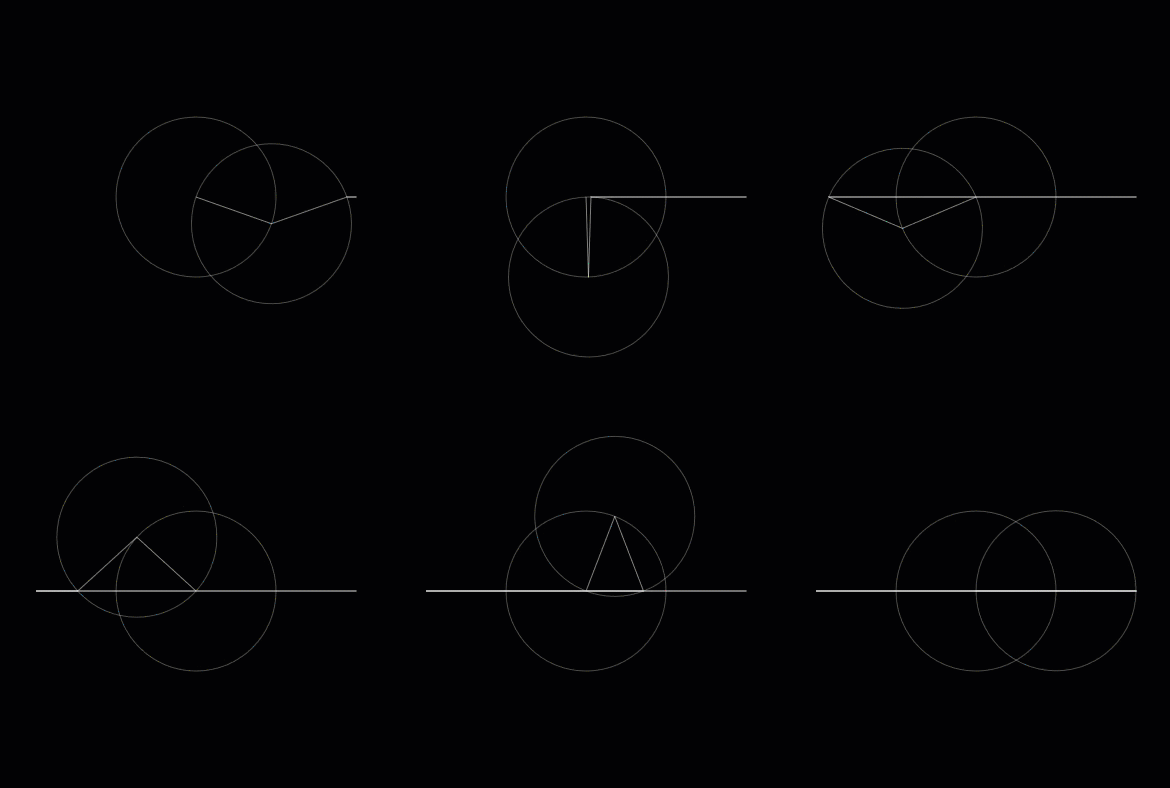
The post illustrates the geometry with simple cases, showing that even a straight line can be produced by circles.
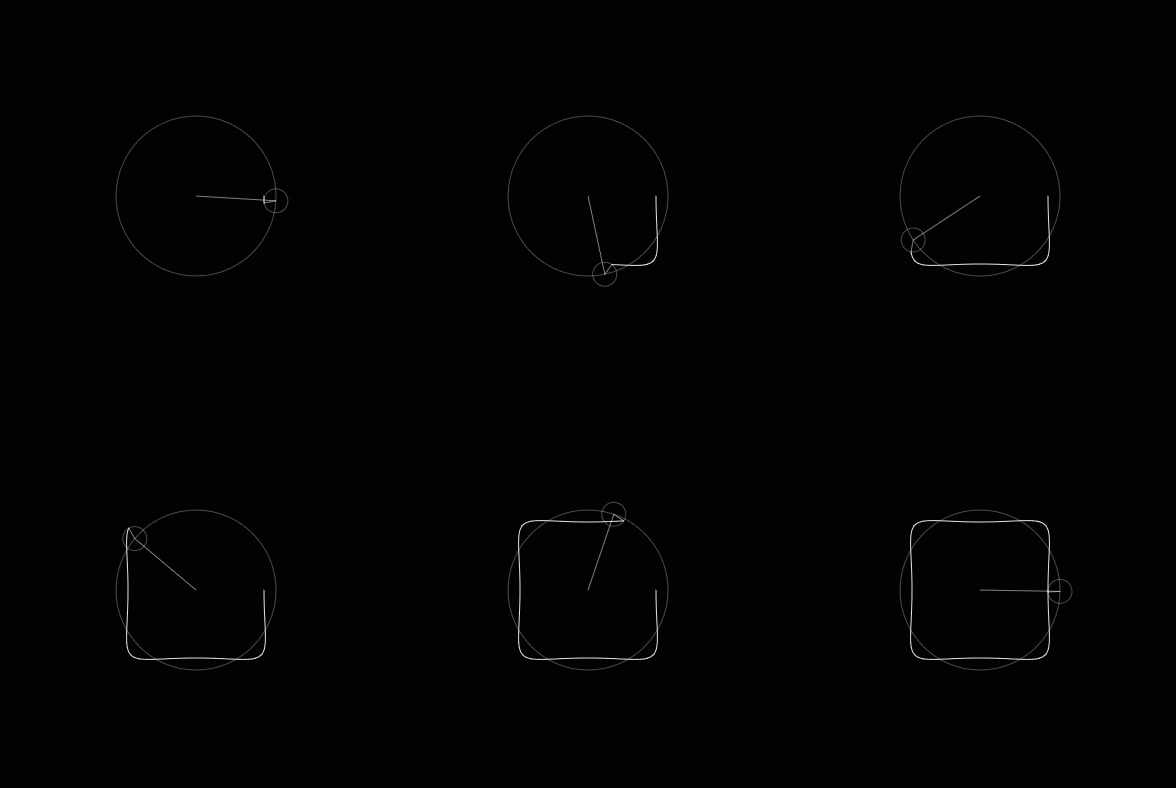
By shrinking the outer circle and spinning it faster, the same arrangement can produce a square.
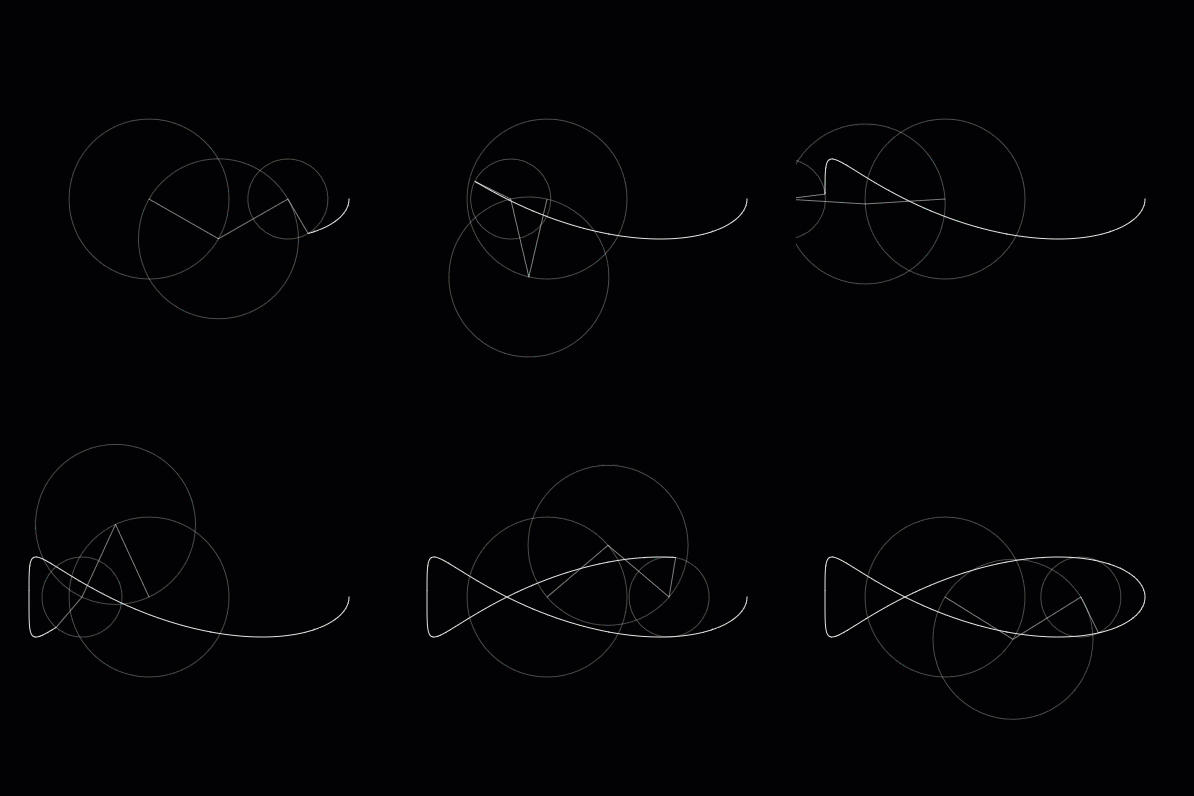
Add a third circle and you get a fish, another of the post's worked examples.
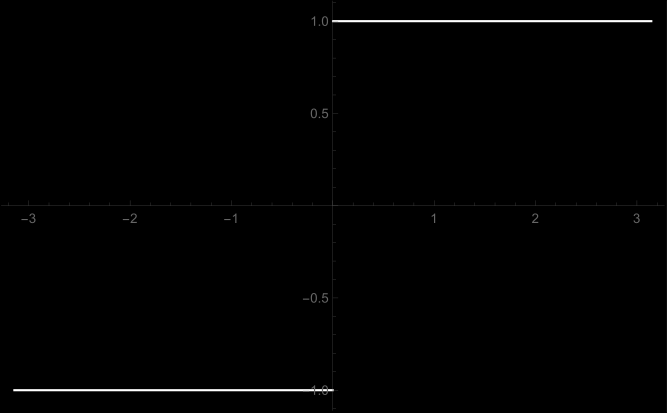
The square wave is the frequency-domain counterpart of the circle-drawn square, illustrating the time/frequency-domain duality.
What you can tweak on any one circle is exactly three things: how fast it rotates (its frequency), how big it is (its radius), and where it starts (its phase). The post's key simplification is that all three can be packed into a single complex number. That's not just a notational trick. A complex number a + bi already encodes a point in two-dimensional space, with the real part on one axis and the imaginary part on the other, and Euler's identity links complex exponentials to rotation. So a rotating vector is naturally written as a complex exponential, and its velocity turns out to be the same vector rotated by 90 degrees, which is exactly why the imaginary unit shows up in what looks like a statement about motion. The post's line "the velocity is the same as the position but imaginary instead of real" is this observation: multiplying by i rotates a vector a quarter turn.
The remaining question is how you go from a drawn path to the right set of circles in the first place. That's the Fourier transform's actual job, and the post builds up to it through two bodies of math. First, complex numbers as two-dimensional vectors. Second, linear algebra: any vector in the plane can be written as a combination of basis vectors, and the dot product tells you how much of each basis vector lives inside the vector you're decomposing. The post works a concrete example, expressing the vector (0.7, 1.2) in terms of two orthogonal unit vectors, and the dot products come out to roughly 1.34 and 0.35, the exact scaling factors needed. The same idea, extended from a finite list of numbers to a continuous function, becomes an inner product defined by an integral: for two functions over an interval, you integrate one times the conjugate of the other and divide by the period. A Fourier coefficient is then just an inner product between the path and a sine or cosine of a given frequency, a measurement of how much of that frequency lives in the path. Add up all those frequency components, each realized as a rotating circle, and you reconstruct the path. The more circles you include, the closer the drawing gets to the original input.
The author didn't just write the math; they built it. The companion project on GitHub, adekau/fourier, is an Angular application that implements exactly this, with a local dev server where you can watch the circles redraw a shape in real time.
What the post can and cannot do is worth stating plainly, because it sets the right expectations. The method works on a single continuous closed curve: something you can draw in one unbroken stroke. It cannot, by itself, encode a drawing with disconnected pieces or gaps, because the tip of the last vector never stops moving along a continuous path, and a chain of rotating circles has no mechanism for "lift the pencil." The post's own claim is carefully worded: "most every closed curve" can be drawn this way, and the llama's 1,024 circles are the author's chosen illustration, not a theoretical minimum. The exposition is an educational walkthrough rather than a rigorous treatment, so the precise conditions under which the approximation converges are outside what the post covers.
Seen as a whole, the piece is a striking demonstration that a complicated shape can be decomposed into simple periodic motions, the same principle that lets you isolate a single instrument in a mix or blur a photograph, now applied to sketching. It works as a teaching tool because it makes the abstract move from time to frequency concrete and visible: you can literally watch a llama emerge from spinning circles.