Modern AI pipelines often rely on generative large language models (LLMs) for simple, structured tasks such as email triage, phishing detection, or ticket routing. This approach introduces significant latency, as models must stream tokens, and creates challenges with hallucination and lack of mathematical calibration. Laya, a newly released open-source decision engine, addresses these inefficiencies by adopting a 'System 1' architecture—a non-autoregressive approach that provides instant, reflex-like decisions without generating free-form text. Laya operates using three core primitives: 'choice' for selecting from a dictionary of criteria, 'score' for placing inputs on an ordinal rubric, and 'noul' for direct boolean probability predictions. Because the model outputs only numbers and probabilities, it eliminates the need for regex or JSON parsing and prevents the hallucinations common in generative models. The system achieves inference speeds of approximately 33 milliseconds per question on standard hardware, significantly outperforming traditional generative LLM workflows. To handle diverse inputs, Laya includes a built-in router that inspects the Unicode scripts of incoming text across 22 alphabets, automatically directing requests to the appropriate specialized checkpoint—such as the multilingual mmBERT-base model—with negligible overhead. This routing capability ensures that the system maintains high accuracy across more than 100 languages. Laya is released under the Apache 2.0 license, providing a transparent, self-hostable alternative to proprietary decision-making APIs. By focusing on calibrated confidence scores rather than generative text, Laya allows developers to build production-ready guardrails and automated workflows that are both faster and more reliable than those dependent on autoregressive models.
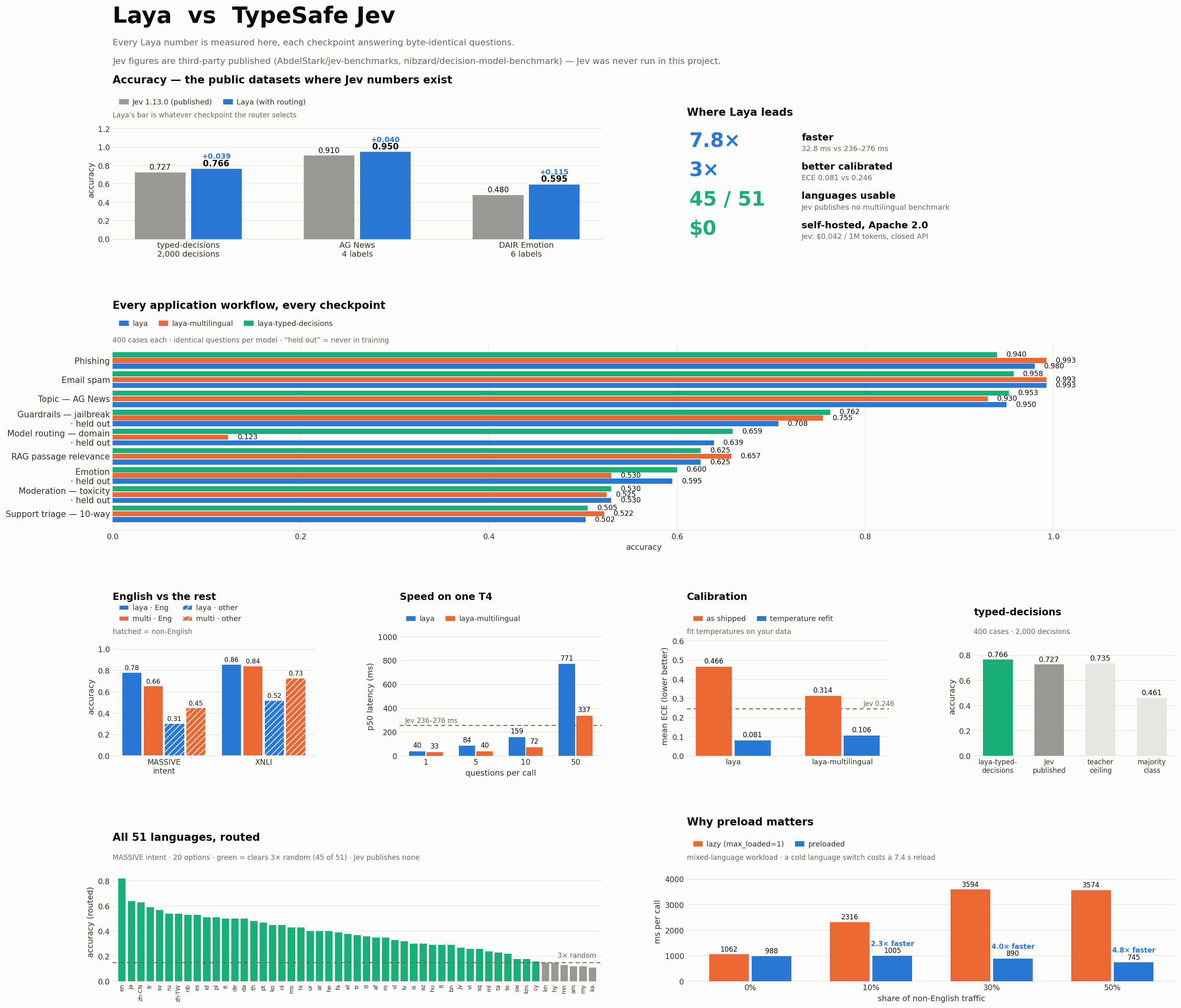
The chart illustrates the performance advantages of Laya's non-autoregressive architecture when compared to existing decision-making frameworks like TypeSafe Jev.