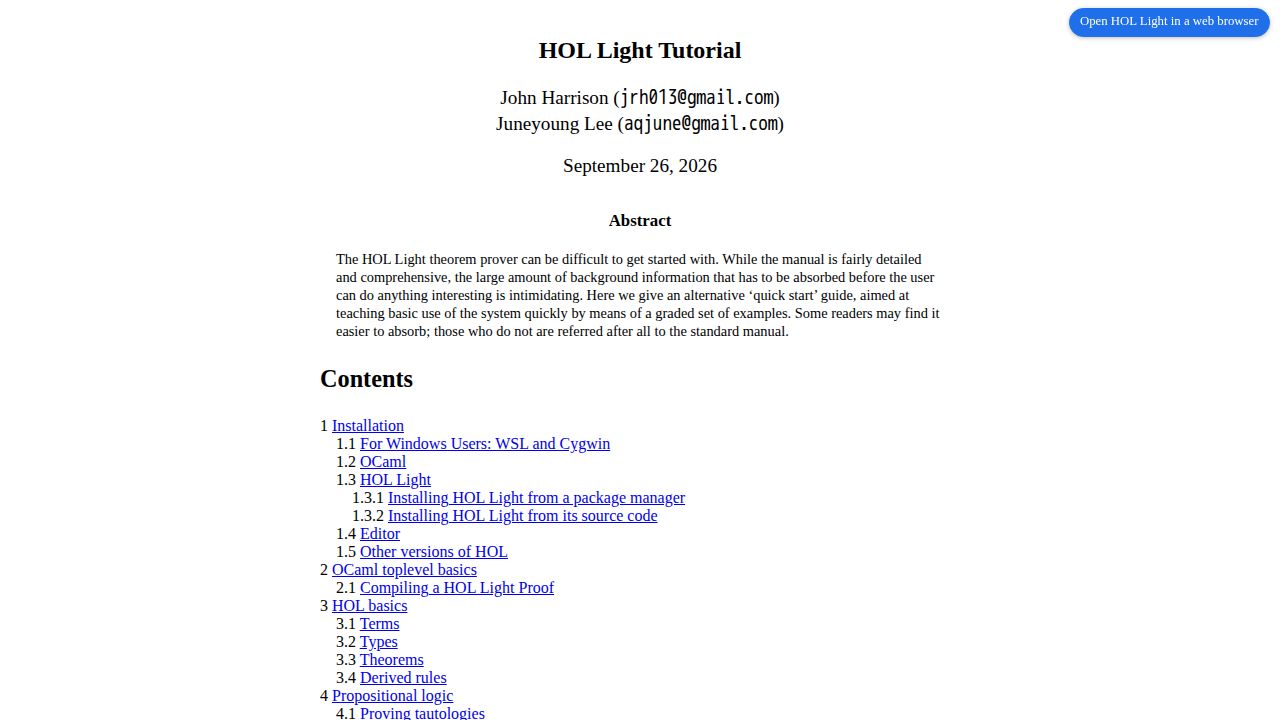
HOL Light is a theorem prover built on the functional programming language OCaml. While the system is highly capable, the authors of the new tutorial note that the standard manual can be intimidating due to the vast amount of background information required before a user can perform meaningful tasks. To address this, the tutorial offers a 'quick start' guide designed to teach basic usage through a graded series of examples, allowing users to build competence incrementally rather than attempting to absorb the entire manual at once.
The tutorial covers the essential technical setup required to run the system. Because HOL Light is written in OCaml, installing the OCaml compiler is a prerequisite. The guide provides instructions for various environments, including Linux, Windows (via WSL or Cygwin), and macOS. It also details how to install HOL Light itself, either through package managers like OPAM or by building from source code. For those using modern editors, the tutorial suggests the Visual Studio Code plugin as a way to access syntax highlighting, tactic submission, and documentation tooltips.
Beyond installation, the tutorial explains the mechanics of interacting with the system through the OCaml read-eval-print loop (REPL). Users can issue directives to load files, evaluate expressions to see results and types, and create definitions to bind names to values. The guide then transitions into the core logic of the prover, covering propositional logic, equational reasoning, and first-order reasoning. It also introduces 'tactics'—the primary mechanism for constructing proofs—and explores more advanced topics like inductive definitions, number systems, and the semantics of programming languages. By providing these structured examples, the tutorial aims to lower the barrier to entry for formal verification and mathematical proof in HOL Light.