Kev is an open-source family of small decision models built on Qwen3.5, designed to run locally or on a user-managed endpoint. The project offers 0.8B, 4B, and 9B variants, training code, evaluation data, and an API compatible with TypeSafe’s System One interface.
The system answers several question types in one request: yes-or-no decisions, multiple-choice routing, and numeric ratings. Questions share the same input text but cannot read one another, so a support ticket can be routed, checked for escalation, and scored for frustration without making the answers dependent on each other.
The repository also provides a practical local path. It documents CUDA, ROCm, and Apple Silicon support, and says the 4B and 9B models fit a 32 GB Mac. The example server binds to localhost by default, while an API key can be required for remote access.
The clearest evidence is the project’s own evaluation table. On “new sources,” the reported test accuracies are 0.684 for Kev-0.8B, 0.837 for Kev-4B, and 0.852 for Kev-9B; lower Brier scores are also reported for the larger models. These are publisher-reported results, not independent validation.
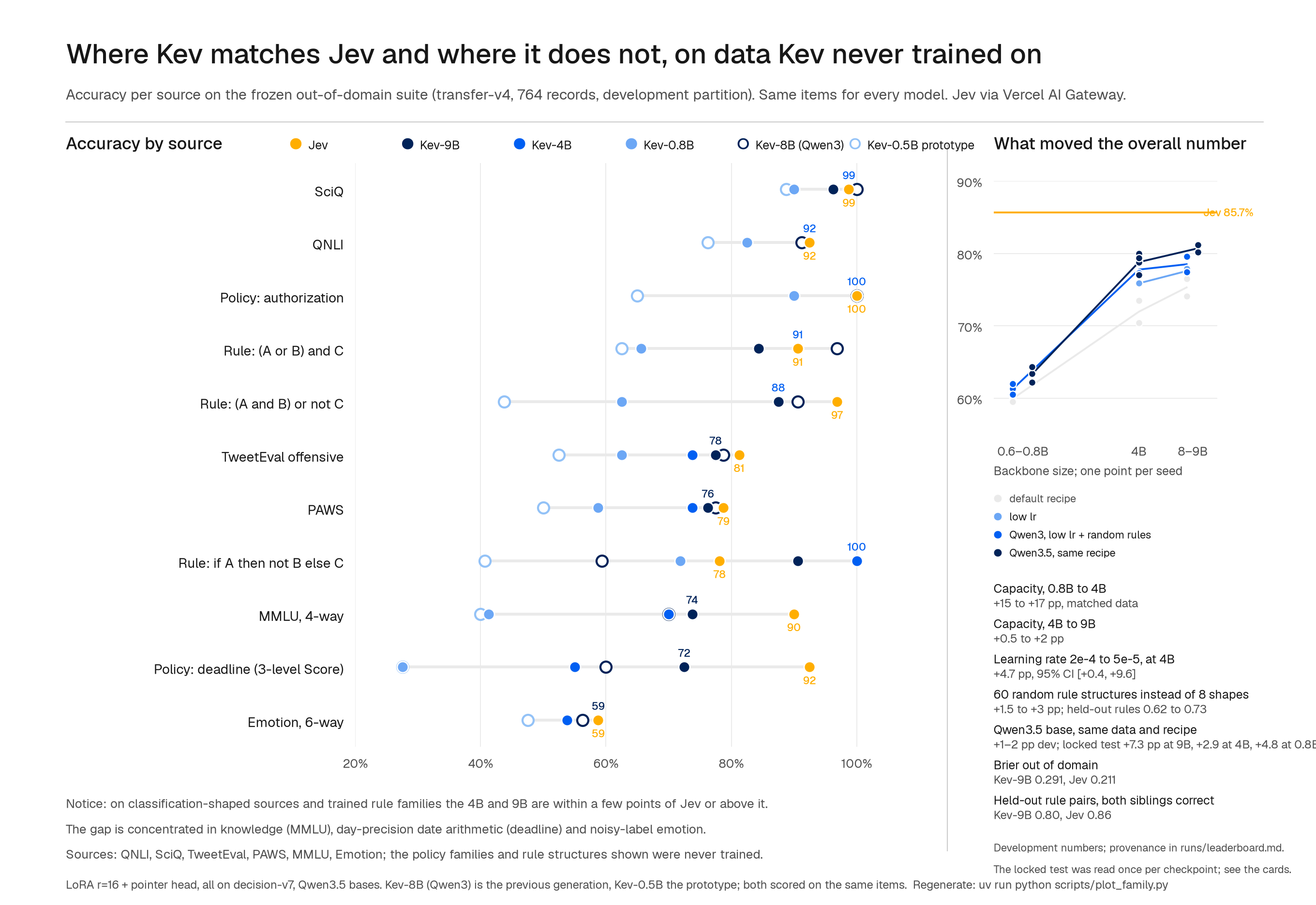
The article discusses the project’s reported evaluation table and the limits of comparing Kev with Jev; this chart directly visualizes those source-specific results.
The README warns that the comparison with Jev is not controlled because Jev’s training datasets are unknown. That matters for readers weighing Kev against similar systems: the packet supports Kev’s stated design and self-reported benchmarks, but not a definitive claim that it is more accurate than Jev in general.