The project involved porting a complex rendering task—specifically an image from 'Ray Tracing in One Weekend'—into Brainfuck, a minimalist Turing-complete language consisting of only eight operations and a one-sided infinite tape of cells. Because Brainfuck lacks standard high-level constructs like variables, registers, or arithmetic operators, writing a sophisticated algorithm directly in its syntax is notoriously difficult. To manage this complexity, the author adopted a first-principles approach to data representation, opting for a signed Q16.16 fixed-point format to represent doubles. This choice provides a resolution of $1/2^{16}$ and a range sufficient to render scene elements like large ground spheres without the overhead of emulated floating-point logic.
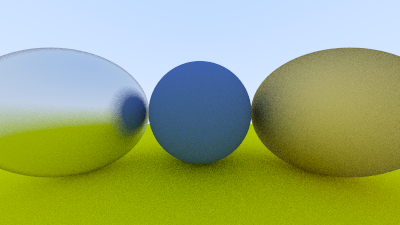
This image serves as the baseline for the rendering task described in the article.
To bridge the gap between high-level logic and low-level memory manipulation, the implementation utilized a tiered transformation process. The original C code was first refactored into a Single Static Assignment (SSA) style to make recursive calls iterative and simplify variable tracking. From there, it was converted into a custom DSL containing basic primitives such as `add`, `mul`, `sqrt`, and `copy`. A specialized compiler then translated this DSL into final Brainfuck instructions. Key mathematical functions were implemented using specific algorithms suitable for limited instruction sets: multiplication used repeated addition, while square roots were calculated via long division. These methods ensure that even though the resulting Brainfuck file reached 23MB—a significant expansion over the roughly 0.9MB target image—the underlying rendering logic remains mathematically consistent with the source material.
While the project demonstrates how abstractions can be layered to solve problems in esoteric environments, it faces inherent limitations regarding efficiency and maintainability. Because the translator maintains position-agnostic variables by ensuring no command is executed at more than one data pointer location, the system avoids complex memory bookkeeping but results in massive code duplication at the Brainfuck level. Furthermore, because the language's state is confined to an infinite tape without native indexing, every 'variable' access requires moving the data pointer across cells. This overhead contributed to slow performance; initial estimates suggested a render time of approximately 62 days on a laptop, though subsequent optimizations to the JIT interpreter significantly improved execution speeds. The final output exhibits visual artifacts, including precision errors that give the rendered scene a texture reminiscent of Van Gogh paintings.
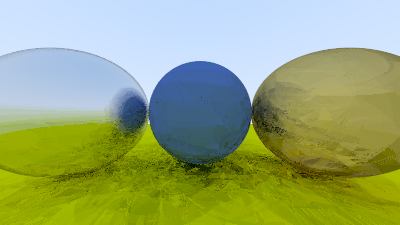
This image illustrates the final output and the specific visual artifacts mentioned in the conclusion.