The Lucas Museum of Narrative Art has opened in Los Angeles’s Exposition Park with an architectural identity as conspicuous as its founder’s film career. Common Edge describes the five-story building as a sculptural, organic form that architect Ma Yansong of MAD Architects called a “cloud.” The reported $1 billion project occupies a landscaped 13-acre former parking lot. Its dramatic exterior may invite comparisons with science fiction, but the more revealing question is what the museum places inside that form—and why such different kinds of storytelling belong together.
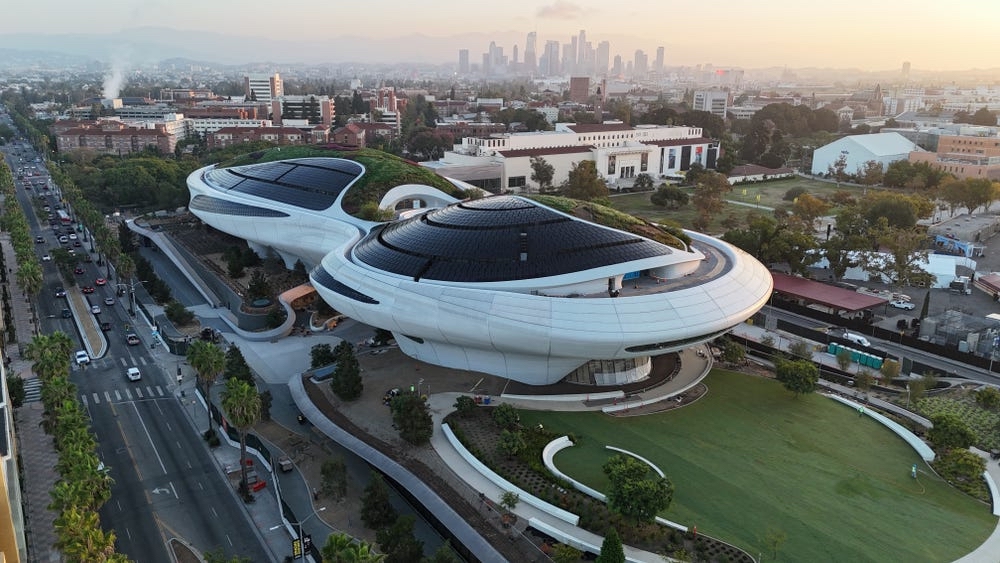
Source: Common Edge, “George Lucas Returns to Earth Bearing Gifts”; image credit: Lucas Museum. The exterior introduces the architectural question that frames the museum’s broader curatorial argument.
The museum’s answer is expansive. According to the Common Edge account, roughly 1,300 objects fill 33 galleries and about 100,000 square feet of exhibition space. Prehistoric cave paintings, ancient sculpture, Renaissance works, photography, graphic novels, comics, film illustrations, costumes, props, and vehicle designs appear within the same institutional framework. George Lucas says the museum was created to honor humanity’s stories and the artists who tell them, connecting modern imagination with ancient emotion. That mission treats narrative as a technique shared across eras and media, not as a hierarchy in which painting automatically outranks cinema or comics.
The most consequential curatorial choice is therefore not the presence of Star Wars material, but its placement alongside works by artists including Diego Rivera, Gordon Parks, Dorothea Lange, Norman Rockwell, Jack Kirby, Alison Bechdel, Frank Miller, and R. Crumb. The museum reportedly describes comics as “the people’s art” and argues that the form has not always received the respect it deserves. Lucas’s own films are presented as examples of a longer visual tradition drawing on mythology, religion, political history, and the hero’s journey. That interpretation may help visitors recognize inherited patterns in popular entertainment, although resemblance alone does not prove direct influence in every case.
For readers deciding whether the museum offers more than a monument to one filmmaker, the breadth of the collection is the strongest evidence. The account also identifies two ground-floor cinemas named for documentary pioneer Robert Flaherty and experimental-film innovator Slavko Vorkapich. The museum plans to admit visitors to curated screenings without an additional charge, creating public spaces that are not confined to static galleries. This programming matters because it extends the museum’s definition of narrative art from objects to time-based experience, though the preview does not establish the long-term screening schedule or how frequently the selections will change.
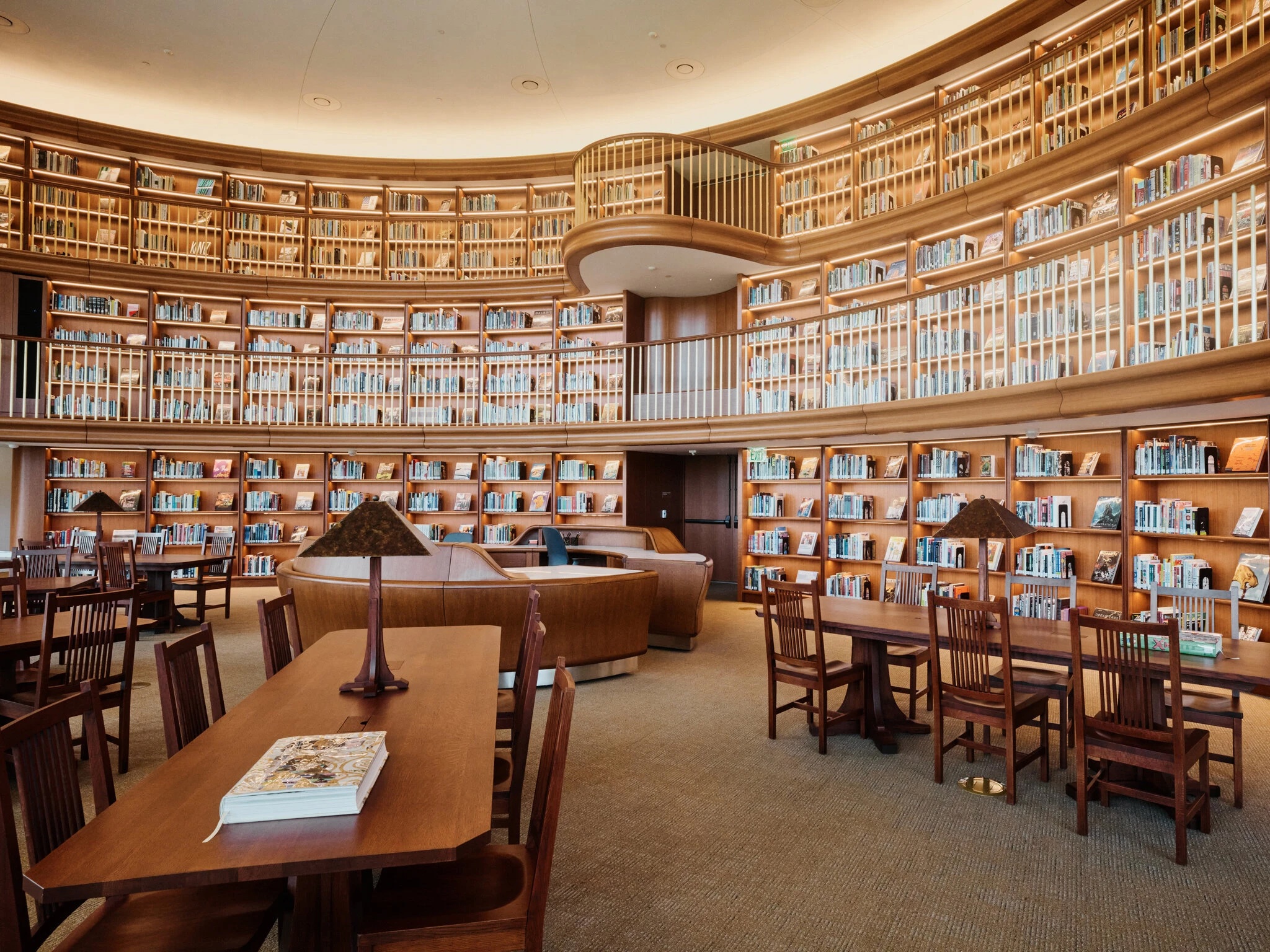
Source: Common Edge, “George Lucas Returns to Earth Bearing Gifts.” The museum interior supports the discussion of galleries and public spaces that bring varied storytelling media into one institution.
The building’s public realm is part of the same accessibility argument. Common Edge reports fluid circulation and says the critic, who describes himself as mobility-challenged, found the galleries accessible. The surrounding landscape includes indigenous and drought-tolerant planting, paths, a fountain, a waterfall, a meadow, and areas intended for gathering or recreation. The same account finds the public areas functionally bland and requests more seating. These are observations from one preview visit, not measurements of crowd capacity or universal accessibility; they indicate an encouraging first impression rather than a definitive assessment of daily operations.
The evidence does not establish whether the museum will achieve its civic ambitions, attract repeat visitors, or justify its reported cost. A preview attended by members, journalists, local notables, and invited guests cannot measure broader public reception. Nor does the source provide attendance figures, a complete ticket policy, conservation standards, acquisition plans, or independent evaluation of the collection’s scholarly organization. The reported $1 billion figure should likewise remain attributed rather than treated as a verified final construction cost.
What the opening does clarify is Lucas’s proposed boundary for cultural legitimacy. By giving comics, commercial illustration, experimental cinema, blockbuster design, documentary photography, and older fine-art traditions a shared setting, the museum asks visitors to compare how stories gain emotional force across media. Whether that experiment produces durable insight will depend on changing exhibitions, interpretation, programming, and access over time. Its first test is not whether the building looks otherworldly, but whether its unusually inclusive definition of narrative art remains intelligible once the opening spectacle has passed.