Scott Jenson, who has worked on user interfaces at Apple, Google and now contributes to projects like Mastodon and Home Assistant, presented his views on modernizing the open-source desktop at Akademy 2026, KDE's annual developer conference. Drawing from decades of experience, Jenson contended that desktop user experience (UX) innovation effectively stabilized after the 1980s and 1990s, stating that 'it just stabilized, and not much has really changed' since then. He observed that much of Linux desktop UX was originally copied from Windows and the Mac, noting that KDE explicitly states it aims to be similar to Windows for users, and criticized the open-source community for leaning on Microsoft and Apple to conduct UX research and testing, effectively letting them 'make the mistakes' while open-source projects simply followed along.
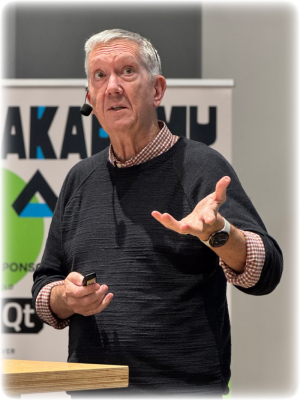
This image shows Scott Jenson presenting at Akademy 2026, where he discussed the stagnation of open-source desktop UX innovation.
Jenson identified three recurring pushbacks when proposing changes to desktop interfaces. First, he encountered the argument that 'mobile won; the desktop is old, just do what mobile does,' which he countered by asserting that while mobile dominates consumer markets and social media, desktops remain superior for productivity tasks due to their keyboards, large screens, and capabilities, suggesting that users have simply lost appreciation for these strengths. Second, he heard claims that 'there are only so many ways that the WIMP model can work' and that efforts to fix it are pointless because 'it's done,' but Jenson disagreed, believing there remains room for improvement beyond the windows, icons, menus, pointer paradigm. Third and most strongly, he faced the objection 'don't touch my stuff' from users who have customized their desktop environments to their preferences and resist any changes that disrupt their established workflows, acknowledging this sentiment while arguing that gradual evolution is necessary as the world changes.
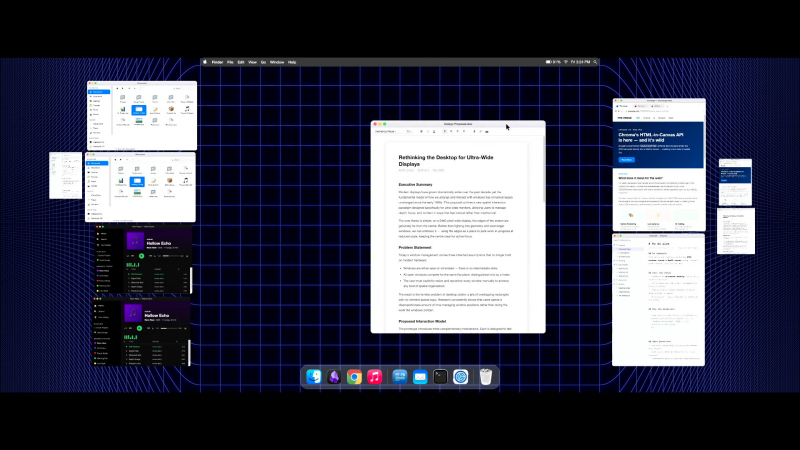
The window manager demo illustrates the WIMP-style interface that Jenson noted has seen little innovation over the past two decades.
Regarding artificial intelligence integration with desktop environments, Jenson argued that the key advancement comes not from superficial AI features but from giving AI systems access to the user's filesystem, which provides essential context about their data and activities. He praised Anthropic's Claude Code for 'looking down into your filesystem' and drawing context from file content, enabling more meaningful interactions compared to approaches that merely try to 'sneak AI in' while keeping the interface unchanged or using screen-reading chatbots that miss the point. Furthermore, Jenson expressed ethical concerns about frontier AI models, calling them 'ethical and environmental disasters,' and instead expressed enthusiasm for alternatives like Apertus—a fully open, responsible model for sovereign AI created by the Swiss AI Initiative—which he believes allows for ethically trained small language models to run locally without compromising one's principles.