ReBarUEFI is a UEFI DXE driver intended for computers whose firmware does not expose Resizable BAR, even though the connected PCI device may support it. The project’s README says the driver can make that capability available without an official BIOS setting. That is the project author’s claim, not proof that every advertised platform will work.
A Base Address Register, or BAR, describes a region of device memory that the processor can map. Resizable BAR changes the size of that mapping during enumeration rather than leaving it at a smaller firmware-selected value. In practical terms, the feature may let the CPU map more graphics memory at once. Whether that improves a particular game or application depends on the GPU, driver, workload, CPU, and firmware; the supplied packet contains no independent benchmark suite.
The project explains its mechanism in concrete terms. ReBarDxe is added to the firmware’s DXE volume and replaces the `PreprocessController` function associated with `PciHostBridgeResourceAllocationProtocol`. It first runs the original function, checks for Resizable BAR capability, and then requests the size stored in the `ReBarState` NVRAM variable. The PCI bus driver subsequently sees the new BAR size and allocates the corresponding address range. This description explains the intended control flow; it does not independently demonstrate that every firmware implementation preserves the required hooks and resources.
The README identifies several prerequisites and failure modes. It recommends enabling 4G decoding and disabling CSM after installing modified firmware. It also warns that systems lacking Large BAR support may need additional patches, and that the `32` setting—described by the project as unlimited—may need to be reduced if it does not work. These are operational requirements, not optional performance tweaks. A machine that cannot expose enough address space may remain limited to a smaller BAR even when the device itself advertises the feature.
The firmware settings provide a concrete example of the capability and address-space conditions discussed in the article.
The project includes UEFIPatch-related changes for problems it associates with 64-bit BAR handling and MMIO allocation, including limits at 4GB, 16GB, and 64GB and prevention of certain 64-bit BARs being downgraded. It also lists platform-specific workarounds, such as increasing MMIO space on Intel generations including Haswell, Broadwell, Skylake, Kaby Lake, and Coffee Lake. The presence of a patch is evidence of a known compatibility target, not evidence that applying it is safe or sufficient on a particular board.
Installation is therefore materially different from changing an ordinary BIOS toggle. The repository points users toward a wiki procedure for adding an FFS module and describes additional firmware modifications when required. It provides a build script for the DXE driver in an edk2 tree and says ReBarState can be built with CMake on Windows or Linux. Readers should treat the supplied README as project documentation, not as a universal recovery guide: flashing or patching firmware can make a system unbootable, and the packet does not establish board-by-board safety, vendor support, or rollback behavior.
The project’s FAQ says that Linux can automatically resize and allocate GPU BARs in recent versions when 4G decoding is enabled, and that a faulty DSDT may require kernel or firmware-side work. It separately states that there is no known method to enable the feature on Windows without modifying the BIOS. Those statements are useful context for choosing an operating system, but they are not a compatibility guarantee and should be checked against the current Linux distribution, GPU driver, and motherboard documentation before changing firmware.
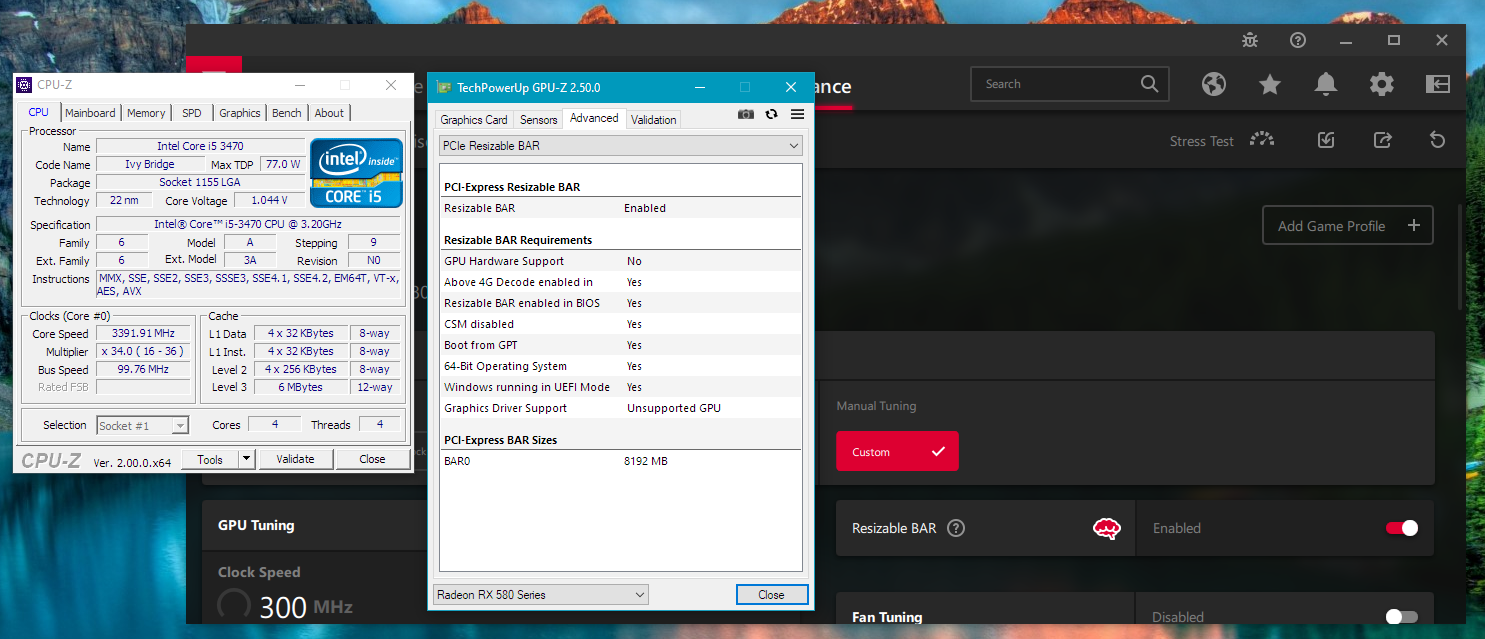
The screenshot illustrates how operating-system and driver tooling can expose the resulting BAR state after firmware enumeration.
The recovery warning is especially important. If an unsupported BAR size prevents booting, the README says to clear CMOS and, in some cases, remove the CMOS battery to disable Resizable BAR. That advice makes clear why the project should not be treated as a harmless software utility. Users need a known-good firmware image, a reliable flashing procedure, and a recovery path appropriate to their hardware before experimenting.
The useful comparison is not simply “old computer versus new computer.” It is whether the hardware advertises the capability, whether the firmware exposes enough address space, whether the operating system and driver can use the resulting mapping, and whether the workload benefits from it. ReBarUEFI addresses the second condition by modifying firmware behavior; it does not create Resizable BAR support in a device that lacks the capability, repair an incompatible driver, or guarantee a measurable performance increase.
The evidence supplied here supports a narrow conclusion: ReBarUEFI is a technically described firmware intervention that can request a larger BAR on some otherwise unsupported systems, while depending on 4G decoding, Large Bar handling, MMIO space, and platform-specific patches. It does not support a broader claim that the tool works on “almost any” UEFI system in the literal sense, nor does it establish a typical gaming uplift. The author’s own example reports up to a 12% FPS increase on one Intel i5-3470 and Radeon RX 580 configuration with a 2GB BAR; that single setup is an anecdotal project claim, not a general benchmark result.
For readers considering the project, the first question should be operational rather than promotional: can the exact motherboard, GPU, firmware version, and operating system be verified together, and can the firmware be recovered if enumeration fails? The repository’s compatibility list and issue documentation may help narrow that question, but the supplied packet does not provide a tested matrix or independent validation. Until those details are checked, the responsible expectation is conditional experimentation on recoverable hardware—not a promise of faster graphics or guaranteed compatibility.