Anthropic says it made the core experience of claude.ai and the Claude desktop app about three times faster in two weeks. The company focused on four journeys it says account for 95% of activity: launching the app, starting a conversation, loading an existing conversation, and sending a message. At the 75th percentile—the point at which three-quarters of measured loads are at or below a given time—a fresh claude.ai page became typeable in 0.55 seconds instead of 3.1 seconds. A new Claude Code session reportedly fell from 0.8 seconds to 0.3 seconds.
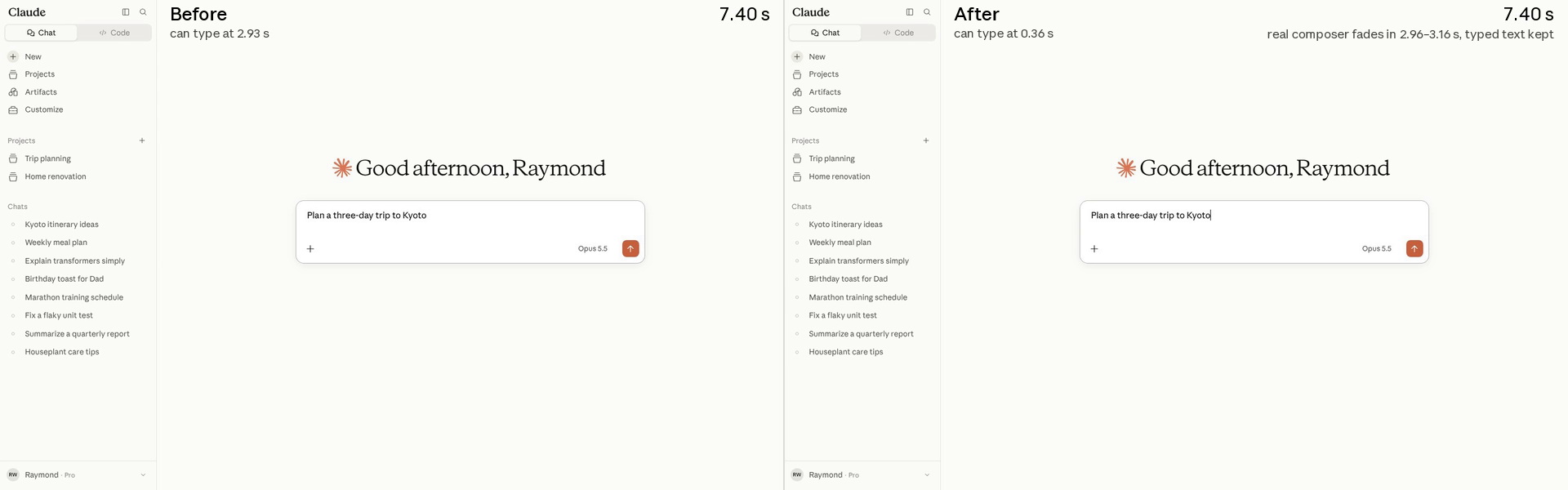
The paragraph’s 0.55-second typeability result is illustrated by a before-and-after fresh-page load.
The central idea was to turn waiting into numbers Claude could improve. Engineers worked with Claude Tag, Anthropic’s beta Slack assistant for reading threads and acting on standing instructions, in one channel. Claude traced slow steps, built or found benchmarks, proposed pull requests, watched deployments, and checked field data. If a change helped, the benchmark ceiling was lowered; if it did not, a feature flag could disable it. The post says more than 3,000 changes were merged without a customer-facing incident or rollback.
The method also targeted problems ordinary dashboards can miss. For sidebar jank, Claude mapped layout shifts to named regions and phases, then used a test that failed when delayed data moved the page after it became usable. The test failed in 20 of 20 runs on the main branch and passed 20 of 20 times in the proposed change. On another path, Valgrind instruction counts fell by 48% and 31%, while reported wall-clock time fell by 78% and 44%. Those paired results show why the team wanted deterministic metrics, but also why it required a correlation with real latency.
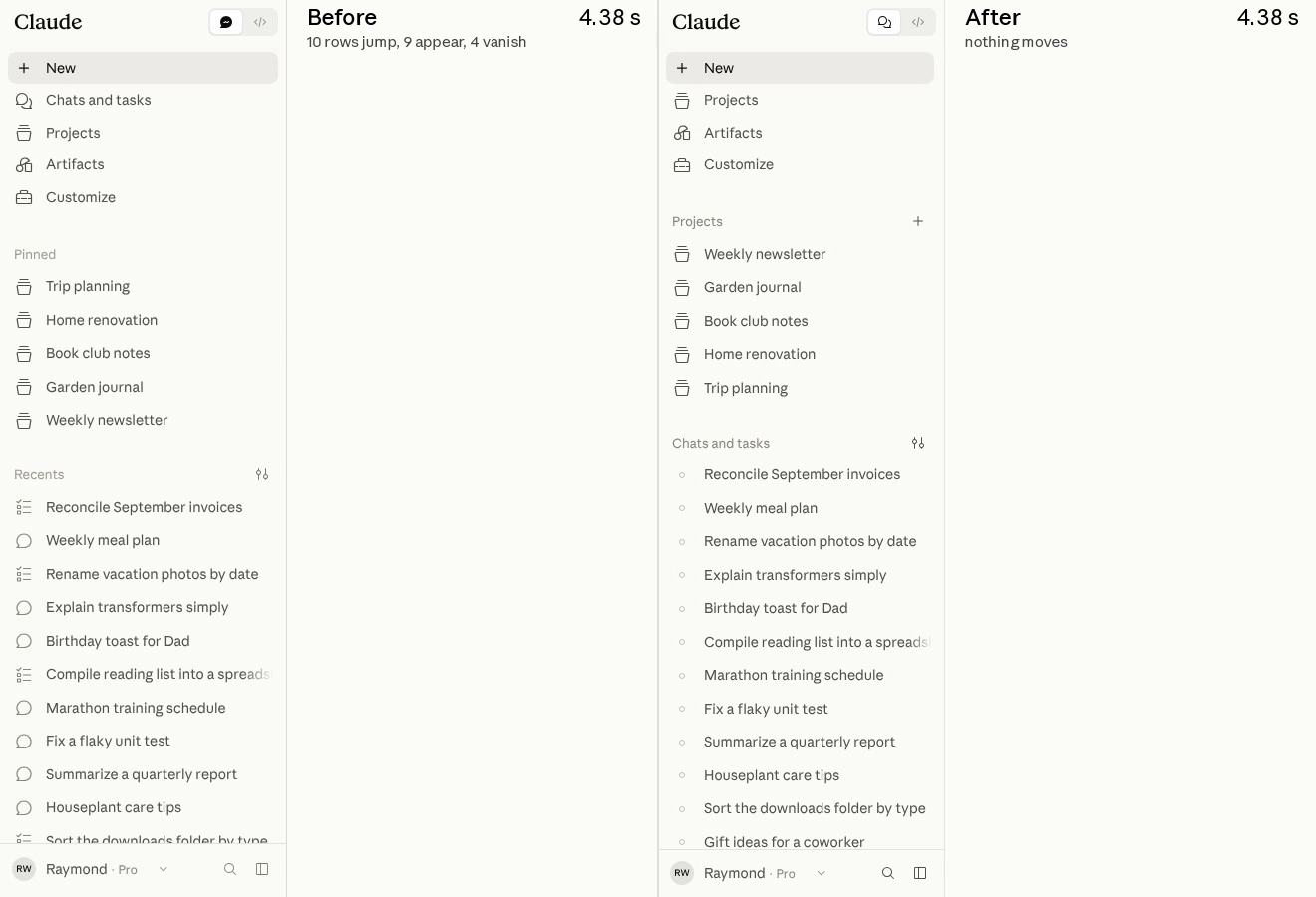
This directly demonstrates the sidebar-jank test described in the paragraph, where late layout shifts were eliminated.
The trade-off is that aggressive optimization can reward shortcuts. Anthropic says it rejected flaky benchmarks, required human approval for every pull request, put unit tests before optimizations, and used short-lived feature flags for user-visible changes. Still, the article is a first-party case study: the measurements, incident count, and estimated daily time savings come from Anthropic’s own sprint, not an independent audit. The supplied material does not establish how the gains held up beyond that two-week period.