First principles thinking involves breaking down problems to their most basic elements to understand what we're truly trying to accomplish. As Sunil Sadasivan describes, this approach helps engineers overcome the 'senior engineer death spiral' where accumulated experience can make it difficult to adapt to changing circumstances. By asking why we're building something and what it would do for users, engineers can connect codebase changes to real-world impact and keep solutions simple.
In the transition to agentic development, first principles thinking becomes particularly valuable. Sadasivan explains that working with AI agents requires putting existing experience 'in a box' long enough to look at problems with fresh eyes. Rather than letting past projects or familiar technical limitations decide solutions prematurely, engineers who set aside their assumptions can discover more ways forward than expected.
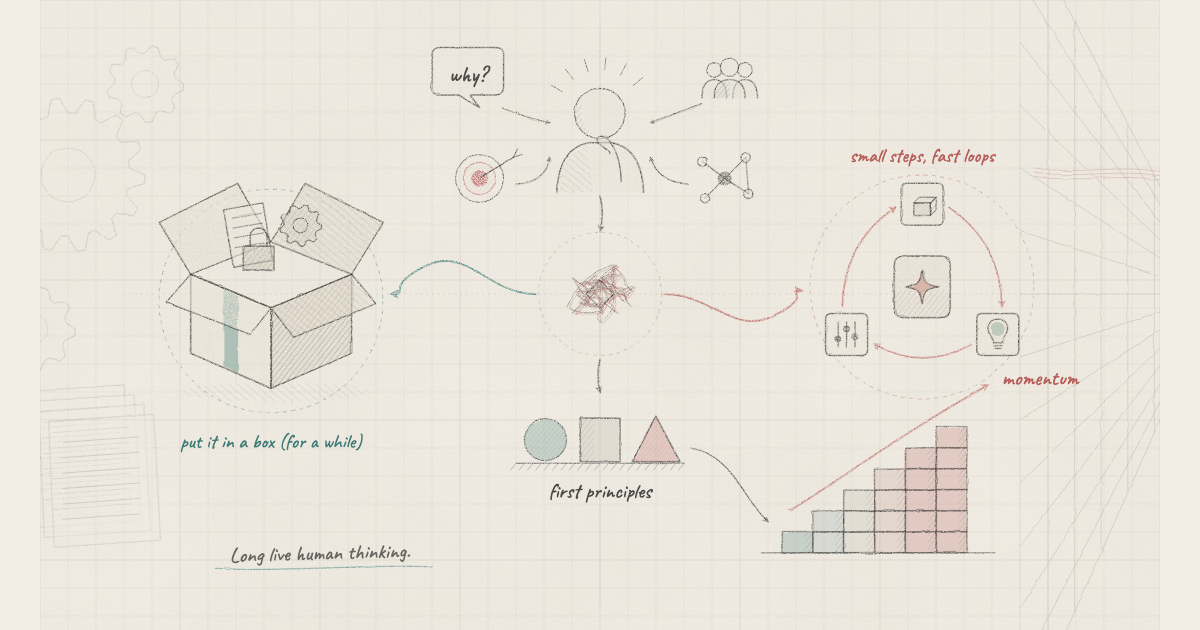
This diagram visualizes the key concepts discussed in the article: questioning assumptions, setting aside prior experience, applying first principles, and creating momentum through small learning loops with AI agents.
The true power emerges when first principles thinking combines with agentic workflows to create faster learning loops. When engineers truly understand what they're trying to accomplish, taking small steps and learning from them becomes easier. Working with agents accelerates this back-and-forth process, creating momentum oriented around deep understanding rather than just technological excitement. As Sadasivan puts it, this represents a new flow state where human thinking remains central even as AI tools evolve.