Xiaomi has introduced the MiMo-V2.6 series: the natively omnimodal Pro and Flash models, plus Pro-UltraSpeed, which the company says was rolling out. VentureBeat reported the launch on September 21 and described Pro as an open-weights benchmark leader, not as a model that beats every closed model.
The most striking figures are about training efficiency. Xiaomi says each model completed 30 reinforcement-learning steps across roughly 750,000 trajectories in less than six days. It reports training costs of about $0.85 million for Flash and $2.62 million for Pro. These are Xiaomi’s figures; the supplied primary article and VentureBeat coverage do not establish independent reproduction or verification.
Xiaomi also reports substantial DeepSWE v1.1 gains: Flash rose from 48.8 to 65.68, while Pro rose from 58.4 to 72.57. Those results should be read as company-reported benchmark outcomes, not as an independently reproduced evaluation. The official article lists an Artificial Analysis Intelligence Index score of 46.32 for Pro and acknowledges that a gap remains against the strongest closed models.
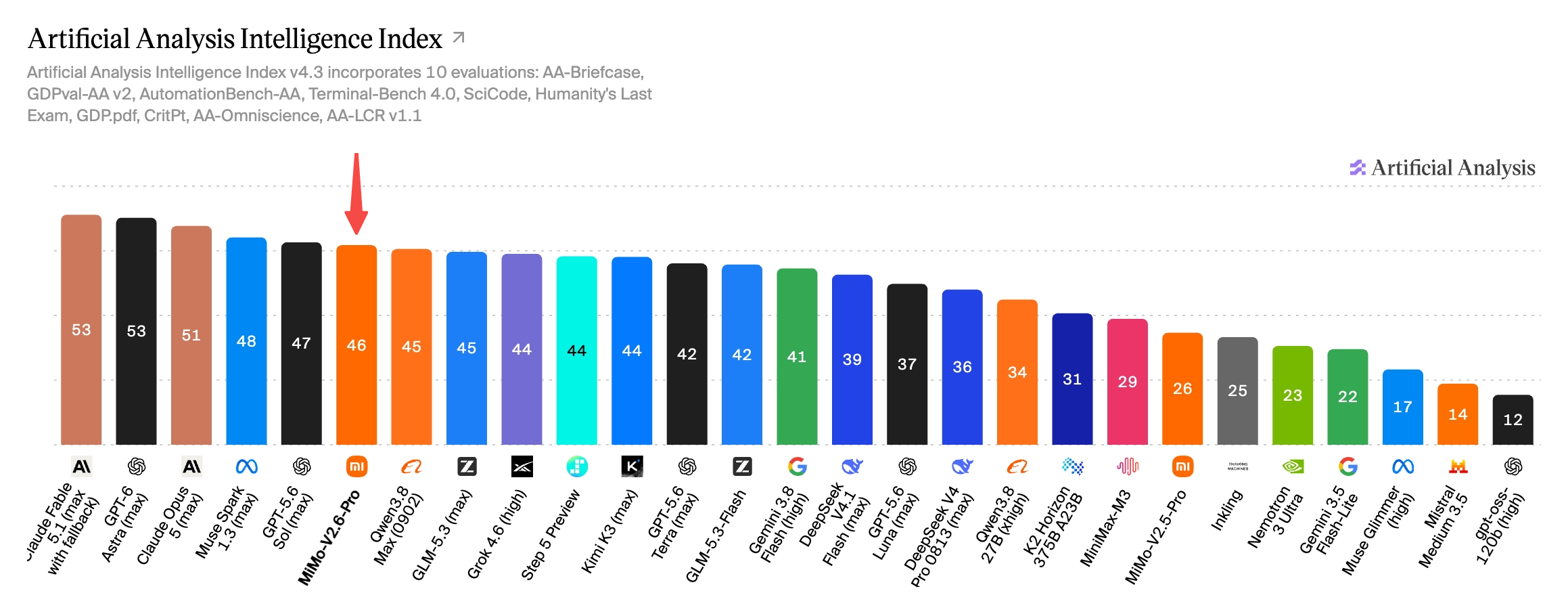
The score is company-published and should be read with the article's caveat that task rankings vary and some closed models remain ahead.
That qualification matters. VentureBeat notes that some closed-model evaluations remain ahead and that rankings change by task. The supplied evidence therefore supports a narrower conclusion: MiMo-V2.6 Pro appears competitive in selected open-weight benchmark comparisons, not universally superior across AI workloads.
Xiaomi says it is releasing model weights, a technical report, more than 7,000 reinforcement-learning task environments, an end-to-end RL framework, and MiMo-V2.6-Distill-Qwen-9B. If those materials are accessible and usable as described, they could help researchers inspect the training approach and reproduce more of the work. The packet does not establish download availability, licensing terms, or independent validation of the artifacts.
The announcement is significant because lower reported training costs and released infrastructure may broaden experimentation beyond organizations with very large budgets. Still, the source packet establishes what Xiaomi announced and what VentureBeat reported; it does not establish that the efficiency claims or benchmark gains have been independently confirmed.