Waymo announced a transit rewards program on September 22, 2026, initially for the San Francisco Bay Area. The company says riders can link a Visa card in the Waymo app and receive $2.85 in Waymo Cash when they use that card for both a Waymo trip and public transit within two hours. The amount matches the San Francisco bus fare cited by Waymo, but the credit is issued by Waymo rather than by a transit agency.
The first phase will be limited to employees before a gradual public rollout in the coming weeks. That distinction matters: the announcement describes an intended launch sequence, not a program already available to every Bay Area rider. Waymo says the offer applies to all 27 Bay Area transit agencies that accept contactless Visa tap-to-pay, but the supplied materials do not include eligibility rules for individual riders, participating agencies’ full payment coverage, or whether every fare product can be paid through the same contactless system.
The central practical question is whether the reward reaches people making genuine transit connections. The program identifies a connection through timing and payment method: a Waymo trip and a transit trip using the linked Visa card must occur within two hours. It does not, based on the supplied announcement, say that riders must prove a station destination, a missed transfer, a commute purpose, or that the Waymo leg replaces a walk, bus, or personal-car trip. A rider who takes a short Waymo trip before or after transit can qualify under the stated mechanics, while a rider who pays for transit with a Clipper card or another payment method may not qualify at all.
That limitation is especially relevant for commuters who already use employer benefits or stored-value transit cards. The source packet includes reader anecdotes raising those concerns, but those comments are not evidence about program uptake. The primary announcement itself establishes the narrower point: participation requires linking a Visa card and using that card for both legs. Whether employers will reimburse the personal-card payment, whether riders will accept the added reimbursement work, and whether the reward changes behavior remain unanswered by the supplied evidence.
Waymo presents the program as part of a broader effort to connect autonomous ride-hailing with public transportation. It cites recent company surveys indicating that more than half of Waymo riders in San Francisco, Los Angeles, and Phoenix also use public transit. That is a company-reported survey result, not an independently verified measure of how many trips are new transit trips, how many replace driving, or whether the reward increases overall transit ridership. The announcement also says the program builds on prior transit-credit pilots in San Francisco and Los Angeles, Waymo’s addition to the LA Metro Mobility Wallet, and a microtransit partnership with Via in Chandler, Arizona.
A separate primary announcement from Via supports one piece of that broader context. Via says its September 18, 2025 partnership with Waymo was designed to let government agencies using Via software introduce Waymo ride-hailing into public transit networks, with Chandler Flex as the first city. It describes Via’s routing and scheduling software matching passengers to vehicles and monitoring service performance. That document corroborates the existence and intended structure of the Chandler integration, but it does not independently validate Waymo’s safety statistics, ridership figures, or the expected results of the Bay Area reward program.
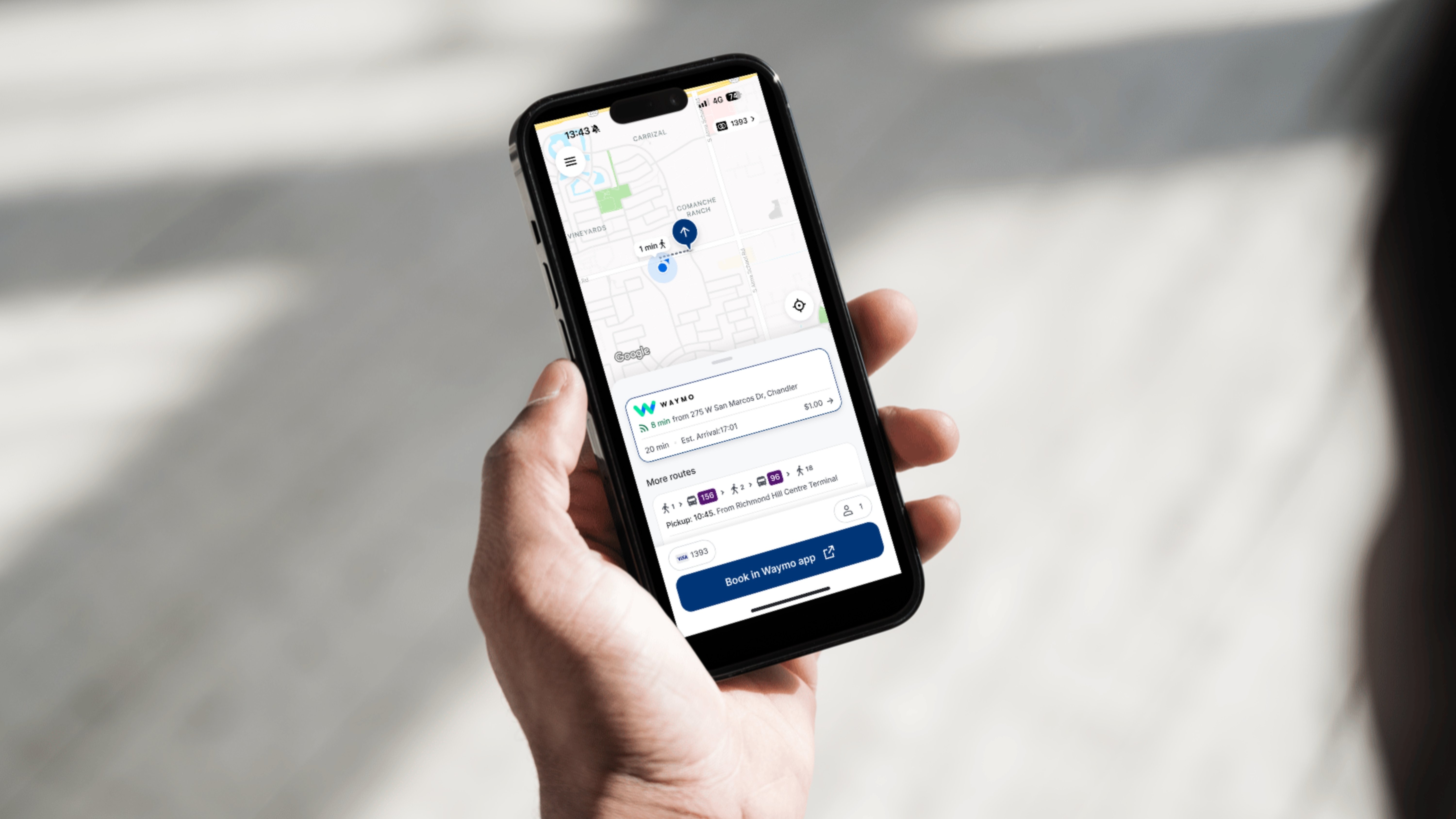
This official Via image illustrates the Chandler, Arizona integration where Via’s software helps connect public transit riders with Waymo vehicles.
The Bay Area launch also includes a station-access component. Waymo says it will lease 40 dedicated Caltrain parking spaces for staged vehicles, making cars available near transit stations. This is operationally different from the payment reward: it could reduce the time needed to find a vehicle near a station, but the announcement does not provide utilization data, pricing effects, or evidence that the spaces improve network-wide access. It also does not establish that station parking is the best use of land or that staged autonomous vehicles will reduce congestion around stations.
For riders, the offer’s value is therefore concrete but conditional. A qualifying connection receives a $2.85 credit toward a future Waymo ride, not an immediate reduction in the transit fare and not cash. The reward may make a multimodal trip cheaper when both payments fit the Visa requirement, while offering little help to riders whose existing transit payment setup falls outside that system. The announcement does not state whether Waymo Cash expires, whether it can be combined with other promotions, or how disputes and failed payment matches will be handled.
The larger policy question is whether subsidies should be designed around individual app transactions or around a coordinated mobility network. Waymo’s program is easy to understand and automate through card-linking, but its rules can reward a broad set of temporally adjacent trips. A more targeted program might require a station geofence, a verified transfer, or integration with a transit account, but those alternatives can add friction and exclude riders without compatible payment tools. The supplied documents do not compare those designs or report results from such targeting.
The evidence supports a modest conclusion: Waymo is testing a payment-linked incentive intended to make some autonomous ride-hailing and transit combinations cheaper and more convenient. It does not yet establish that the program expands public transit, reduces car trips, improves equity, or lowers regional emissions. Those outcomes will depend on who qualifies, which payment methods riders already use, whether employers absorb the extra reimbursement burden, and whether the staged vehicles actually solve first- and last-mile gaps rather than simply subsidizing trips that would have happened anyway.