Unreal Labs is pitching a question that is easy to overlook when evaluating coding agents: how much of the bill comes from the model, and how much comes from the software deciding when that model should think, wait, or call a tool? The company’s September 22, 2026 introduction to Unreal Agent argues that conventional agent loops spend substantial time and tokens managing tool calls rather than doing the underlying work.
Its proposed answer is an asynchronous harness. According to Unreal Labs, every tool call is recorded immediately as in progress while execution continues in the background. The model can accept another steering message, issue additional tool calls, or continue other work instead of repeatedly polling for completion. When an operation finishes, its result is appended to the session log and the model is invoked again. The company says this reduces both waiting and the number of model turns needed to complete a task.
That is a claim about the harness, not proof that every agent using it will be cheaper. Unreal Labs attributes the savings to two design choices: a relatively small tool and prompt footprint, and more useful tool work between model calls. The published GitHub repository provides material support for the architectural description. It identifies an append-only session store, a coordinator, a tool translator that must not block the event loop, and an operation manager responsible for asynchronous execution. It also describes durable, serializable operations and session recovery, suggesting that the design is intended to extend beyond an in-memory demonstration.
The benchmark results show why the idea attracted attention, but they require careful reading. On Terminal-Bench 4.0, Unreal Agent and Codex each recorded a 57.9% pass rate, while Unreal Agent cost $1,428 across the reported trials versus $2,350 for Codex. Pi recorded 55.0% and $1,827. On SWE-Atlas Codebase QnA, Unreal Agent reached 65.8% at $936, compared with 63.3% and $1,303 for Codex and 64.0% and $1,033 for Pi. Those figures support the narrower conclusion that this implementation was less expensive than the listed baselines on those runs while achieving a similar or somewhat higher measured pass rate.
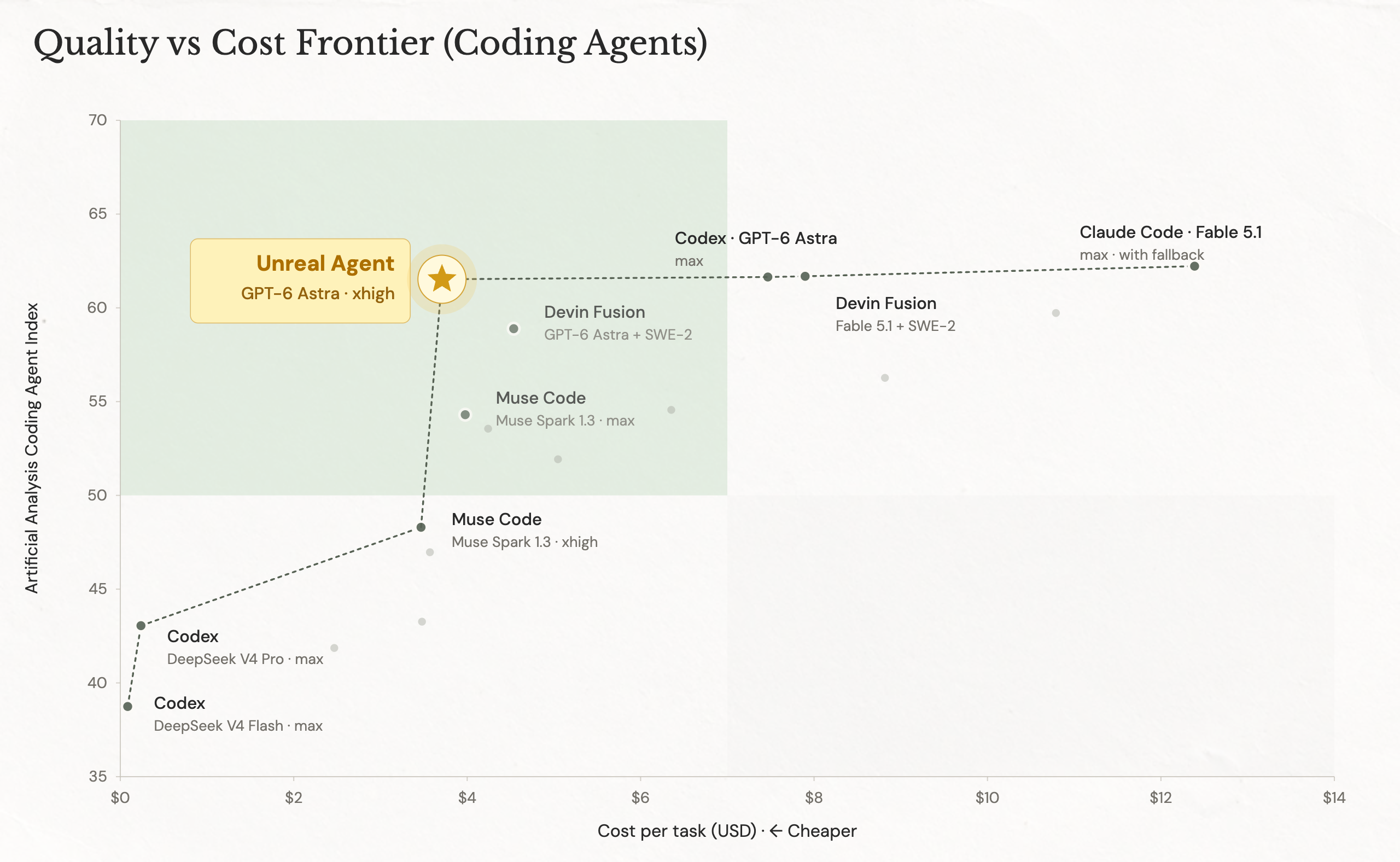
The chart maps the article’s benchmark evidence, where Unreal Agent generally costs less than the listed Codex and Pi baselines while achieving comparable measured pass rates.
The pattern continued in the other reported tests. On DeepSWE 1.1, Unreal Agent recorded 72.4% at $1,367, versus 69.0% and $1,633 for Codex and 69.6% and $1,584 for Pi. On Agents’ Last Exam · ALE-CLI, it recorded a 30.0% full pass rate at $217, compared with 29.0% and $292 for Codex and 29.0% and $262 for Pi. The primary page says the small pass-rate differences may reflect benchmark variance, so the results should not be read as proof of a large or consistent quality advantage.
The most important limitation is comparability. The page describes Unreal Agent as running GPT-6 Astra at xhigh reasoning effort and labels Codex as a leaderboard baseline, but the supplied material does not provide enough configuration detail to establish that every comparison used the same underlying model, reasoning setting, tool set, context policy, and execution budget. The ALE-CLI runs were also not on Harbor, unlike the other reported benchmark runs. As a result, the tables demonstrate a favorable result for Unreal Agent’s tested configuration; they do not isolate asynchronous execution as the sole cause of the cost difference.
The company’s headline claim of “up to 40%” savings relative to Codex and “up to 20%” relative to Pi is therefore best treated as a publisher-reported upper bound, not a general performance guarantee. It is compatible with several figures in the tables, but the packet does not establish a single controlled experiment in which all competing harnesses were rerun under identical conditions. A reader choosing a production agent still needs to test the relevant repositories, tools, approval policies, latency targets, and failure modes.
The repository also clarifies what the architecture does not automatically solve. It describes validation, cancellation, provider errors, session recovery, operation state, and host-selected tools as separate responsibilities. That division may make the system easier to adapt, but it also leaves deployment teams responsible for sandbox boundaries, credentials, proxies, tool registries, and the behavior of remote operations. Unreal Labs says environment constraints and granular access controls are more robust than relying only on harness hooks; that is an engineering position from the company, not independent evidence about every security model.
There is an additional interoperability caveat for teams considering a custom implementation. Unreal Labs reports that representing a running result and a final result as two tool-call output items was underspecified in the Responses API documentation. It encountered rejections with some models and inference providers other than OpenAI, and says the `function_call_output` status field appeared ineffective in those cases. The supplied evidence therefore supports a real compatibility concern in the company’s tests, but not a claim that all providers behave the same way.
For practitioners, the practical question is not whether asynchronous tools sound elegant. It is whether independent operations can safely overlap, whether a long-running setup task can be cancelled or recovered, and whether the model receives enough structured state to make the next decision. Unreal Agent’s published design directly addresses those operational questions at the component level, while the benchmark tables offer an initial cost-and-quality signal. They do not establish production reliability, security, or savings for workloads outside the reported coding tests.