A new essay from brand.io proposes a sharper name for one kind of invisible media signal: the “spymark.” Its central distinction is not whether a file contains an embedded marker, but whether the person handling that file can see, understand, control, or remove it. The essay reserves “watermark” for visible ownership or authenticity marks and uses “spymark” for a hidden signal that traces a file or its user without meaningful consent.
This is a proposed term and an argument about framing, not a newly standardized technical category. The terminology matters because “watermark” currently covers visibly obvious copyright marks, historical anti-counterfeiting features, editable metadata, and invisible signals designed to survive transformations. Combining those cases under one word can make a tracking function sound like a simple ownership label. brand.io illustrates the visible side of that distinction with the faint portrait watermark on a U.S. $20 bill: a mark readers can see and recognize as an anti-counterfeiting feature. The source also shows Getty's visible watermark over Dorothea Lange's Migrant Mother as an example of an ownership claim, distinct from an invisible tracking signal.
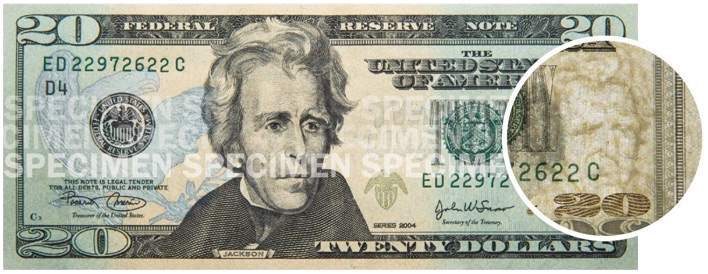
This image illustrates the essay's contrast between a visible anti-counterfeiting watermark and a hidden tracking signal. Credit: brand.io.

The source uses this Getty overlay as a visible ownership-mark example, not as evidence about SynthID. Credit: brand.io.
The essay points to Google’s SynthID as a prominent example. Google says SynthID embeds signals directly into AI-generated images, audio, text, and video; that the signals are imperceptible to people; and that they can remain detectable after common edits such as cropping, filtering, frame-rate changes, or lossy compression. Those are Google’s descriptions of the system’s purpose and behavior, not proof that every deployment is harmless or free from privacy consequences.
The cited SynthID-Image paper adds technical and deployment claims. It reports that SynthID has watermarked more than ten billion images and video frames across Google services, while its verification service was available to trusted testers. The paper also describes an experimental evaluation of SynthID-O against other post-processing watermarking methods, reporting strong visual quality and robustness under common image perturbations.
That benchmark should not be mistaken for an independent evaluation. It appears in the cited technical paper and reflects the authors’ experimental setup, threat models, and selected tests. The supplied sources establish that the system was reported at substantial scale and tested for robustness; they do not establish universal resistance to removal, universal detection accuracy, or the absence of privacy and abuse risks.
The privacy concern is most consequential when a signal can link a copy to a database record rather than merely identify content as AI-generated. The brand.io essay says a payload could encode a database identifier associated with user information and argues that widespread embedding could reveal how copies move between people and platforms. The supplied Google overview does not verify those particular identity-linking scenarios, so they should be understood as a risk described by the essay, not as a demonstrated property of every SynthID deployment. The essay also points to printer-tracking dots as an older example: tiny yellow patterns can encode a print date and a printer serial number, making an otherwise inconspicuous mark useful for tracing a document's origin.
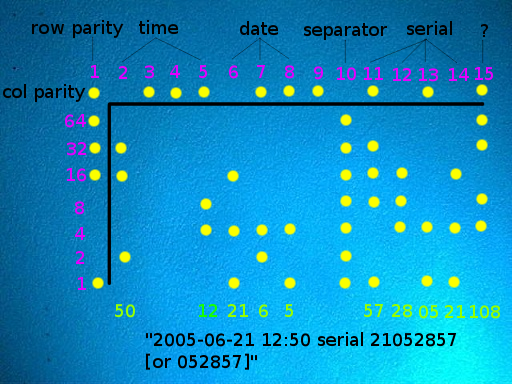
Placed after the paragraph discussing printer tracking dots, this diagram makes the essay's historical example concrete. Credit: brand.io.
The essay also separates hidden signals from ordinary metadata. EXIF data in images and ID3 data in audio files can contain sensitive information, but they are documented fields that users can often inspect, edit, or strip from files they control. A signal embedded into pixels, audio waveforms, or statistical word choices may survive metadata removal and ordinary edits, which is why the author considers it harder to govern and easier to overlook.
For readers, the practical question is not simply whether invisible marking can help identify synthetic media. It is who can embed a signal, what identifier it carries, who may decode it, whether affected people receive notice, and what controls exist over retention and use. Those governance details are not resolved by a robustness score or by calling the signal a watermark.
The sources therefore establish three narrower points: brand.io has proposed “spymark” as privacy-forward terminology; Google presents SynthID as an invisible tool for identifying AI-generated or altered content; and the cited paper reports large-scale use and favorable robustness results within its own evaluation. They do not settle whether every hidden media signal is dangerous, whether the reported performance holds in every setting, or how organizations will regulate access to decoded identifiers. The lasting value of the essay is that it makes those unanswered questions visible before hidden tracing becomes an unquestioned feature of everyday media.