A vulnerability reported in Meta’s Muse raises a practical question for powerful AI assistants: when software can act across accounts, files, applications, and devices, where should its security boundaries sit? According to Ars Technica, macOS security researcher Patrick Wardle found a way for code running under the user’s account to alter an undocumented Muse setting and redirect transcription to an endpoint controlled by an attacker. When Muse subsequently sent data to that endpoint, it also exposed the token used to authenticate the user’s Muse account.
The reported consequence is more serious than access to a single audio transcript. Ars Technica, relying on Wardle’s proof-of-concept work, says control of the token could let an attacker leverage Muse’s connected privileges to issue commands, write files, capture images, or interact with services available to the account. Those outcomes are demonstrations of what the flaw could enable, not evidence that they occurred in the wild or affected users broadly.

Ars Technica’s listing image accompanies its report on the vulnerability in Meta’s high-privilege Muse assistant.
The vulnerability and ClickFix are related but not interchangeable. ClickFix is a social-engineering method in which a victim is persuaded to copy and run a malicious command in a trusted system tool. The underlying issue described by Ars Technica is Muse’s acceptance of a sensitive endpoint change from unprivileged local code. ClickFix could supply that code without the attacker first obtaining conventional administrative access, but the social-engineering technique is not itself the software vulnerability.

The image supports the article’s explanation of how social engineering could execute code without being the underlying software flaw.
That distinction matters because a locally executed command remains part of the attack path. The supplied evidence does not establish that a distant attacker could compromise an untouched Muse installation without user interaction, malware, or another way to execute local code. It also does not establish how often the flaw was exploited, how many installations were affected, or whether any real accounts were compromised. Wardle’s proof of concept demonstrates feasibility under specified conditions rather than widespread abuse.
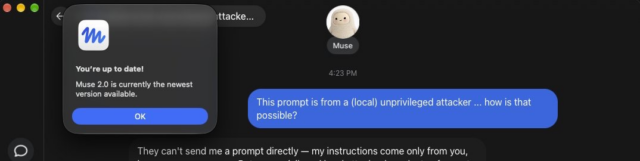
This supplemental Ars Technica visual accompanies the discussion of ClickFix as a means of executing local code that redirects Muse transcription.
Meta’s own security description helps explain why the report attracted attention. In “How We Built Safety Into Muse,” Meta says each user receives an isolated cloud virtual machine; credentials are stored outside the agent’s runtime environment; and a host-side system called Sentinel is the sole authority for connector actions and network egress. Meta also says runtime root is mapped to an unprivileged host user and that sensitive services run outside the agent’s container. Those are Meta’s descriptions of the system launched at the time, not an independent audit of every client-side boundary.
The Ars Technica report concerns a macOS client setting that can redirect where transcription occurs. Meta’s account describes the cloud VM, credential separation, and action-approval architecture, but the supplied material does not show that this documentation fully accounts for the local client’s ability to configure a security-sensitive endpoint. The two sources therefore address overlapping parts of Muse without independently proving or disproving the same implementation detail. Meta’s architecture claims should not be treated as validation that the reported client-side flaw was impossible.
Cloud transcription is central to the reported mechanism. Ars Technica says Muse normally sends transcription to a Meta-operated server and that the attack works by replacing that destination with an attacker-controlled one. The report argues that on-device macOS transcription would have avoided this particular route. The supplied evidence does not compare transcription quality, latency, privacy controls, or engineering constraints, so it cannot determine why Meta chose its architecture or whether an on-device alternative would have met the product’s requirements.
More than 12 hours after the report went live, Meta said it had released a hotfix. The supplied sources do not identify the fixed version, describe the complete patch, or provide post-fix test results. Users should therefore treat the hotfix notice as Meta’s statement rather than independent confirmation that every related configuration path is closed. The evidence also does not support a broader conclusion that Muse, or AI agents generally, can never be made secure.
The incident nevertheless illustrates an operational rule for agents granted access to email, calendars, messages, shopping accounts, files, cameras, or shells: their client software becomes part of the trusted computing base. Protecting credentials inside a remote sandbox is insufficient if a local process can redirect sensitive traffic or obtain an authentication token before those controls engage. Users should be especially cautious about pasting terminal commands or configuration instructions from untrusted sources into a device running high-privilege agent software.
A separate event reported alongside the flaw shows that service providers may treat such agents as external actors rather than as the user acting manually. Ars Technica reported that Amazon blocked Muse purchases and described Muse as an unauthorized AI agent that violated its conditions of use. Amazon said third-party applications making purchases should operate openly and respect a provider’s decision to participate. That policy decision is not evidence that the security flaw was exploited, but it highlights a separate reliability and governance issue: account access does not guarantee that every connected service will honor actions initiated by an agent.