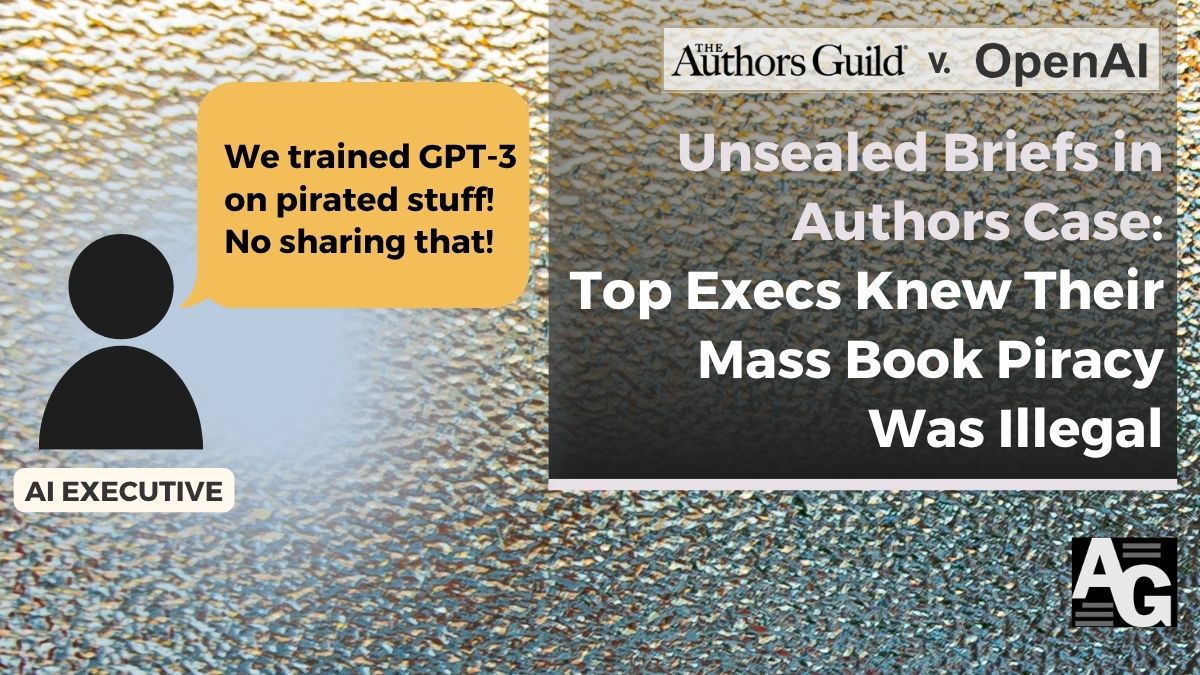
The Authors Guild has released unsealed briefs in its ongoing copyright lawsuit against OpenAI and Microsoft, alleging that the companies illegally trained their AI products on copyrighted books taken from pirated sources. The filings, submitted as part of the case Alter v. OpenAI and Microsoft, claim to reveal the defendants’ “guilty knowledge and reckless actions” regarding the use of copyrighted material for model training.
This image relates to the Authors Guild's public advocacy efforts mentioned in the lawsuit filings against OpenAI and Microsoft.
The briefs contain several specific allegations supported by internal communications. OpenAI Policy Director Jack Clark reportedly stated in May 2020 that their work on AI and creativity would “increasingly lead to us creating systems that substitute for the labor of [] people” and that “the better we do on GPT-X, the more worried genre fiction authors will become about us substituting for them on Amazon.” He allegedly added that their work would “make people unemployed” and that they would “likely ignore [artists’] concerns and release anyway.” The documents also allege Microsoft was aware of OpenAI’s use of LibGen—a site providing pirated books—as early as April 2019 when Sam Altman and Dario Amodei presented an early GPT-3 to Bill Gates and disclosed the use of LibGen to Gates and Microsoft’s Chief Technology Officer Kevin Scott.
This mark reflects the Authors Guild's response to fears that AI systems replace human writers, as discussed in the internal communications.
Additionally, the briefs claim OpenAI hired Tarun Gogineni in 2022 to improve the writing quality of its models, with Gogineni stating his “research mission” was to have GPT models write the “last two books of [Martin’s] A Song of Ice and Fire” series by “finishing it one day.” Gogineni reportedly mused that he would “rest easy knowing that even if GRRM [George R. R. Martin] dies early, GPT-5 will autocomplete his series.” Although aware of authors’ complaints that the datasets were stolen and that authors were losing work to AI‑generated competition, Gogineni viewed those complaints as “acceptable economic disruption” and wrote that the world would soon experience “the death of the reader” as machines create slop for more machines. The filings further allege that OpenAI executives were more concerned about optics than law, with researcher Dario Amodei describing LibGen as “a bit sketchier” as a training set and colleague Sam McCandlish expressing worry only about the negative publicity of “openai uses copyrighted data from sketchy russian website” appearing on Hacker News. The briefs say OpenAI attempted to conceal this evidence through “Project Clear,” deleting LibGen files in summer 2022 after internal discussions about removing references to the source from company systems. The case, which is part of a multidistrict litigation in Manhattan, is expected to see further briefing before a hearing in early 2027.