Tom Wojcik's September 2026 essay opens with a claim that is easy to skim past: "The world is not ending. But for thirty years we swapped buffers for dependencies, because a supplier is cheaper than a stockpile and a guarantee is cheaper than an army."
That sentence is the essay's spine. Wojcik, a Polish writer, spends the next several pages tracing what happens when the things a modern society used to count on — stockpiles, alternate suppliers, redundant fuels, patient lenders — are replaced by whoever is cheapest this quarter. In 2026, he argues, several of those dependencies were stress-tested at the same time. The result is a structural diagnosis rather than an apocalypse story.
One strait, three crises
Start about 4,000 kilometres south-east of Warsaw. US and Israeli military operations against Iran began in late February. Since March, Iran has kept the Strait of Hormuz closed with drones, missiles, mines and small boats. Tanker traffic through it has fallen by more than 90 percent, and the International Energy Agency (IEA) calls it the largest supply disruption the oil market has ever seen.
For context: the Strait of Hormuz is the narrow passage out of the Persian Gulf, the route through which Gulf oil and gas tankers reach the open ocean. Closing it does not stop oil production; it stops oil from moving. And the closure travels in three directions at once — into fuel, into food and into this winter's heating.
A ceasefire that did not hold
A fragile ceasefire pulled prices back to pre-war levels in early summer, then broke down. By early September Brent crude was near $97 a barrel, up 19 percent in a month; by mid-month it was around $105, and on 24 September it touched $108.
On 22 September Iran handed Washington a written road map: a regional ceasefire of up to 60 days, a phased reopening of the strait and an end to the American naval blockade. Washington rejected it, and by one report the president expects to resume bombing after the November midterm elections.
The detour around the Gulf runs through the Red Sea's own chokepoint, the Bab al-Mandab, where Houthi forces seized a key Yemeni port this month. Every route that is closed pushes traffic onto the next narrowest one.
Somebody is getting rich
A tanker-shipping fund has gone parabolic — and the numbers are real. The Breakwave Tanker Shipping ETF (exchange-traded fund), which tracks the cost of hiring a crude tanker, rose more than 600 percent in the first two months of the war and was up more than 2,300 percent for the year by early September. Day rates for some supertankers rose from under $100,000 before the war to a record of about $860,000 on 10 September.
The fund is tiny, and its own manager says rates will fall if the strait reopens. But as Wojcik puts it, the same closure that empties a granary fills somebody's brokerage account.
The war next door is burning the same fuel
Ukrainian drones have hit Russian refineries at least 70 times this year — roughly once every four days by the IEA's count — pushing Russia's refining output to a two-decade low. Half of its six biggest diesel plants cut or halted output this month, and Moscow has restricted fuel exports. US diesel passed $6 a gallon for the first time on 10 September. The American president has phoned Kyiv to ask it to stop hitting diesel targets.
France: a run on the pumps
A viral post in mid-September declared that France was running out of fuel. The official data is less dramatic and more instructive. On 20 September, 15 percent of stations had run out of petrol or diesel, up from 11 percent two days earlier. In Grand Est it was 20 percent.
The government rules out a shortage. About nine in ten of the dry stations belong to TotalEnergies, the French energy company, which caps petrol at €1.99 a litre, and drivers fleeing record prices elsewhere emptied its tanks faster than trucks could refill them. The official count also understates the gaps: a station is listed only when it is out of every petrol grade or out of diesel. A price cap meant as a cushion, in a system with no slack, turned a price shock into empty pumps.
Diesel moves food, and Hormuz moves what grows it
The strait normally carries up to 30 percent of internationally traded fertiliser. The UN Food and Agriculture Organization (FAO) warns that scarcity will cut yields and tighten food supplies through late 2026 and into 2027.
The damage is delayed. Fertiliser that arrives late cannot recover lost yield, and because people keep eating grain planted before the disruption, the system looks fine until the smaller harvests come in.
The baseline was already grim
2025 was the first year in the history of the Global Report on Food Crises with two confirmed famines, in Gaza and Sudan. Funding for food assistance fell an estimated 59 percent between 2022 and 2025. The World Food Programme (WFP) estimates that sustained high oil prices could push up to 45 million more people into acute food insecurity.
The harvest at home
Europe's potato belt tells the story in a single season. Last year there was a glut across the continent; in Poland alone growers lifted about 7 million tonnes, 18 percent more than the year before, and by spring farmers were selling below cost. So growers in Belgium, France, the Netherlands and Germany planted 14 percent less. Then came five heatwaves and a drought. Their growers' organisation now expects a harvest down 25 percent, one of the smallest in a decade, and in Belgium the price of potatoes for processing went from €10 to €150 a tonne within days.
Grain is dearer too. Milling wheat on the Paris exchange has gone from €191 a tonne in January to about €245, a rise of 28 percent, and maize is up 36 percent. At Polish purchase points wheat has gone from 778 zloty (Poland's currency) a tonne to about 900, and maize from 748 to over 930. Back in May, traders were already pointing to frost and drought here, drought in France and America, and record energy prices.
Self-sufficient, and paying anyway
Here the essay makes its most striking move. By Credit Agricole Bank Polska's count, using FAO data, Poland is the most food self-sufficient country in the EU, covering its own needs in seven of nine food groups — everything except fish and vegetable fats. In a normal year it grows about a fifth more grain than it uses, and it is among the world's ten largest food exporters. If any country should be insulated from a food shock, it is this one.
It is not. Self-sufficiency is counted in tonnes, and prices are set elsewhere. Polish grain buyers follow the Paris exchange with a lag of three to seven days. When the world pays more, Polish grain can simply leave, so the price at home has to match. And the harvest itself is made of things Poland does not control: diesel at a record, fertiliser that has to sail through Hormuz, and water that the Vistula — Poland's main river — no longer carries. Poland can feed itself. It cannot price itself.
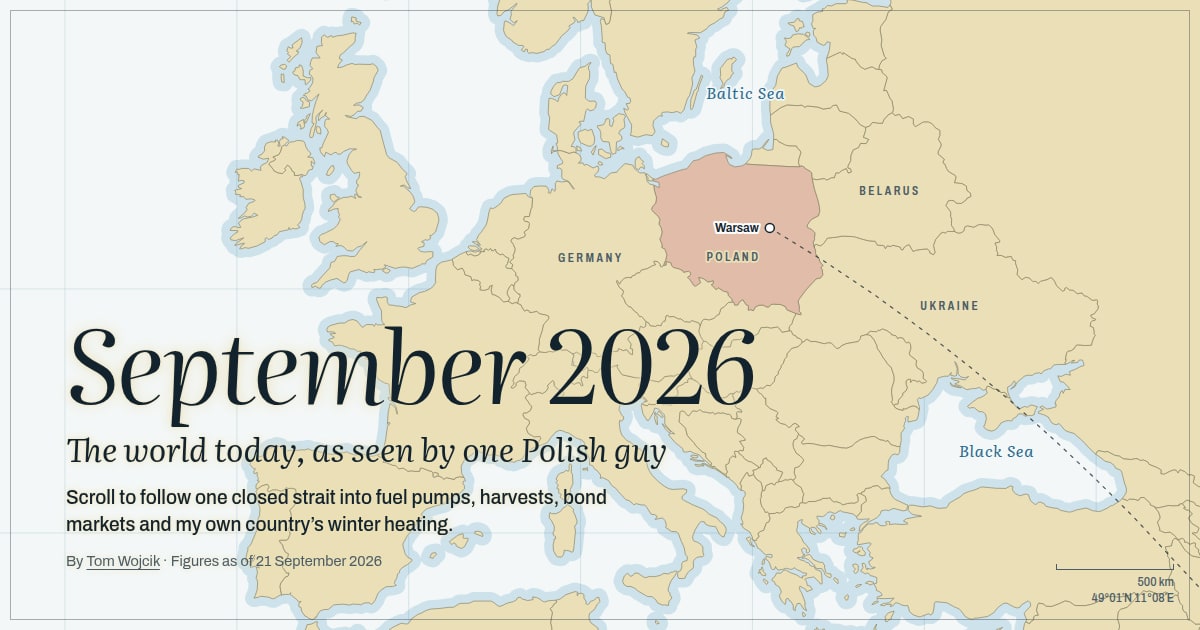
This image appears in Wojcik's essay and directly visualizes Poland's geographic relationship to the global supply networks he analyzes. The highlighted Poland shows why the country's paradox—being highly food self-sufficient yet fully exposed to global commodity prices—is geographically inevitable.
We traded one dependency for another
After 2022, Europeans replaced Russian pipeline gas with liquefied natural gas (LNG) bought on a global market — and Qatar, shipping close to a fifth of the world's LNG through Hormuz, was one of that market's pillars. QatarEnergy, Qatar's state LNG company, declared force majeure in March: a legal step that excuses a company from fulfilling its contracts when events beyond its control make delivery impossible. Drone damage at Ras Laffan has taken about 17 percent of capacity offline, with repairs estimated at three to five years.
In August, roughly one Qatari cargo made it through the strait, against a pre-war flow of some 6.5 million tonnes a month — dozens of cargoes.
Gas storage is at a record low for the date. The EU is at 67 percent of capacity and Germany at 56 percent, mid-September, against an EU target of 90 percent that countries may undershoot by up to ten points in difficult market conditions. The summer heat that drove up cooling demand also forced nuclear plants to curtail output, and wind generation was weak. The new dependency ran through a chokepoint about 39 kilometres wide at its narrowest.
Poland made the same swap, with oil
After 2022, Poland stopped buying Russian crude, and Saudi Aramco became the main supplier to Orlen, Poland's state-controlled oil refiner, at about 40 percent. That oil reached Poland without passing Hormuz, through a 1,200-kilometre pipeline across the Arabian desert to the Red Sea. On 10 September, drones shut that pipeline. Aramco cancelled late-September cargoes and has reportedly told its European buyers to expect none in October. The pipeline restarted on 22 September at a trickle, with no date for full flow.
Orlen is buying on the spot market from Norway, Britain, Algeria, Kazakhstan, Azerbaijan and the Americas, and a new deal with Equinor, the Norwegian state energy company, covers up to a quarter of its refining capacity. Orlen says its refineries are being supplied without disruption. But the energy journalist Jakub Wiech writes that a pump price starting with a nine — 9 zloty a litre — is no longer out of reach.
We have been burned on the spot market before
The essay pauses here for a story that is not about this war at all, and that is the point. Orlen set up a Swiss trading arm in 2022 to find oil that was not Russian, and gave it $600 million to work with. In November 2023, during a brief easing of US sanctions, that unit agreed to buy six million barrels of cheap Venezuelan crude. Within days it wired a $230 million advance to a Dubai intermediary, with no collateral and no bank guarantee. According to a Financial Times investigation, most of the money was turned into Tether, a crypto token pegged to the dollar, and handed over on USB sticks to brokers in Caracas hotels and restaurants.
One cargo worth about $29 million arrived. Chartered tankers waited off Venezuela for months, at a cost of some $72 million. The state now puts the total loss at about 1.6 billion zloty, or $424 million. In August, Warsaw prosecutors charged three former managers, who deny wrongdoing and face up to 25 years in prison.
Wojcik's line deserves to be quoted in full: a country that loses its regular supplier does not only pay more. It ends up dealing with people it does not know.
The old buffer, coal, is running thin
Coal held at Polish mines fell from 5.65 million tonnes in July 2025 to 3.2 million tonnes in July 2026 — a drop of roughly 43 percent in a year, and the country's biggest miner expects its own heaps to shrink to practically nothing by December. In mid-September, the head of Orlen Termika told an industry conference that a frosty winter would mean running out of coal, with everyone "scraping along the bottom." He was dismissed the next day, though the company did not give that as the official reason.
Since September 2019, Kraków has banned coal and wood in boilers, stoves and even fireplaces. Residents are left with gas, heating oil, electricity or district heat. The ban was a serious answer to a serious problem, in a city notorious for its winter smog. But it shows the same pattern as everything else here: a sound policy that removed a redundancy on the assumption that the replacement fuel would always be there.
A strong El Niño — a periodic warming of the Pacific that shifts weather patterns globally — points to a milder winter. How hard this winter is now depends on the weather.
The bill comes due
Now go about 8,600 kilometres east of Warsaw. For years the Bank of Japan held interest rates at zero, so Japan's savings went abroad. Pension funds and insurers poured trillions into foreign bonds, and Japan became the largest foreign owner of US government debt, with about $1.2 trillion of Treasuries. It was the world's most reliable lender, and it helped keep borrowing cheap for everyone, America above all.
That era is ending. On 18 September the Bank of Japan raised its policy rate to 1.25 percent, the highest since 1995, and a former board member expects a rise roughly every three months, towards 2 percent by the middle of 2027. Japan's 10-year yield crossed 3 percent and reached 3.1 percent on 25 September, the highest since August 1996 — pulled up by oil in the inflation numbers, by the Bank's own hikes and by American yields. Japanese investors sold $29.6 billion of US debt in the first quarter alone.
Strategists do not describe a stampede home. They describe Japan quietly ceasing to be the buyer everyone could count on, and long-term borrowing costs rising everywhere as a result.
America: the borrower at the other end
The US 10-year yield reached 5.2 percent on 25 September, the highest in nineteen years, since the summer before the 2007 crash. On 16 September the Fed raised rates for the first time since 2023, and markets price another rise. The drivers are the ones this essay is about: oil showing up in inflation expectations, a deficit that keeps growing, and weak demand at a Treasury auction — which is what happens when the patient buyer stays home. A 30-year mortgage now costs 7.12 percent, up from 6.09 in February.
Home purchase was down 19 percent and refinancing down 65 percent in the week to 11 September, against the same week last year. Buyers are pausing and builder confidence is at a 12-month low. This is how a bond sell-off reaches a household: through the monthly payment.
Does America's housing weather reach Poland?
Wojcik's instinct says that whatever happens to American mortgages arrives here a little later. The research half agrees. House prices across rich countries move together, more so with each decade, and the IMF's explanation is financial conditions that mirror America's. After the American bust of 2006, it took about two years to reach Poland. In 2021, Poland's central bank raised rates five months before the Fed, and both markets froze in the same year.
This time he does not need the research, because he has spent the past year looking for a house. Polish banks lent a record 14.8 billion zloty for housing in July. Look underneath it: the average loan is at a record because prices are, and more than a fifth of new lending is people refinancing old loans. The essay turns next to Polish developers, but the supplied text breaks off mid-paragraph; the direction of the argument is clear enough to follow.
What remains uncertain
Wojcik's essay is not a prediction of collapse, and it is worth being precise about what it is and is not claiming. It is a structural argument about resilience: that the cheapest way to run a society turned out to be the most expensive when the assumptions broke. It is also, by its own account, incomplete. The winter's severity depends on the weather. Whether the strait reopens depends on politics in Washington and Tehran. Whether American mortgage rates reach Polish households is, at this point, an open question the essay flags rather than resolves.
What the packet establishes is narrower than the essay's ambition, and that is the honest boundary. The figures come from the IEA, the FAO, the World Food Programme, Credit Agricole Bank Polska, the Financial Times and market data; the essay is one observer's synthesis, not a verified audit of each number. What it does establish, with unusual clarity, is the shape of the problem: a world that treated stockpiles as costs and suppliers as certainties, and is now finding out what that trade was worth. Whether the buffers can be rebuilt — in coal piles, gas storage, alternate pipelines, patient capital — is the question the essay poses but does not answer.