The M5 Ultra Mac Studio is Apple’s high-end desktop built around two M5 Max chips linked into one system. In a four-day review, MacStories tested a 256-gigabyte model for local artificial intelligence agents—software that can chain reasoning steps and call tools rather than merely answer one prompt. The author’s central claim is that faster prompt processing and text generation made local models feel practical for repeated, long-running tasks.
The article opens by introducing the M5 Ultra Mac Studio and its local AI workload, including local image generation used in the review.
The mechanism matters more than the headline chip name. When an agent starts a turn, it must process its instructions, memories, tool descriptions, and earlier conversation before producing output; that wait is called token prefill. Generation speed then determines how quickly the response appears. The reviewer reported that, compared with an M3 Ultra, the M5 Ultra cut generation time by about 70% on average and improved prompt processing by up to 150%, or roughly 2.5 times. In one setup, Qwen3.8-Flash-Next exceeded 100 tokens per second on short prompts and remained at 60–85 tokens per second with 64K–256K of context.
Those results came from the reviewer’s own comparisons with an M3 Ultra and a desktop PC containing an Nvidia GeForce RTX 5090, a consumer graphics processor with 32GB of memory. Nvidia’s product page describes the RTX 5090 as a Blackwell-based GPU intended for demanding creative and AI workloads. MacStories nevertheless found that the RTX 5090 retained an edge in memory bandwidth, while the Mac Studio was smaller, quieter, and easier to keep local. The comparison is illustrative, not a universal ranking: the machines differ in memory, software, and workload setup.
The review’s most concrete example is Desk, an internal research app that used local agents for 99 days to organize 310 documents, extract information from web pages and PDFs, cross-reference notes, and update Notion databases. The author says this avoided cloud API charges and kept data on a machine he controlled. That explains the appeal for persistent workloads, but it is one person’s workflow, not a controlled study of developer productivity or total cost of ownership.
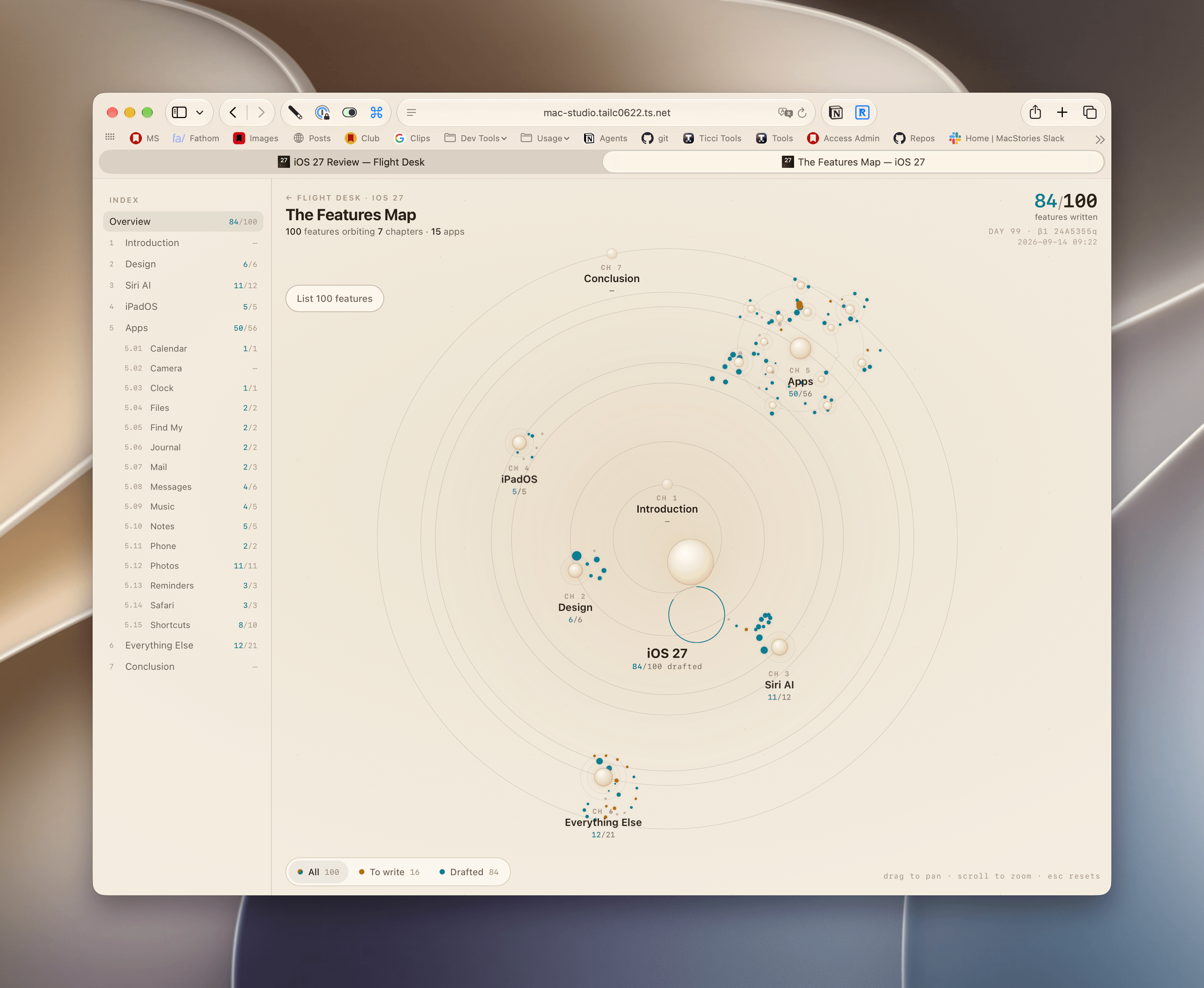
The article’s concrete workflow example is Desk, which used local agents to organize documents, extract information, cross-reference notes, and update Notion.
There is also a capacity caveat. MacStories says the tested machine had 256GB of memory; a MacRumors forum report quoting Apple says a 512GB configuration is expected in late October, with pricing above $10,000. The supplied packet does not include Apple’s full specifications or an independent benchmark, and it does not establish how lower-bit model quantization—compressing a model to use less memory—changes answer quality. The defensible takeaway is narrower: for this reviewer, the M5 Ultra made local agents substantially faster and more usable, while broader performance, quality, and economic comparisons remain open.