Colin Breck’s central complaint is not simply that AI prose sounds generic. He argues that it often lacks the perspective needed to tell a reader what matters, what remains uncertain, and where judgment is required. A machine-generated design document may describe everything that changed while obscuring why the change was proposed, which risks deserve attention, and what kind of feedback the author wants. The result can be longer without becoming more informative.
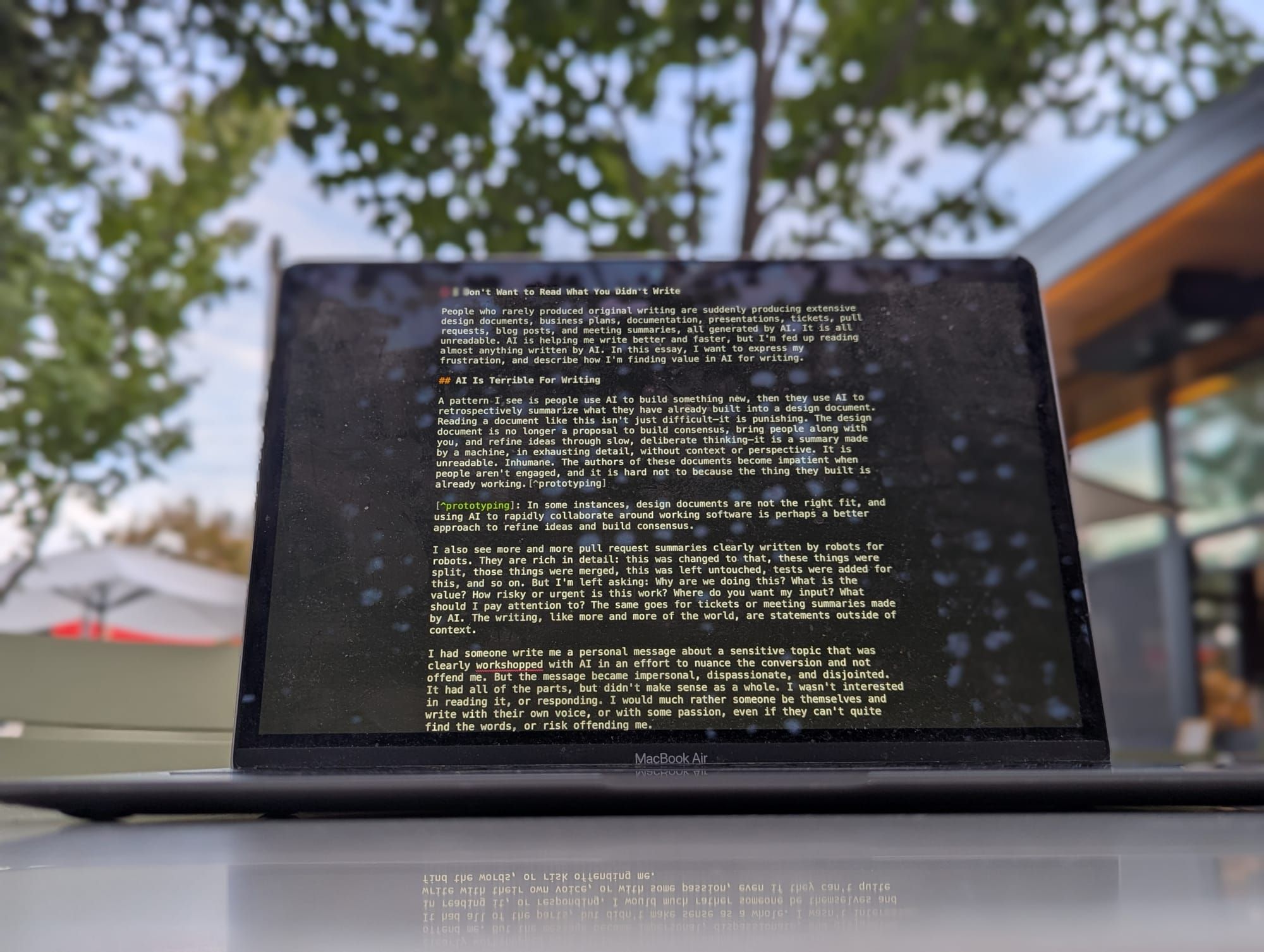
The essay opens with Colin Breck’s argument that AI writing often omits the perspective needed to explain why a change matters and where judgment is required. Credit: blog.colinbreck.com.
The context gap helps explain why the person who created a document may find it useful while another reader struggles. The prompter supplied the constraints, source material, omissions, and intended purpose, so they can reconstruct the reasoning behind the output. A recipient receives only the finished text. Without access to that private chain of decisions, the recipient may have to examine every sentence to determine which details are relevant, accurate, or consequential.
That distinction matters in engineering reviews. A pull-request summary that lists changed files, refactors, and tests may still fail to identify the riskiest assumption or the decision on which the author needs a reviewer’s judgment. Breck’s argument suggests asking authors to lead with purpose, urgency, risk, and the specific input requested—not to generate ever more exhaustive descriptions. The available evidence does not establish that AI-written review notes cause rejected changes, however; it identifies a plausible communication failure rather than measuring its frequency or effect on review outcomes.
Reader reaction may sharpen the cost of that failure. Cynthia Dunlop’s anonymous survey of 668 respondents reported that 78% would stop reading a technical article they suspected was AI-assisted or AI-authored, while 71% said they would avoid the author in the future. It also reported that 98% preferred the author’s own writing, including its imperfections, to an AI-polished version. These figures describe the responses of people who encountered the survey, not necessarily developers or technical readers generally: the survey was anonymous, and its author explicitly noted that there was no demographic guarantee.
The survey’s results therefore do not prove that every AI-assisted text will be rejected or that readers can reliably distinguish assistance from authorship. They do establish a relevant editorial risk within this respondent group: visible traces of AI writing can trigger distrust before a reader evaluates the underlying insight. Breck presents that survey as support for his broader argument about voice and attention, but the survey itself measures reported reactions rather than long-term reading behavior or the quality of individual articles.
Breck’s preferred use of AI is more selective. In describing his work on an academic paper, he says he wrote the prose himself and used AI to check technical statements against source code, configuration, logs, and metrics. He also used it to complete citations, simplify unclear sentences, find spelling and grammar errors, draw technical diagrams, and identify one notation mistake. He reports that asking AI to generate paragraphs from the same material was consistently less valuable and sometimes inaccurate. That account is one author’s experience, not controlled evidence that this workflow will help every writer, but it offers a concrete alternative to delegating the initial act of composition.
Simon Sarris frames the underlying concern as a loss of attention. In “Resist Summary,” he argues that summaries can accelerate simple learning while making complex or creative understanding harder to build. His point is philosophical rather than a measured comparison of writing methods: compression may omit the reasoning, sensory detail, and relationships through which a person develops a durable mental model. It supports Breck’s warning that efficient text is not automatically effective communication, but it does not show that all summaries—or all AI assistance—produce that outcome.
A practical standard follows from both accounts. Writers can let AI search for inconsistencies, test whether key points are clear, prepare citations, or translate an already considered draft into another format. Before sending the result to a reader, however, the writer should restore the missing context: state the decision, identify the evidence, acknowledge uncertainty, and mark where judgment is still needed. The goal is not to make human writing sound less artificial; it is to ensure that a person remains responsible for the argument, emphasis, and relationship with the reader.