The Hacker News item links to a September 19 Bloomberg investigation, not to the March essay previously summarized here. Bloomberg says an internal Pentagon inquiry found a cascade of preventable failures before two Tomahawk missiles struck Shajarah Tayyebeh Elementary School and its grounds in Minab on February 28. Officials involved in the inquiry told Bloomberg that more than 150 people died, including at least 123 children. The inquiry itself has not been publicly released, so these findings should be understood as Bloomberg’s account of interviews with people familiar with it.
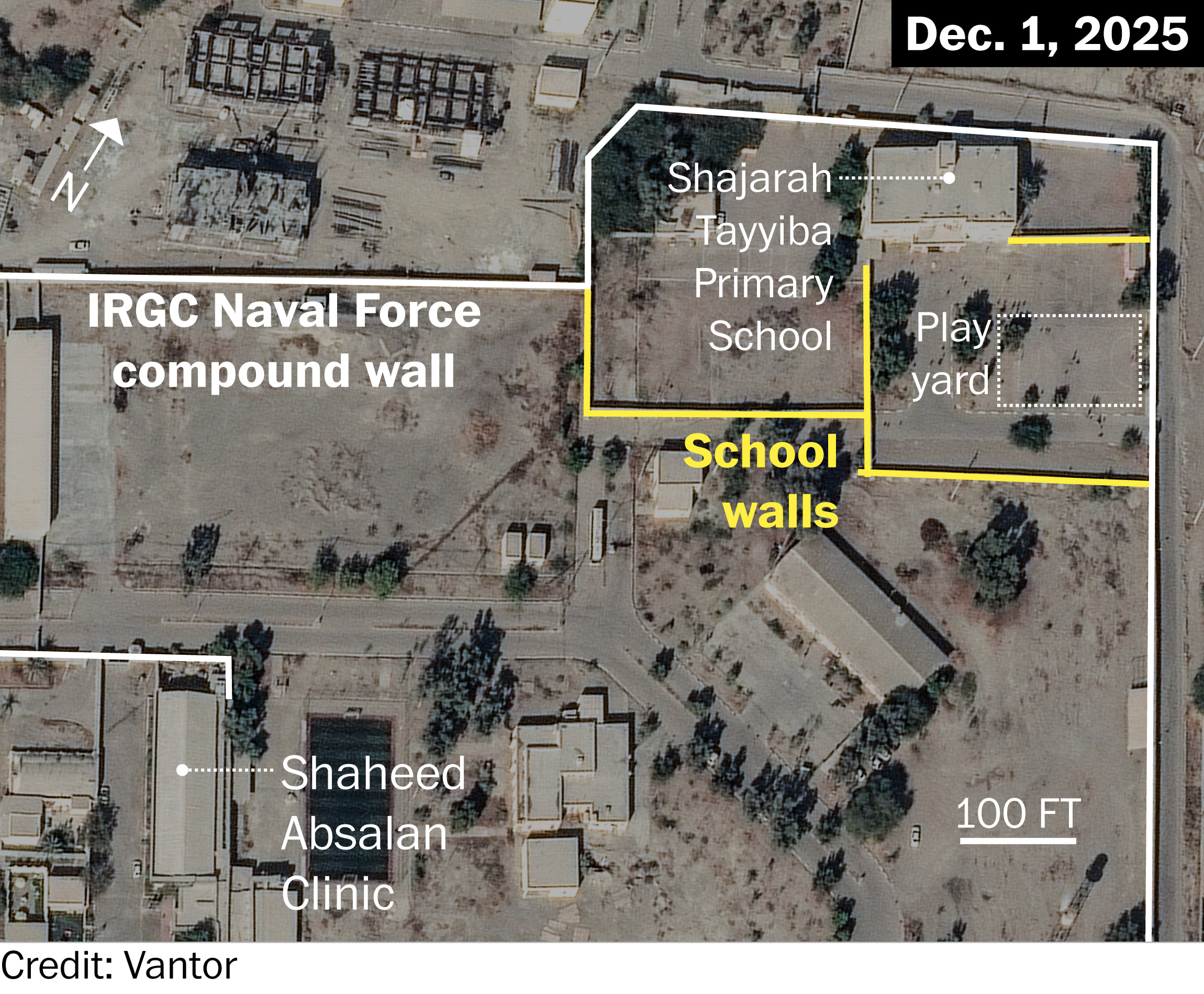
Placed after the explanation of the school’s separation from the adjacent base, the map makes the geographic distinction visible without implying it was part of the targeting record.
The investigation’s central puzzle is how a site that had openly operated as a school could remain in a targeting database as an Islamic Revolutionary Guard Corps facility. Commercial satellite imagery showed separating walls and entrances by 2017; 2018 imagery showed painted walls, a soccer pitch and markings for school activities. Bloomberg says an analyst had noticed changes as early as 2019, but recorded observations in a system disconnected from the main intelligence database used for targeting. A warning existing somewhere in an organization is not the same as that warning reaching the people who make a decision.
AI entered this chain as an aid to intelligence fusion, not as a proven autonomous trigger. Bloomberg reports that staff relied on Palantir’s Maven Smart System, which combines many data sources, and that some expected it to surface stale or inconsistent information. But a system can only flag problems detectable in the data and checks it receives. Palantir told Bloomberg it was not responsible for underlying data or identifying intelligence deficiencies, and said there was no evidence its software was at fault. Bloomberg also reports that the military later added functions to re-check intelligence for inconsistencies. Those details point to questions about system design and use; they do not establish that Maven independently selected the school.
The operational tempo mattered too. Bloomberg’s reconstruction says more than 1,000 targets were struck in the first 24 hours of the campaign, while target-preparation time had been compressed from hours to minutes. It also reports that civilian-harm mitigation staffing at the relevant command had fallen sharply and that no member of that team reviewed the Minab site. These conditions are not interchangeable causes, and the article does not disclose a complete targeting log. Together, however, they describe how stale information, separated warning channels, staffing choices and accelerated workflows could reinforce one another.
The distinction that matters is between AI making a recommendation and people and institutions creating a process in which recommendations are trusted without adequate challenge. The available reporting attributes the inquiry’s conclusions to officials and does not publish the underlying report, database entries or system logs. That leaves important details unresolved: what exact data Maven presented, what warnings were visible to each reviewer, and who authorized the target. Accountability cannot be assigned to a model alone from this evidence; nor does the presence of human approval, by itself, show that the review was meaningful.