Daniel Lemire’s Geekbench 6 comparison reports a roughly 50% performance gain across three comparable eight-core, 3D V-Cache Ryzen 7 processors released from 2022 through 2024. The 5800X3D scored 2,016 in the single-core test and 11,832 in the multi-core test; the 9800X3D scored 2,969 and 18,751. That is a 47% single-core gain and a 58% multi-core gain.
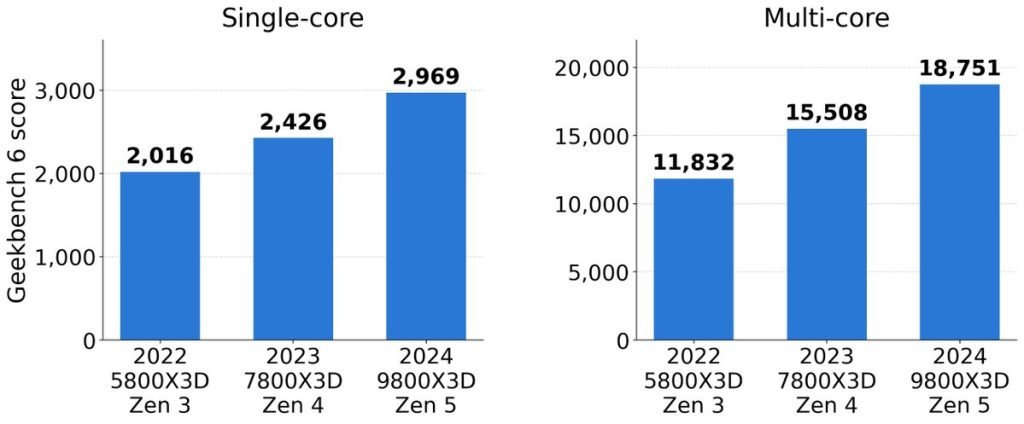
The benchmark chart quantifies the roughly 50% gain reported across the three Ryzen 7 3D V-Cache processors.
Clock speed alone does not explain the result in Lemire’s account. Maximum boost rose from 4.5 GHz to 5.2 GHz—about 15%—while transistor count increased from roughly 11 billion to 16 billion. He says most of the added transistors went into the core rather than the 3D cache.
The core changes help explain the gap. Lemire reports that Zen 5 widened dispatch from six instructions per cycle to eight, increased integer arithmetic units from four to six, and expanded the reorder buffer from 256 to 448 entries, allowing more instructions to remain in flight. Per-core L2 cache doubled from 512 KB to 1 MB, while the L1 data cache grew from 32 KB to 48 KB.
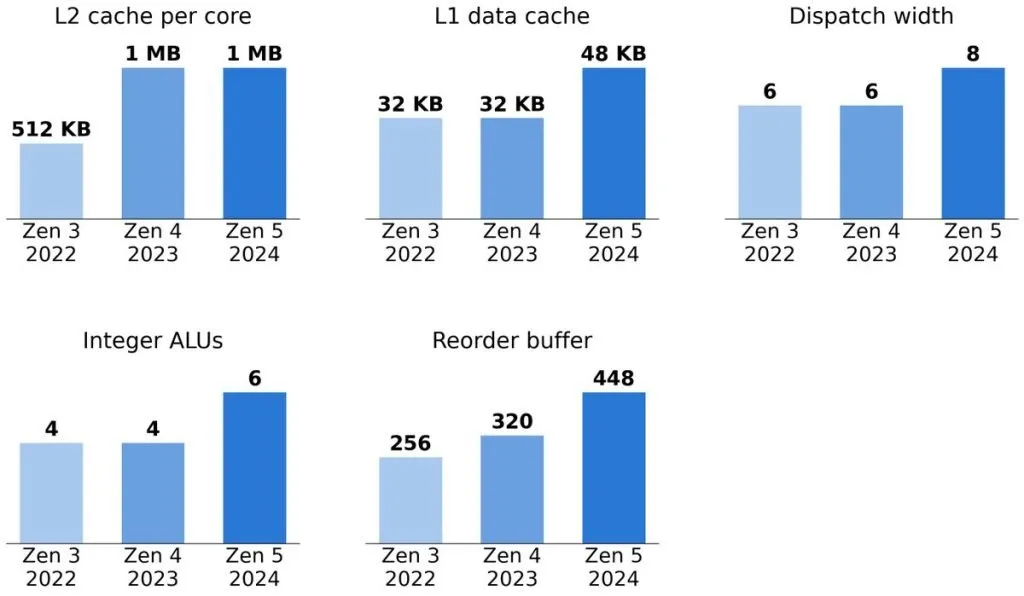
The figure maps the wider dispatch, extra integer units, larger reorder buffer, and expanded caches discussed in the article.
Zen 5 also changed the processor’s vector machinery. Lemire describes four 512-bit SIMD arithmetic units, compared with four 256-bit units in Zen 3 and Zen 4, alongside wider loads and stores. Those changes can move or process more data per cycle when software can use them. The article does not provide workload-level benchmarks proving how much each architectural change contributed, so the reported gains should be read as a Geekbench comparison, not a universal speedup for every application.
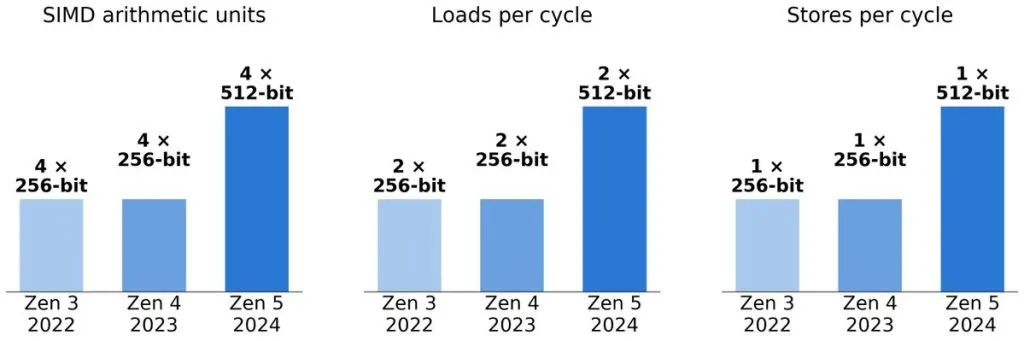
The comparison illustrates the wider vector units, loads, and stores that can move or process more data per cycle.