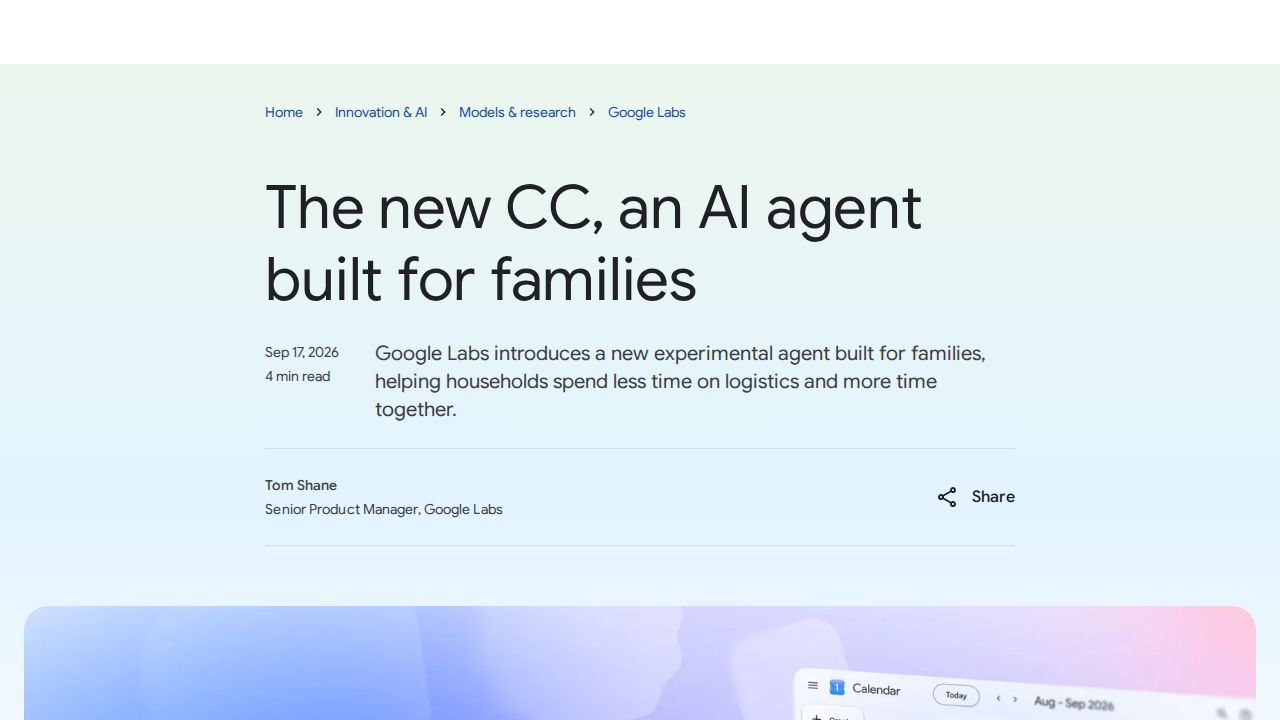
Google Labs is expanding its experimental CC agent from an individual productivity assistant into a service designed for families and households. In a Sept. 17, 2026 post, Google says CC can now operate as a distinct Google Account shared by up to six members, pulling selected information into a daily brief, Calendar, and Tasks. The company frames the change as a way to reduce household logistics, from school schedules and sports practices to bills, meals, and registration paperwork. That is Google’s product claim; the supplied material does not independently measure whether families save time or make fewer mistakes after adopting it.
The family version depends on CC having its own verified Google account and an isolated cloud computer. Google says each member chooses what to share, can change those choices later, and can auto-share messages from selected senders such as schools or travel providers. CC can also receive one-off emails, images, Drive files, or calendar information, then use shared context to update household records. The post says the agent distinguishes household-wide memory, such as a grocery list, from personal details, such as dietary preferences or time zones.
The most practical reader concern is operational: a shared assistant is only as useful as the information it can see, and it becomes riskier when it can act on that information. Google says CC will not take action or share information outside the group without permission, and it will ask for missing details before completing tasks such as filling out forms. However, the supplied primary post does not provide an independent security audit, a detailed account-recovery policy, or evidence about how permissions behave when a member leaves the group. Those limits matter because a household agent may handle sensitive school, health, travel, and financial information in one shared workflow.
CC’s expansion also follows Google’s earlier description of the service as an experimental assistant for individual users. The December 2025 launch post says CC connected Gmail, Calendar, Drive, and the web to produce a morning “Your Day Ahead” briefing and help with drafts, calendar links, and remembered requests. The newer post adds group membership, shared memory, and task execution, but both pages identify CC as an early Labs experiment rather than a settled, universally available product. Google says the family version is for people aged 18 or older in the U.S. with personal Google accounts, with existing users receiving upgrade emails and new users able to join a waitlist.
For families, the strongest potential benefit is consolidation: information scattered across inboxes, chats, calendars, and forms could be turned into one shared view. The strongest limitation is that the same consolidation creates a larger concentration of personal context and delegated actions. Readers should therefore treat the feature as a controlled experiment, verify exactly which accounts and senders are shared, review what CC stores in household memory, and test whether important updates are being captured before relying on it for school, medical, or time-sensitive commitments. The evidence establishes what Google says the product is designed to do; it does not establish that the system is accurate, durable, private by default, or suitable for every household.