Ctenophores, commonly known as comb jellies, are marine predators that move using rows of beating cilia which refract light to create an iridescent shimmer and capture prey with sticky colloblasts. For over a century, sponges were regarded as the earliest branch of the animal tree of life, but recent genomic analyses have challenged that view. A 2023 study of chromosome organization found that ctenophores, not sponges, appear as the sister group to all other animals, a placement supported by the fact that ctenophores possess true muscles and a nervous system, while sponges lack both.
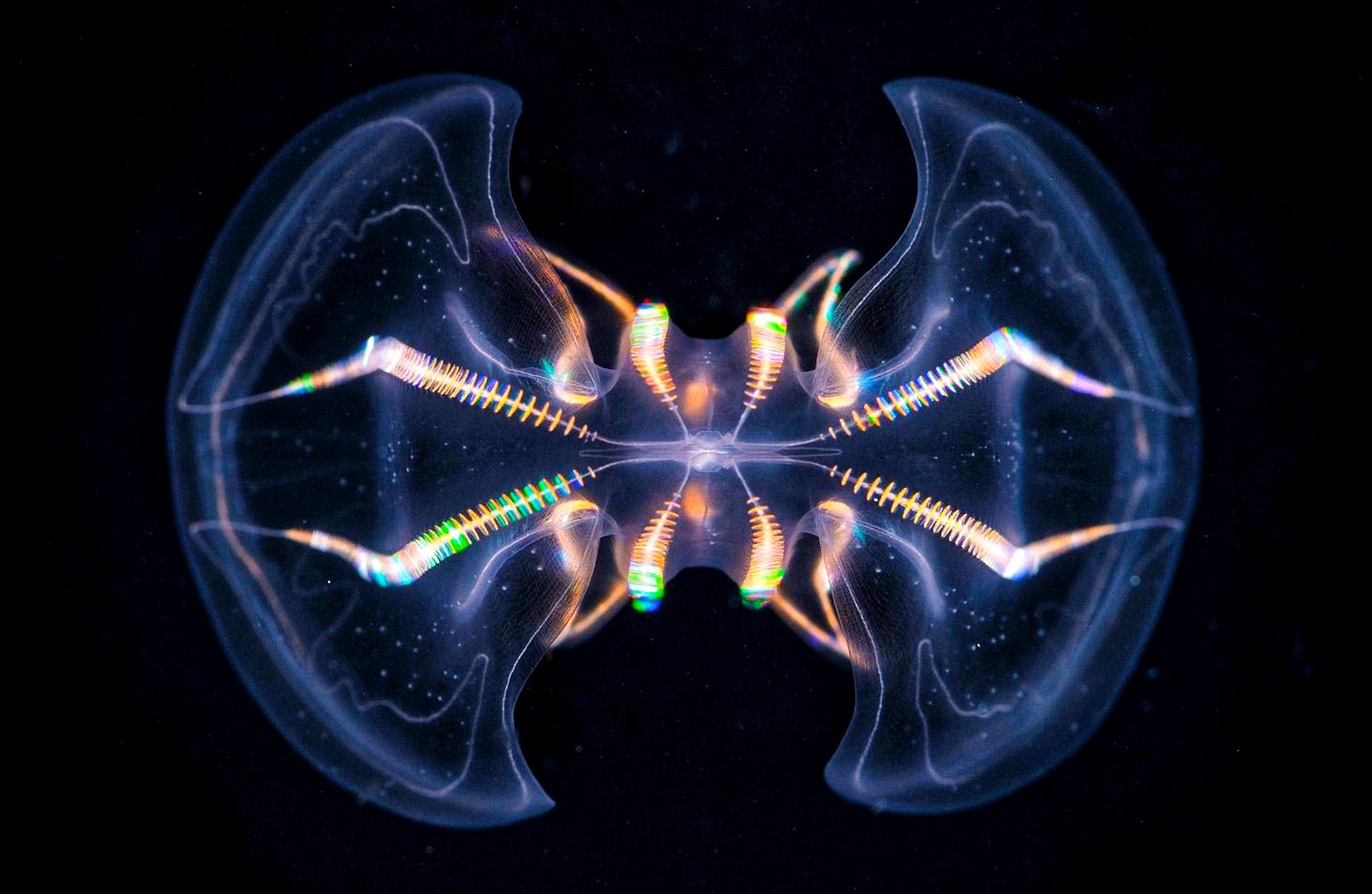
Shows the cilia-driven iridescent shimmer described in the article's first paragraph about comb jelly movement and light refraction.
Their nervous system is unlike that of typical animals. Using volume electron microscopy on the species Mnemiopsis leidyi, researchers identified 17 distinct cell types in the aboral organ, 11 of which were previously unknown. These cells form a nerve net where neurons are linked by continuous cytoplasm but lack synapses between them—a structure described by evolutionary biologist Pawel Burkhardt as unique in the animal kingdom. This suggests that nervous systems may have evolved independently in ctenophores and in the lineage leading to jellyfish and all other animals.
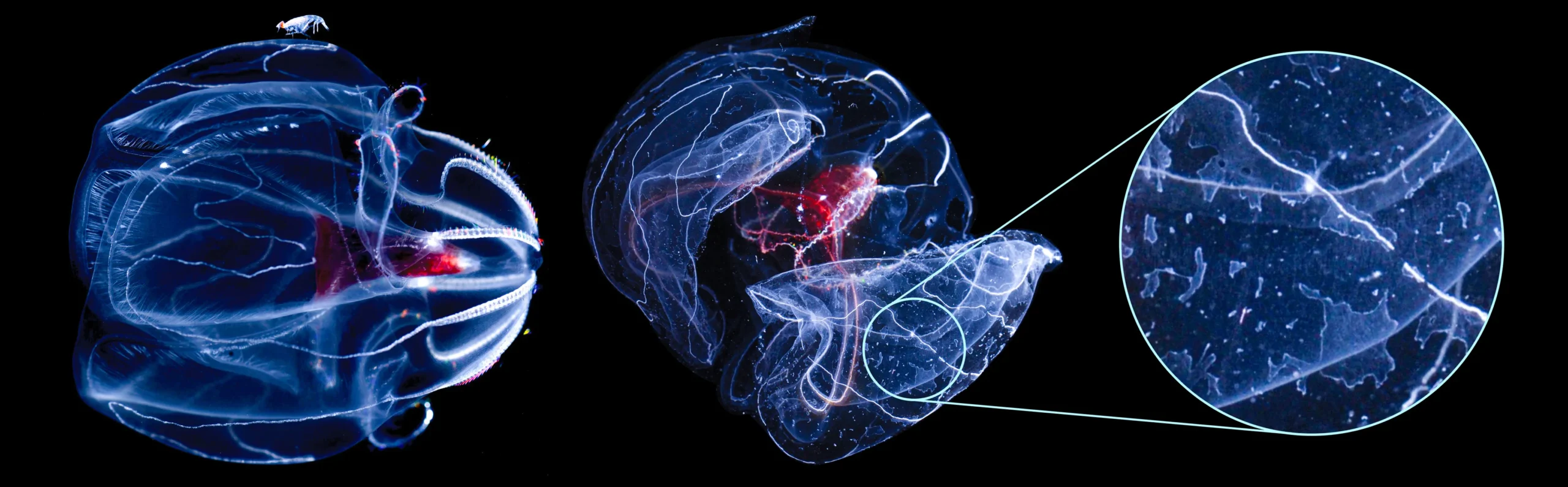
Illustrates the internal structures referenced in the discussion of the comb jelly's unique nervous system and cellular organization.
Beyond neurobiology, ctenophore genomes reveal extraordinary complexity. The genome of M. leidyi contains more than 4,000 DNA loops within its 100‑million‑base‑pair sequence, indicating that loop‑based genome regulation—which allows cell‑type specialization without inventing new genes—evolved far earlier than previously estimated. Some species can reverse their life cycle from adult to larval stage when starved or injured, joining a small group of animals with this ‘Benjamin Button’‑like plasticity. Deep‑sea varieties rely on plasmalogen lipids in their cell membranes to withstand extreme hydrostatic pressure, and the same lipids are found in human brains where their depletion links to neurodegeneration. Additionally, the blastopore organizer that patterns embryos is conserved between ctenophores and bilaterians, pointing to an ancient developmental mechanism.