When the United States set out to create a national emergency oil stockpile, the challenge was to store hundreds of millions of barrels of crude securely for decades, keep the oil safe from attack, and release it quickly if supplies were interrupted. Early ideas looked to scale up commercial aboveground storage. External floating‑roof tanks, the common commercial solution, would require about 1,130 tanks covering roughly 45,000 acres—rough the size of Washington, D.C.—and would be extremely vulnerable to fire or attack because petroleum is flammable and the seal between a floating roof and the tank shell is a weak point.
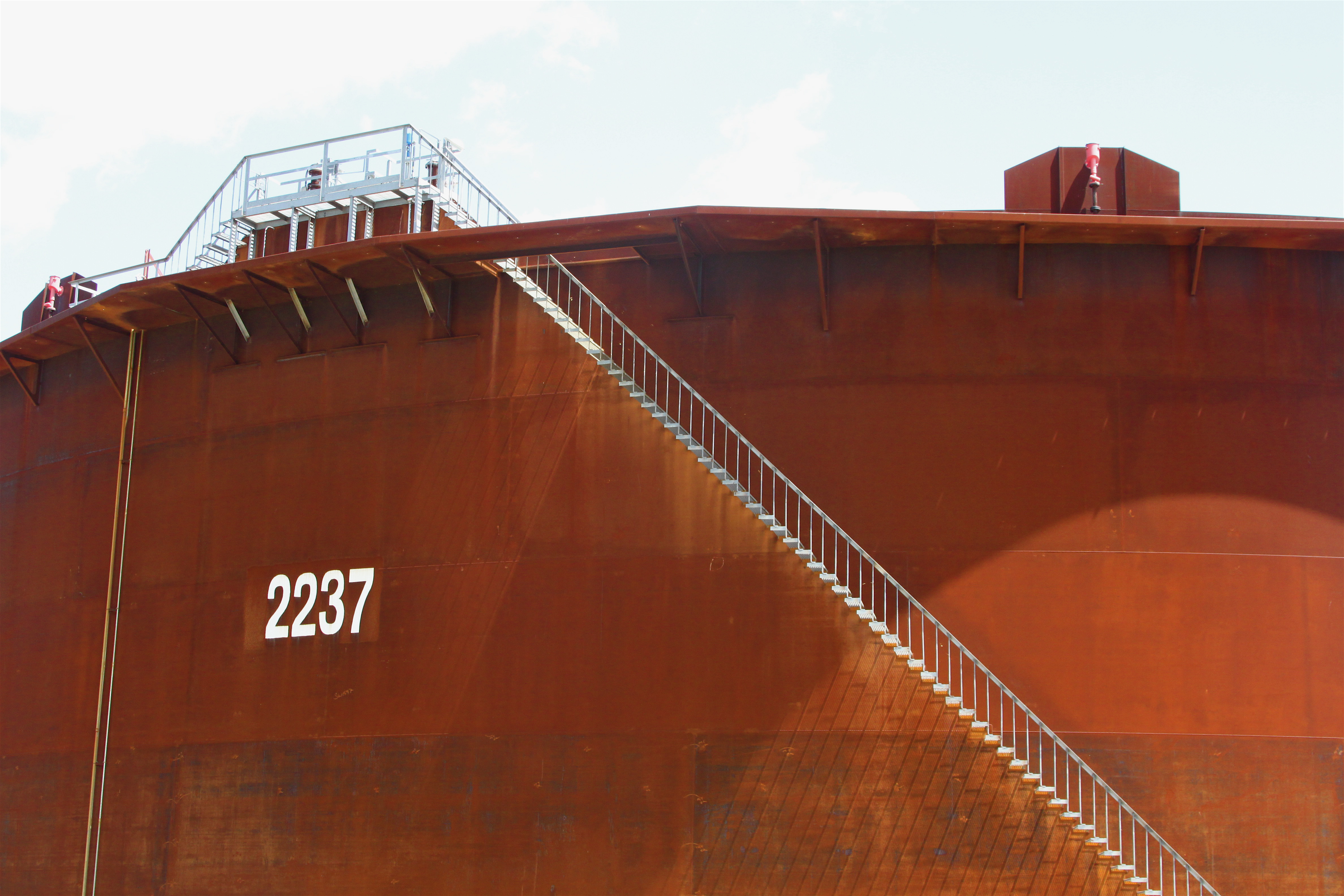
The article evaluates aboveground tank storage as the initial concept, noting the scale (roughly 1,130 tanks covering 45,000 acres) and the fire/attack vulnerabilities that made it impractical, before turning to salt caverns as the adopted solution.
Another approach considered was burying tanks, as the U.S. Navy did at the Red Hill Facility near Pearl Harbor. Those 20 concrete‑lined steel tanks, each about 100 feet across and 250 feet tall, held 6 million barrels total. The surrounding rock offered protection from aerial attack, but the project was enormously expensive (about $42.2 million in 1943, roughly $820 million in 2026 dollars) and created groundwater contamination problems that ultimately led to the facility’s permanent closure.
The solution the U.S. actually adopted uses salt domes. At four sites in Texas and Louisiana along the Gulf of Mexico, the Department of Energy has carved cylindrical caverns into underground salt formations. Engineers drill into a salt dome and inject fresh water; the salt dissolves, and pumps remove the resulting brine, leaving a cavern that can store petroleum. Salt’s extremely low permeability means fluids have very little ability to pass through it, and the rock does not react with petroleum. Under the high pressure underground, salt also slowly deforms, helping to close small fractures. Because oil floats on water, pumping water into the bottom of a cavern pushes the oil upward into a delivery system.
The DOE currently lists about 60 such caverns with a combined authorized storage capacity of roughly 714 million barrels—enough to meet the reserve’s design goal. This salt‑cavern approach costs about $3.50 per barrel of capacity, compared with $15‑$18 per barrel for aboveground tanks, making it far more economical. The Gulf Coast locations put the reserve near refineries, pipelines, and marine terminals, which is especially useful when the purpose is to deliver oil during a supply disruption.
Nonetheless, the method has trade‑offs. Creating the caverns requires a water supply and a way to dispose of the brine withdrawn during construction. Fresh water introduced during oil withdrawals gradually dissolves more salt, enlarging the caverns over time and limiting how often they can be cycled. Ongoing monitoring and maintenance of wells, pumps, and pipelines are therefore essential.
By storing oil deep underground in naturally sealing salt caverns, the Strategic Petroleum Reserve combines large capacity, low cost, and geographic advantage. The reserve’s size makes it a significant deterrent to oil‑import cutoffs and a key tool in U.S. foreign policy, while its underground placement protects the oil from aerial attack.