Paleontologists working in eastern Spain have uncovered the first definitive evidence that the iconic long-necked dinosaur Diplodocus lived outside North America. The fossils, described in a forthcoming paper in the Journal of Vertebrate Paleontology, were excavated at the La Tejería site near the city of El Castellar in the province of Teruel — a region already renowned for its Jurassic sauropod diversity.
The specimen consists of 14 well-preserved caudal (tail) vertebrae and several chevron bones, the distinctive Y-shaped structures on the underside of the tail that give Diplodocus its name (Greek for "double beam"). These chevrons helped support the long, heavy tail and protected blood vessels running beneath it. From this material, researchers estimate the animal stretched approximately 25 meters (82 feet) in length, placing it on par with its North American relatives.
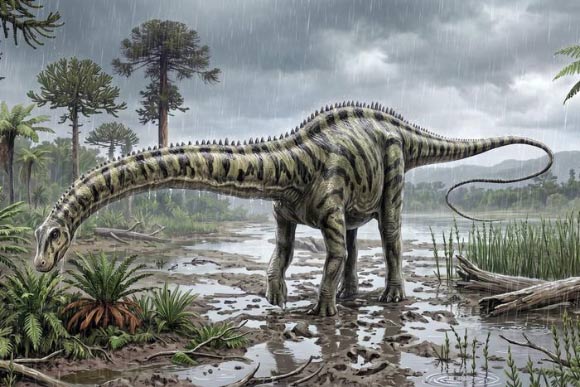
This image illustrates the Diplodocus specimen discovered in Spain, a close relative of Diplodocus hallorum, helping visualize the long-necked sauropod that lived 150 million years ago during the Late Jurassic period.
"From the early stages of the osteological study, we noticed strong similarities with several diplodocine sauropods," said Sergio Sánchez Fenollosa, a Ph.D. student at Fundación Dinópolis and lead author of the study. "As we looked more closely at the anatomy, we began to identify a combination of features characteristic of Diplodocus species. Then, as we carried out different evolutionary analyses, they kept pointing in the same direction."
The Spanish Diplodocus lived roughly 150 million years ago, near the end of the Jurassic period. Phylogenetic analysis identifies it as a close relative of Diplodocus hallorum — the species formerly known as Seismosaurus, a name once attached to what was thought to be a separate, even larger genus before further study revealed it represented exceptionally large, mature individuals of Diplodocus.
The find carries significant paleogeographic implications. During the Late Jurassic, the proto-North Atlantic Ocean was opening between North America and Europe, but sea levels fluctuated. The research team argues that the presence of Diplodocus in Iberia offers "some of the strongest paleontological evidence for episodes of dispersal and faunal exchange between the two continents across the proto-Atlantic Ocean during the Late Jurassic." Temporary land bridges — exposed continental shelves or island chains — would have allowed large terrestrial animals to cross when the ocean periodically receded.
This discovery adds a new dimension to the known dinosaur fauna of the Iberian Peninsula. Teruel already hosted other giant sauropods with very different body plans, such as Turiasaurus and Losillasaurus, which belong to lineages distinct from the diplodocids. The coexistence of these diverse forms underscores the ecological complexity of European Jurassic ecosystems.
Diplodocus itself is one of the most recognizable dinosaurs, partly due to industrialist Andrew Carnegie, who funded excavations in the American West and donated casts of a nearly complete skeleton (Diplodocus carnegii) to museums worldwide in the early 1900s. Its slender, bridge-like build — hollow bones reducing weight to an estimated 10–30 tons despite lengths of 20–35 meters — and its extraordinarily long, whip-like tail (comprising up to 80 vertebrae) have made it a subject of both popular fascination and biomechanical debate. A once-popular hypothesis that the tail tip could break the sound barrier, producing a sonic boom, was refuted by a 2022 simulation study showing the tail would fracture at such speeds; the actual maximum speed was likely around 120 km/h, still a formidable defensive weapon.
The Spanish specimen, while fragmentary compared to the Carnegie skeletons, is diagnostically significant. Chevron morphology and vertebral anatomy together provide the "combination of features" needed to assign the fossils to the genus Diplodocus rather than merely to the broader family Diplodocidae, which was already known from fragmentary European remains. The paper, authored by Sánchez Fenollosa et al. (2026), will appear in the Journal of Vertebrate Paleontology (doi: 10.1080/02724634.2026.2718423).
Questions remain about the frequency and duration of these trans-Atlantic dispersal events, the precise routes taken, and whether the Spanish Diplodocus represents a resident population or a rare migrant. The La Tejería fossils, however, confirm that the genus achieved a trans-Atlantic distribution — a milestone in our understanding of Jurassic dinosaur biogeography.